
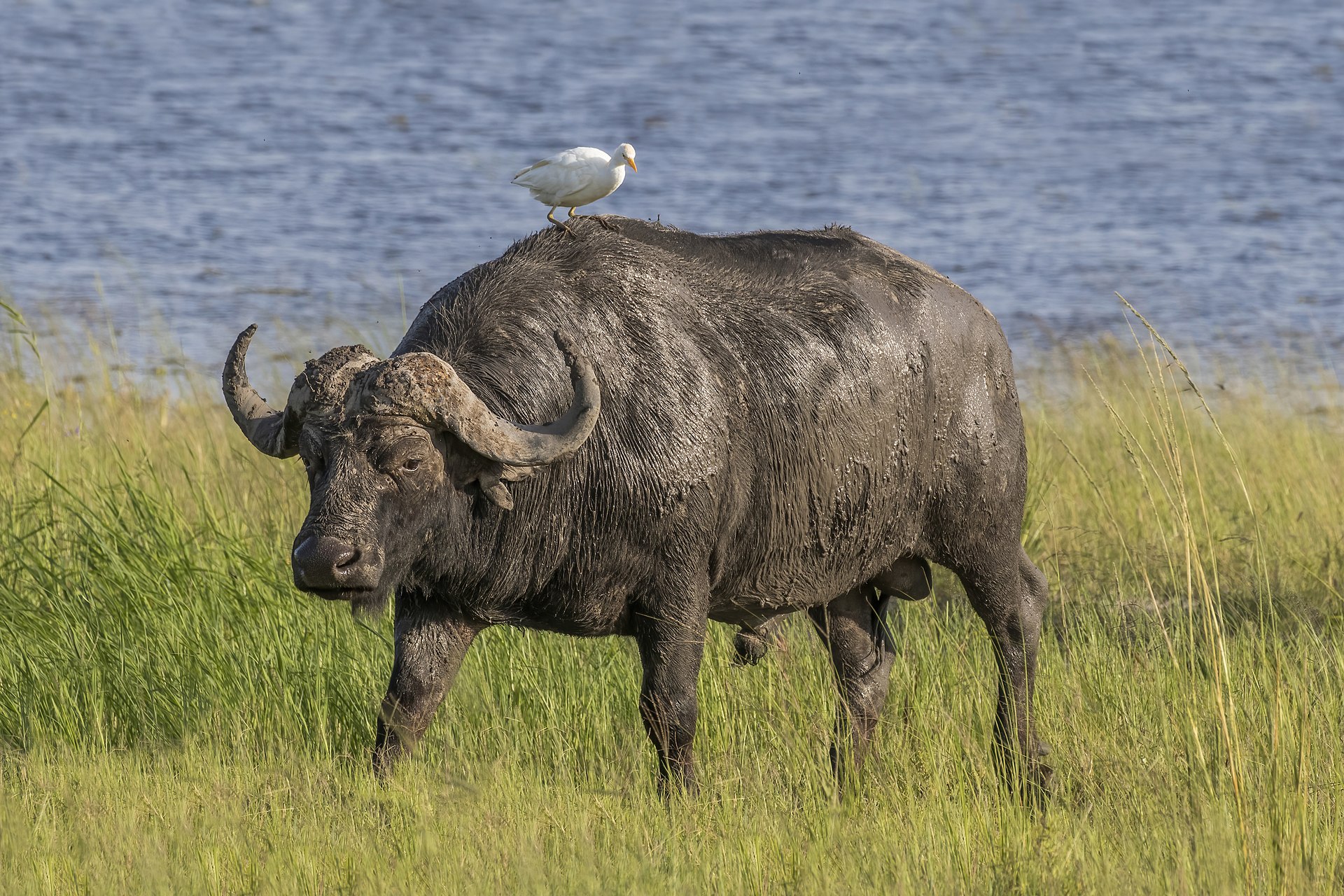
The African buffalo is one of the most numerous and ecologically influential large grazers of sub-Saharan Africa and a member of the celebrated "Big Five." Yet behind its apparent abundance lies a species in measurable decline: across much of its range numbers have fallen as habitat is converted, livestock competition intensifies, and disease moves across the wildlife–livestock interface [IUCN 2019]. This profile examines the buffalo's biology, its complex relationship with bovine diseases, the population trends that prompted its reclassification, and the conservation programs working to keep its herds intact.
Biology and Identification
The African buffalo is a heavily built bovid with a broad muzzle, large drooping ears, and a stocky, deep-chested frame. The species shows pronounced variation across its range. In the Cape buffalo (Syncerus caffer caffer) of southern and eastern Africa — the largest form — bulls commonly weigh in the region of 750 kg or more, while cows are substantially smaller; the forest buffalo (S. c. nanus) of the Central African rainforests is roughly half that mass and reddish in coat [Cornélis et al. 2014]. Adults of the savanna forms are dark brown to black, whereas the forest form is bright rufous.
The most distinctive feature of mature bulls is the boss — the heavily thickened, fused bases of the horns that form a continuous bony shield across the top of the skull. The horns sweep downward and outward before curving up at the tips; bosses harden fully only when a bull is roughly eight to nine years old, and cows carry smaller horns without a fully developed boss [Cornélis et al. 2014].
Buffalo are bulk grazers, dependent on tall, coarse grasses and on regular access to water and shade, which constrains where herds can live. Gestation lasts approximately 340 days, and births are seasonally timed so that calves arrive when forage quality peaks — monthly birth rates correlate most strongly with rainfall and vegetation greenness recorded about a year earlier [Ryan et al. 2007].
Socially, the African buffalo lives in large mixed herds structured around related cows and their offspring, with bachelor males forming smaller groups or living alone. Herd movement decisions appear to be reached collectively: before a herd rises to feed, adult cows orient their bodies in particular directions, and the herd subsequently moves in the average of these orientations — a pattern interpreted as a form of "voting" [Prins 1996a; Prins 1996b].
Habitat and Range
The African buffalo historically occupied most of sub-Saharan Africa wherever sufficient grass, water, and cover occurred, from the savannas and floodplains of southern and eastern Africa to the rainforests of the Congo Basin and the Sudano-Sahelian woodlands of West and Central Africa [IUCN 2019]. Four subspecies are conventionally recognized along this gradient: the Cape buffalo (S. c. caffer) in southern and eastern Africa, the forest buffalo (S. c. nanus) in Central and West African forests, the Sudan or Central African savanna buffalo (S. c. brachyceros), and the Nile buffalo (S. c. aequinoctialis) [Cornélis et al. 2014]. Recent continent-wide genomic analysis, however, found only limited support for these four named subspecies as discrete genetic units, instead identifying population structure shaped largely by geographic barriers to gene flow [Talenti et al. 2024].
Today the species persists as a patchwork of populations, with its strongholds concentrated in the large protected-area networks of southern and eastern Africa — including national parks and adjoining hunting and conservation areas — while West and Central African populations are far smaller and more fragmented [IUCN 2019; Cornélis et al. 2014].
In accordance with NRWL sensitive-species policy, specific site locations, corridor routes, and seasonal movement details are not disclosed in this article.
Conservation Status
The African buffalo is listed as Near Threatened on the IUCN Red List, assessed in 2019 by the IUCN SSC Antelope Specialist Group [IUCN 2019]. This represented a change from its earlier listing of Least Concern, driven by documented and projected population declines. The assessment notes that the decline over three generations (about 28 years, 1999–2027) is close to the threshold for Vulnerable under criterion A4, and under some scenarios may approach or cross it [IUCN 2019]. The species is not listed on any CITES appendix [IUCN 2019].
Population estimates differ by buffalo type. The most recent continental-scale census of the three savanna-type subspecies (S. c. caffer, S. c. brachyceros, and S. c. aequinoctialis) placed their combined total at approximately 513,000 individuals as of 2014, an overall decline of about 18% relative to 1999 [Cornélis et al. 2014; IUCN 2019]. The Cape buffalo accounts for the large majority of this total, while the Nile buffalo (S. c. aequinoctialis) declined most steeply over the same interval [IUCN 2019]. The forest buffalo (S. c. nanus) has never been rigorously surveyed range-wide; a rough working figure of around 56,000 individuals is derived by applying an assumed decline to a 1999 estimate, and the subspecies is considered to be declining throughout its range [IUCN 2019].
Threats
Habitat loss and competition with livestock. The conversion of savanna and woodland to cropland and grazing land, together with expanding human and cattle populations, reduces and fragments the grass-and-water habitats buffalo require, and brings them into direct competition with domestic stock [IUCN 2019; Cornélis et al. 2014].
Disease at the wildlife–livestock interface. The African buffalo is a maintenance host for several economically important bovine diseases. It harbors the Southern African Territories (SAT) serotypes of foot-and-mouth disease virus as long-term, largely sub-clinical carriers, sustaining the virus in the absence of cattle and posing a transmission risk to livestock [Vosloo et al. 1996; Maree et al. 2016]. Buffalo also act as a reservoir for bovine tuberculosis (Mycobacterium bovis), which spread through the Kruger National Park population after its first detection there in 1990 and can be shed and transmitted within herds [De Vos et al. 2001; Michel et al. 2007]. Because of these reservoir roles, buffalo are frequently fenced out of livestock areas and culled or restricted near park boundaries — measures that constrain populations and limit range connectivity.
Historical disease shocks. The 1890s rinderpest panzootic, introduced to Africa through infected cattle, killed an enormous fraction of buffalo and other wild ungulates alongside livestock, with mortalities reported as high as the order of 90% in affected areas; populations such as the Serengeti's recovered only after the disease was eliminated from wildlife in the mid-twentieth century following cattle vaccination [Sinclair et al. 2010].
Unregulated hunting and drought. Illegal hunting for meat reduces populations, particularly where enforcement is weak, and periodic severe droughts can cause sharp die-offs — as documented in the Serengeti–Mara ecosystem, where buffalo numbers fell steeply during the drought of the mid-1990s before slowly recovering [Sinclair et al. 2015; IUCN 2019].
What Is Being Done
Protected-area networks. The buffalo's persistence rests heavily on Africa's large, well-managed conservation areas, where populations remain numerous and demographically robust; the IUCN assessment notes that the species is expected to remain secure where extensive, healthy populations are sustained in national parks and well-managed hunting zones [IUCN 2019]. Long-term monitoring in flagship systems such as the Serengeti–Mara has tracked buffalo population dynamics for decades and underpins evidence-based park management [Sinclair et al. 2010; Sinclair et al. 2015].
Disease management and research. Veterinary and wildlife agencies in southern Africa maintain disease-control fencing, surveillance, and the creation of certified disease-free buffalo herds to reconcile conservation with livestock health [De Vos et al. 2001]. Research into the dynamics of foot-and-mouth disease and bovine tuberculosis in buffalo — including how virus virulence affects persistence and how M. bovis is shed and transmitted — informs strategies to manage spillover at the wildlife–livestock interface [Maree et al. 2016; Michel et al. 2007].
Genetic and taxonomic science. Continent-wide genomic work is clarifying how buffalo populations are connected and where genetically distinct groups occur, providing a basis for conservation planning that protects the species' adaptive diversity rather than relying solely on traditional subspecies boundaries [Talenti et al. 2024].
How Readers Can Help
Support well-managed protected areas. Visiting reputable national parks and choosing operators that channel revenue into conservation and local communities helps fund the protected-area networks on which buffalo depend.
Citizen science. Log wildlife sightings on platforms such as iNaturalist while on safari. Verified records contribute to distribution data used in range mapping and assessments.
Informed engagement. Support policies and organizations that maintain habitat connectivity, sustainable land-use planning, and effective anti-poaching enforcement across buffalo range states.
Education outreach. Share accurate, science-based information about the African buffalo's ecological role as a bulk grazer and about the realities of the wildlife–livestock disease interface, which is frequently misunderstood.
References
[Cornélis et al. 2014] Cornélis, D., Melletti, M., Korte, L., Ryan, S.J., Mirabile, M., Prin, T. & Prins, H.H.T. (2014). African buffalo Syncerus caffer (Sparrman, 1779). In M. Melletti & J. Burton (Eds.), Ecology, Evolution and Behaviour of Wild Cattle: Implications for Conservation (pp. 326–372). Cambridge University Press. https://doi.org/10.1017/CBO9781139568098.022
[De Vos et al. 2001] De Vos, V., Bengis, R.G., Kriek, N.P.J., Michel, A., Keet, D.F., Raath, J.P. & Huchzermeyer, H.F.K.A. (2001). The epidemiology of tuberculosis in free-ranging African buffalo (Syncerus caffer) in the Kruger National Park, South Africa. Onderstepoort Journal of Veterinary Research, 68(2), 119–130. https://pubmed.ncbi.nlm.nih.gov/11585089/
[IUCN 2019] IUCN SSC Antelope Specialist Group. (2019). Syncerus caffer. The IUCN Red List of Threatened Species 2019: e.T21251A50195031. https://doi.org/10.2305/IUCN.UK.2019-1.RLTS.T21251A50195031.en
[Maree et al. 2016] Maree, F., de Klerk-Lorist, L.-M., Gubbins, S., Zhang, F., Seago, J., Pérez-Martín, E., Reid, L., Scott, K., van Schalkwyk, L., Bengis, R., Charleston, B. & Juleff, N. (2016). Differential persistence of foot-and-mouth disease virus in African buffalo is related to virus virulence. Journal of Virology, 90(10), 5132–5140. https://doi.org/10.1128/jvi.00166-16
[Michel et al. 2007] Michel, A.L., Bengis, R.G., Keet, D.F., Hofmeyr, M., de Klerk, L.M., Cross, P.C., Jolles, A.E., Cooper, D., Whyte, I.J., Buss, P. & Godfroid, J. (2007). Bovine tuberculosis in African buffaloes: observations regarding Mycobacterium bovis shedding into water and exposure to environmental mycobacteria. BMC Veterinary Research, 3, 23. https://doi.org/10.1186/1746-6148-3-23
[Prins 1996a] Prins, H.H.T. (1996). Ecology and Behaviour of the African Buffalo: Social Inequality and Decision Making. Chapman & Hall, London. https://doi.org/10.1007/978-94-009-1527-5
[Prins 1996b] Prins, H.H.T. (1996). Selecting grazing grounds: a case of voting. In Ecology and Behaviour of the African Buffalo (pp. 247–267). Chapman & Hall, London. https://doi.org/10.1007/978-94-009-1527-5_8
[Ryan et al. 2007] Ryan, S.J., Knechtel, C.U. & Getz, W.M. (2007). Ecological cues, gestation length, and birth timing in African buffalo (Syncerus caffer). Behavioral Ecology, 18(4), 635–644. https://doi.org/10.1093/beheco/arm028
[Sinclair et al. 2010] Sinclair, A.R.E., Hopcraft, J.G.C., Olff, H., Mduma, S.A.R., Galvin, K.A. & Sharam, G.J. (2010). Historical and future changes to the Serengeti ecosystem. Evaluating the protection of wildlife in parks: the case of African buffalo in Serengeti. Biodiversity and Conservation, 19, 883–891. https://doi.org/10.1007/s10531-010-9904-z
[Sinclair et al. 2015] Sinclair, A.R.E., Metzger, K.L., Fryxell, J.M., Packer, C., Byrom, A.E., Craft, M.E., Hampson, K., Lembo, T., Durant, S.M., Forrester, G.J., Bukombe, J., Mchetto, J., Dempewolf, J., Hilborn, R., Cleaveland, S., Nkwabi, A., Mosser, A. & Mduma, S.A.R. (2015). Population regulation of African buffalo in the Mara–Serengeti ecosystem. Wildlife Research, 42(5), 382–393. https://doi.org/10.1071/WR14205
[Talenti et al. 2024] Talenti, A., Wilkinson, T., Cook, E.A., Hemmink, J.D., Paxton, E., Mutinda, M., Ngulu, S.D., Jayaraman, S., Bishop, R.P., Obara, I., Hourlier, T., Garcia Giron, C., Martin, F.J., Labuschagne, M., Atimnedi, P., Nanteza, A., Keyyu, J.D., Mramba, F., Caron, A., Cornelis, D., Chardonnet, P., Fyumagwa, R., Lembo, T., Auty, H.K., Michaux, J., Smitz, N., Toye, P., Robert, C., Prendergast, J.G.D. & Morrison, L.J. (2024). Continent-wide genomic analysis of the African buffalo (Syncerus caffer). Communications Biology, 7, 792. https://doi.org/10.1038/s42003-024-06481-2
[Vosloo et al. 1996] Vosloo, W., Bastos, A.D.S., Kirkbride, E., Esterhuysen, J.J., van Rensburg, D.J., Bengis, R.G., Keet, D.W. & Thomson, G.R. (1996). Persistent infection of African buffalo (Syncerus caffer) with SAT-type foot-and-mouth disease viruses: rate of fixation of mutations, antigenic change and interspecies transmission. Journal of General Virology, 77(7), 1457–1467. https://doi.org/10.1099/0022-1317-77-7-1457