
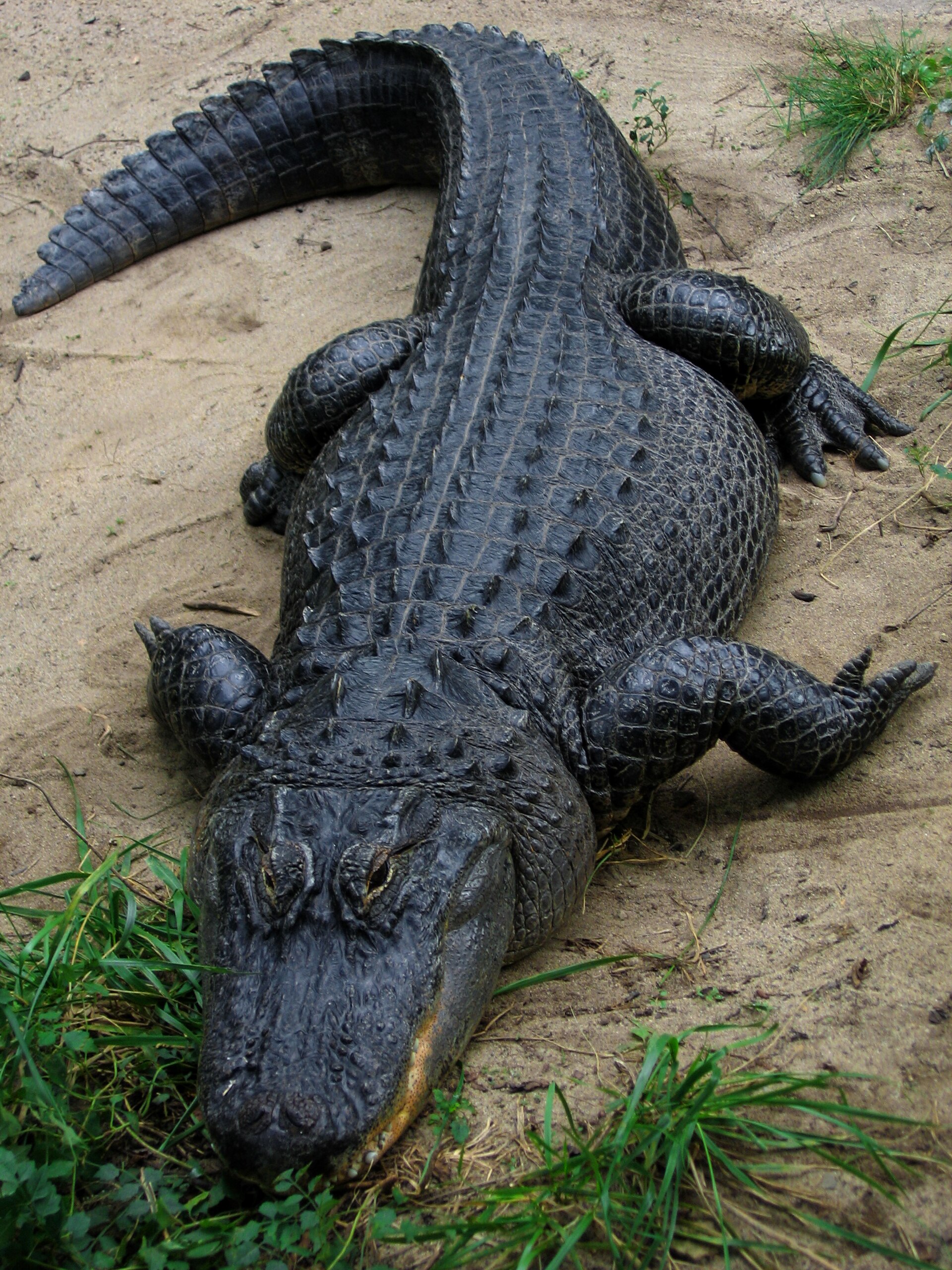
The American alligator is the largest reptile in North America and a keystone "ecosystem engineer" whose excavations sustain the wetlands of the southeastern United States. Once hunted to the brink of disappearance, it rebounded so completely that it is now a defining wildlife recovery story of the twentieth century [Elsey et al. 2019; USFWS 2021]. This profile examines the alligator's ecological role, the pressures it overcame, and the regulated-use and monitoring programs that keep its recovery durable.
Biology and Identification
The American alligator is a large, heavy-bodied crocodilian with a broad, rounded snout that distinguishes it from the narrow-snouted American crocodile. Adults are dark, blackish-grey above and lighter below; juveniles carry bright yellow crossbands that fade with age. Males grow consistently larger than females, which tend to plateau in growth above roughly 91 cm in length while males continue growing, with large adult males reaching well over 3.5 m [Lance 2000; Wilkinson et al. 2024].
Alligators have no sex chromosomes. Instead, sex is fixed during egg incubation by nest temperature — a mechanism known as temperature-dependent sex determination. In the landmark experimental demonstration, incubation at or below about 30 °C produced all females, while temperatures at or above about 34 °C produced all males [Ferguson & Joanen 1982]. Females build large mound nests of vegetation and soil, lay roughly 35–50 eggs in early summer, and guard the nest and hatchlings.
The species is long-lived and slow-maturing, and its body size shapes its ecological function: larger individuals maintain deeper water features and move greater distances between aquatic systems, linking marsh, pond, and estuary habitats [Subalusky et al. 2009; Wilkinson et al. 2024]. Diet is broad and shifts with age, spanning invertebrates, fish, turtles, birds, and mammals.
Habitat and Range
The American alligator occupies freshwater and brackish wetlands — marshes, swamps, rivers, lakes, and coastal estuaries — across the southeastern United States, from coastal North Carolina south through Florida and west to the Rio Grande in Texas [Elsey et al. 2019; USFWS 2021]. Louisiana and Florida hold the largest populations.
Within these wetlands, alligators function as ecosystem engineers. By clearing vegetation and pushing sediment to the banks, they excavate and maintain depressions known as "alligator holes" that retain water through the dry season. These features hold more standing water and greater plant richness than the surrounding marsh and serve as dry-season refugia that concentrate fish, amphibians, turtles, wading birds, and other wildlife [Palmer & Mazzotti 2004]. Through habitat modification and nutrient enrichment, the alligator measurably increases the food-web heterogeneity of the wetlands it occupies, which is why it is treated as an indicator species for Everglades restoration [Strickland et al. 2023].
In accordance with NRWL sensitive-species policy, specific nest sites, den locations, and seasonal movement details are not disclosed in this article.
Conservation Status
The American alligator is listed as Least Concern on the IUCN Red List, assessed in 2018 and published in 2019 [Elsey et al. 2019]. The species occupies essentially all of its historical range at or near carrying capacity, and its population is considered stable to increasing, with an estimated 0.75–1.06 million mature adults supported by well-implemented monitoring and sustainable-use programs [Elsey et al. 2019].
This standing reflects a dramatic reversal. Decades of unregulated hide hunting had severely depleted the species, which was protected under the Endangered Species Act (ESA) of 1973. Recovery was rapid: by 1987 the U.S. Fish & Wildlife Service determined that the alligator no longer met the biological criteria for listing on its own conservation status and reclassified it as "Threatened due to similarity of appearance." This designation is not a measure of risk to the alligator itself; it retains federal oversight of the trade because alligator hides and parts are difficult to distinguish from those of genuinely at-risk crocodilians, preventing illegally taken animals from being laundered into legal markets [USFWS 2021]. The species is listed on CITES Appendix II, under which international trade in the species and its products is regulated rather than prohibited [Elsey et al. 2019; USFWS 2021].
Threats
Although the population is now secure, several pressures require ongoing management. Habitat loss and wetland alteration remain the most significant long-term concern: drainage, water-management infrastructure, and coastal development fragment the marshes alligators depend on, and altered hydrology lowers the abundance of functional alligator holes [Palmer & Mazzotti 2004; Strickland et al. 2023].
Human–wildlife conflict rises as people increasingly live and recreate near alligator habitat, leading to nuisance-animal complaints and removals, particularly in urbanizing parts of Florida and the Gulf Coast [USFWS 2021].
Illegal take and trade laundering are the specific risks the "similarity of appearance" framework counters; without regulated tagging, illegally killed crocodilians could enter legal hide markets [USFWS 2021].
Climate-linked change — coastal saltwater intrusion, altered nest-flooding regimes, and temperature shifts that can skew sex ratios in a temperature-sex-determined species — represents an emerging concern for long-term stability [Ferguson & Joanen 1982].
What Is Being Done
Regulated, science-based use. State wildlife agencies in Louisiana, Florida, Georgia, Texas, and elsewhere operate tightly regulated wild-harvest, egg-ranching, and farming programs. Ranching collects a permitted share of wild eggs, returns a portion of grown juveniles to the wild, and supports a hide and meat industry that gives landowners a direct economic stake in conserving wetlands [Elsey et al. 2019].
Federal oversight of trade. The U.S. Fish & Wildlife Service maintains the "similarity of appearance" listing, tagging and export-permit requirements, and CITES Appendix II controls, which together curb laundering of protected crocodilians [USFWS 2021].
Long-term monitoring. Night-count surveys, nest counts, and mark-recapture studies track population trends across the range, providing the data that underpin sustainable harvest quotas [Elsey et al. 2019; Lance 2000].
Ecosystem restoration. Because the alligator indicates wetland health, its abundance and the condition of alligator holes are used to gauge the success of efforts such as the Comprehensive Everglades Restoration Plan [Palmer & Mazzotti 2004; Strickland et al. 2023].
How Readers Can Help
Citizen science. Log alligator sightings on platforms such as iNaturalist. Verified records contribute to distribution mapping and population monitoring.
Coexistence. Never feed alligators — feeding habituates them to people and is the leading cause of dangerous encounters. Keep a safe distance, supervise pets near water, and report nuisance animals to state wildlife authorities.
Wetland protection. Support policies that conserve and restore freshwater and coastal wetlands, the habitat on which the alligator's continued recovery depends [Strickland et al. 2023].
Informed consumer choices. When buying alligator products, choose items carrying official CITES tags and state-issued documentation, which confirm legal, regulated sourcing and help keep protected crocodilians out of illegal trade [USFWS 2021].
Education outreach. Share accurate, science-based information about the alligator's keystone role and its recovery, one of the clearest examples that wildlife law and sustainable use can work together.
References
[Elsey et al. 2019] Elsey, R., Woodward, A. & Balaguera-Reina, S.A. (2019). Alligator mississippiensis. The IUCN Red List of Threatened Species 2019: e.T46583A3009637. https://dx.doi.org/10.2305/IUCN.UK.2019-2.RLTS.T46583A3009637.en
[Ferguson & Joanen 1982] Ferguson, M.W.J. & Joanen, T. (1982). Temperature of egg incubation determines sex in Alligator mississippiensis. Nature, 296, 850–853. https://doi.org/10.1038/296850a0
[Lance 2000] Lance, V.A. (2000). Sex ratios of American alligators (Crocodylidae): male or female biased? Journal of Zoology, 252(1), 71–78. https://doi.org/10.1111/j.1469-7998.2000.tb00821.x
[Palmer & Mazzotti 2004] Palmer, M.L. & Mazzotti, F.J. (2004). Structure of Everglades alligator holes. Wetlands, 24(1), 115–122. https://doi.org/10.1672/0277-5212(2004)024[0115:SOEAH]2.0.CO;2
[Strickland et al. 2023] Strickland, B.A., Massie, J.A., Viadero, N., Santos, R., Gastrich, K.R., Paz, V., Brown, K., Whoriskey, D., Heithaus, M.R. & Rehage, J.S. (2023). An apex predator engineers wetland food-web heterogeneity through nutrient enrichment and habitat modification. Journal of Animal Ecology, 92(8), 1591–1606. https://doi.org/10.1111/1365-2656.13939
[Subalusky et al. 2009] Subalusky, A.L., Fitzgerald, L.A. & Smith, L.L. (2009). Ontogenetic niche shifts in the American Alligator establish functional connectivity between aquatic systems. Biological Conservation, 142(7), 1507–1514. https://doi.org/10.1016/j.biocon.2009.02.019
[USFWS 2021] U.S. Fish & Wildlife Service. (2021). Endangered and Threatened Wildlife and Plants; Regulations Pertaining to the American Alligator (Alligator mississippiensis). 86 FR 5499. https://www.federalregister.gov/documents/2021/01/19/2021-01012/endangered-and-threatened-wildlife-and-plants-regulations-pertaining-to-the-american-alligator
[Wilkinson et al. 2024] Wilkinson, P.M., Rainwater, T.R., Woodward, A.R. & Brandt, L.A. (2024). Ecological implications of allometric relationships in American alligators (Alligator mississippiensis). Scientific Reports, 14, 6356. https://doi.org/10.1038/s41598-024-56798-5