
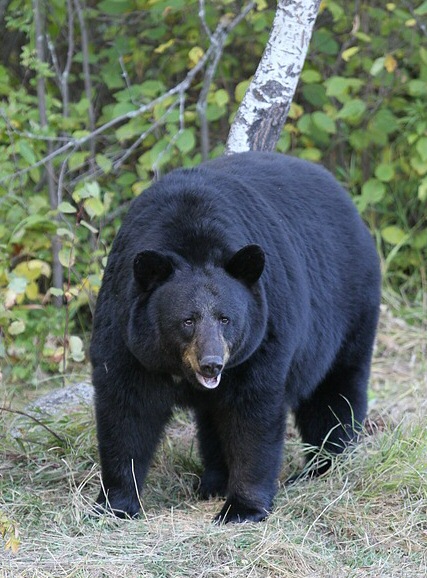
The American black bear is the most widespread and abundant bear on Earth, with a population estimated to be roughly twice that of all other bear species combined [Garshelis et al. 2016]. Once heavily reduced across much of its range, it has rebounded across North America to become one of conservation's clearer success stories — a recovery that rests on regulated harvest, habitat protection, and the everyday work of keeping bears and people apart.
Biology and Identification
Ursus americanus is a medium-to-large bear with a comparatively straight facial profile, rounded ears, short curved climbing claws, and no shoulder hump — features that distinguish it from the brown bear. Adult males typically weigh 60–300 kg and females 40–150 kg, with body length spanning roughly 120–190 cm; size varies widely with region, season, and food availability [Garshelis et al. 2016]. Despite the name, coat color is highly variable: eastern animals are usually uniformly black, while western populations include cinnamon, brown, and blonde individuals, with rare white and bluish-grey morphs in parts of the Pacific Northwest [Garshelis et al. 2016].
Black bears are dietary generalists. The bulk of their intake is plant matter — grasses and forbs in spring, soft and hard mast such as berries, acorns, and nuts in summer and autumn — supplemented by insects, carrion, fish, and occasionally young ungulates [Garshelis et al. 2016]. This flexibility underlies their success from boreal Canada to subtropical Mexico.
The species is also a physiological specialist. Continuous winter monitoring of denning bears showed that they suppress metabolic rate to about 25% of basal levels while keeping body temperature relatively high, cycling between roughly 30 and 36 degrees Celsius, with heart rates falling from about 55 to as few as 9 beats per minute [Tøien et al. 2011]. These adaptations let bears survive months without eating, drinking, or eliminating.
Habitat and Range
The American black bear is fundamentally a forest animal, occupying a vast diversity of wooded and shrub habitats across the continent. Survey work compiling expert range maps placed primary and secondary range across 12 Canadian provinces and territories, 40 U.S. states, and 6 Mexican states — about 10.5 million square kilometers, an estimated 65–75% of the species' historical range [Scheick & McCown 2014]. Over recent decades the trend has been one of expansion, as bears recolonize areas from which they were extirpated [Scheick & McCown 2014; Hristienko & McDonald 2007].
Bears require seasonally abundant food and secure denning sites, and they range from dense boreal and montane forests to swamp and bottomland hardwoods in the south. Because the species is wide-ranging, local distribution is dynamic rather than fixed.
In accordance with NRWL sensitive-species policy, specific site locations, corridor routes, and seasonal movement details are not disclosed in this article.
Conservation Status
The American black bear is assessed as Least Concern on the IUCN Red List (e.T41687A45034604), and its population trend is reported as increasing [Garshelis et al. 2016]. The listing reflects the species' enormous range and abundance: the assessment notes a total population exceeding that of all other bears combined, with most populations stable or growing [Garshelis et al. 2016].
Population figures support that picture. Compiled state and provincial estimates and subsequent reviews place the continental total in the hundreds of thousands, with Canadian populations on the order of 400,000 or more and U.S. populations (excluding several unsurveyed states) in the range of roughly 340,000–465,000 [Garshelis & Hristienko 2006; Garshelis et al. 2016]. The species is listed on CITES Appendix II [CITES 2024]. This listing is largely a "look-alike" measure: black bear parts in trade — particularly paws and gallbladders — can resemble those of more threatened bear species, so regulating black bear trade helps protect the others [Garshelis et al. 2016].
Not every population is secure. The Louisiana black bear (U. a. luteolus) was listed as Threatened under the U.S. Endangered Species Act in 1992; after more than two decades of recovery work it was removed from the federal list in 2016, an outcome the U.S. Fish and Wildlife Service cited as a recovery success [USFWS 2016].
Threats
Although the species as a whole is thriving, several pressures shape its management. Human-caused mortality — legal harvest, poaching, vehicle collisions, and lethal removal of conflict animals — is the dominant cause of death in many populations and must be managed carefully to keep harvest sustainable [Hristienko & McDonald 2007].
Habitat loss and fragmentation remain concerns at the range edges, where small or isolated populations are more vulnerable to road mortality and chance events [Scheick & McCown 2014]. Human–bear conflict is a persistent challenge: as both populations grow, bears that learn to exploit garbage, crops, and other human food sources are more likely to be killed [Hristienko & McDonald 2007]. Attacks on people are rare but real; an analysis of fatal black bear attacks across 1900–2009 documented at least 63 deaths, most involving predatory behavior by male bears, with incident rates rising alongside human population growth [Herrero et al. 2011].
What Is Being Done
State, provincial, and federal wildlife agencies manage black bears primarily through regulated hunting, monitoring, and habitat programs. Setting harvest objectives, restricting methods, and tracking population trends are the backbone of management across North America, and these tools — with public-land protection and law enforcement — drove the recoveries and range expansions of the late twentieth century [Hristienko & McDonald 2007; Scheick & McCown 2014].
Conflict reduction is a major focus. Agencies promote bear-resistant garbage containers, sanitation rules, aversive conditioning, and public education to keep bears from associating people with food [Hristienko & McDonald 2007]. The Louisiana black bear recovery illustrates targeted intervention at its most effective: coordinated habitat restoration and partnership among federal and state agencies, universities, and private landowners restored the subspecies to the point of federal delisting [USFWS 2016]. CITES Appendix II controls, meanwhile, regulate international trade in bear parts so black bears do not become a conduit for trafficking in more threatened species [Garshelis et al. 2016].
How Readers Can Help
Coexistence begins at home. In bear country, secure garbage in bear-resistant containers, manage bird feeders during active seasons, clean grills, and never leave pet food outdoors — removing these attractants is the single most effective way to prevent the conflicts that get bears killed [Hristienko & McDonald 2007]. Never feed bears, intentionally or otherwise: a food-conditioned bear is frequently a dead bear.
Readers can also support agencies and programs that monitor populations and restore habitat, report bear sightings and conflicts to local wildlife authorities so management is grounded in good data, and back habitat-protection efforts where small populations remain vulnerable [Scheick & McCown 2014]. Choosing not to purchase bear products helps close the trade channels that CITES controls regulate [Garshelis et al. 2016].
References
[Garshelis et al. 2016] Garshelis, D.L., Scheick, B.K., Doan-Crider, D.L., Beecham, J.J. & Obbard, M.E. Ursus americanus. The IUCN Red List of Threatened Species 2016: e.T41687A45034604. https://doi.org/10.2305/IUCN.UK.2016-3.RLTS.T41687A45034604.en
[Scheick & McCown 2014] Scheick, B.K. & McCown, W. Geographic distribution of American black bears in North America. Ursus, 25(1), 24–33. https://doi.org/10.2192/URSUS-D-12-00020.1
[Hristienko & McDonald 2007] Hristienko, H. & McDonald, J.E. Going into the 21st century: a perspective on trends and controversies in the management of the American black bear. Ursus, 18(1), 72–88. https://doi.org/10.2192/1537-6176(2007)18[72:GITSCA]2.0.CO;2
[Tøien et al. 2011] Tøien, Ø., Blake, J., Edgar, D.M., Grahn, D.A., Heller, H.C. & Barnes, B.M. Hibernation in black bears: independence of metabolic suppression from body temperature. Science, 331(6019), 906–909. https://doi.org/10.1126/science.1199435
[Herrero et al. 2011] Herrero, S., Higgins, A., Cardoza, J.E., Hajduk, L.I. & Smith, T.S. Fatal attacks by American black bear on people: 1900–2009. The Journal of Wildlife Management, 75(3), 596–603. https://doi.org/10.1002/jwmg.72
[Garshelis & Hristienko 2006] Garshelis, D.L. & Hristienko, H. State and provincial estimates of American black bear numbers versus assessments of population trend. Ursus, 17(1), 1–7. https://doi.org/10.2192/1537-6176(2006)17[1:SAPEOA]2.0.CO;2
[USFWS 2016] U.S. Fish and Wildlife Service. Endangered and Threatened Wildlife and Plants; Removal of the Louisiana Black Bear From the Federal List of Endangered and Threatened Wildlife and Removal of Similarity-of-Appearance Protections for the American Black Bear. Federal Register, 81(47), 13123–13171. https://www.federalregister.gov/documents/2016/03/11/2016-05206/endangered-and-threatened-wildlife-and-plants-removal-of-the-louisiana-black-bear-from-the-federal
[CITES 2024] CITES. Appendices I, II and III — Ursus americanus (American black bear), Appendix II. Convention on International Trade in Endangered Species of Wild Fauna and Flora. https://cites.org/eng/gallery/species/mammal/american_black_bear.html