
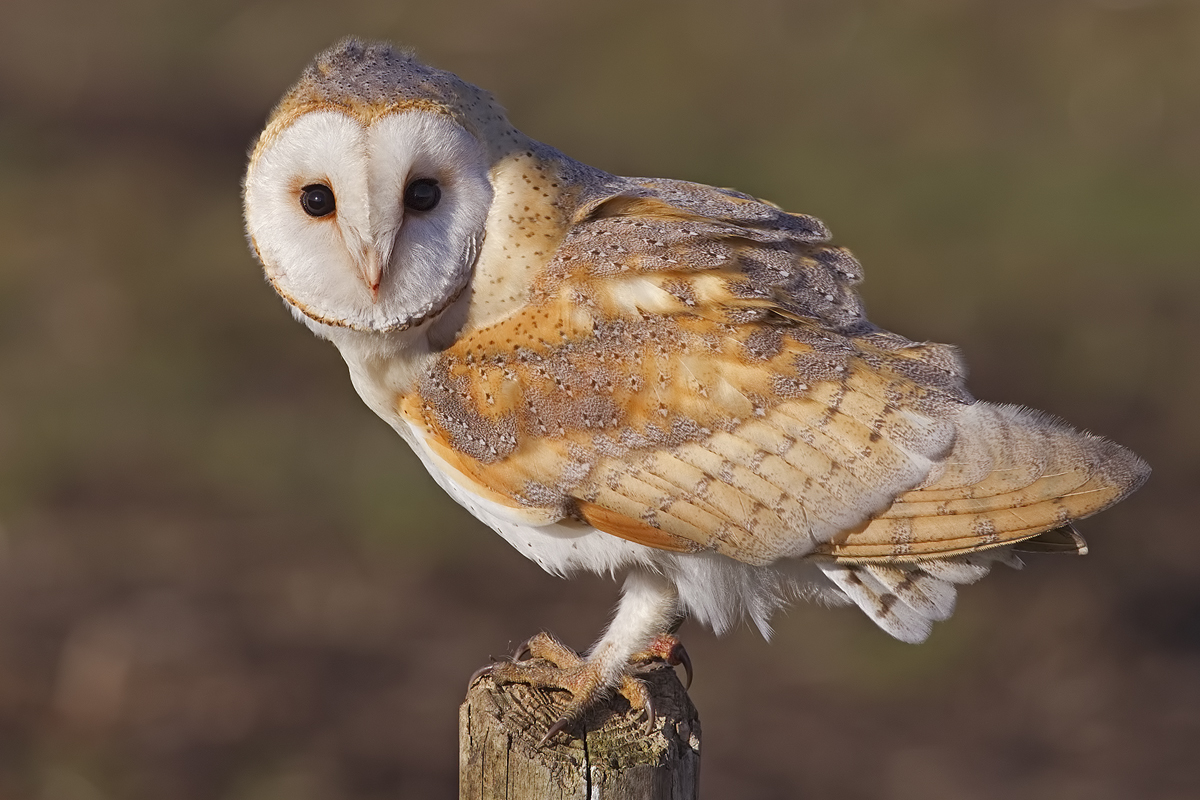
The barn owl is among the most widely distributed land birds on Earth, occurring on every continent except Antarctica and across countless oceanic islands [BirdLife International 2019]. A specialist hunter of small mammals, it locates prey in near-total darkness using hearing of extraordinary precision and approaches on wings engineered for near-silent flight. This profile examines the sensory and aerodynamic adaptations that define the species, the human-linked pressures it faces, and the agricultural programs now enlisting it as a living alternative to chemical rodent control.
Biology and Identification
The barn owl is a medium-sized, pale owl with a distinctive heart-shaped facial disc, dark eyes, and long, feathered legs. Overall body length is approximately 33–39 cm with a wingspan of roughly 80–95 cm; body mass varies considerably by region and subspecies, broadly spanning about 240–480 g, with females typically heavier and more heavily marked than males [Marti et al. 2020]. The upperparts are golden-buff mottled with grey, and the underparts range from white to cinnamon depending on population.
The species' hunting ability rests on two specialized systems. Its hearing is among the most acute measured in any animal: the heart-shaped facial ruff functions as a sound collector, and asymmetrically positioned ear openings let the bird resolve a sound source in both the horizontal and vertical planes from interaural timing and intensity differences alone [Coles & Guppy 1988]. Experimental removal of the facial ruff in a virtual acoustic model measurably degrades sound-localization accuracy, confirming the ruff's direct functional role [Hausmann et al. 2009]. The wings, in turn, are adapted for acoustic stealth: a comb-like serration on the leading edge of the outer primaries, a soft fringe on the trailing edges, and a velvety upper feather surface together suppress the aerodynamic noise that would otherwise alert prey [Wagner et al. 2017].
The diet is dominated by small mammals — voles, mice, shrews, and rats — which in temperate, moist regions commonly exceed 90% of prey items taken [Marti et al. 2020]. Indigestible bone and fur are compacted and regurgitated as pellets, a habit that makes the species an unusually tractable subject for non-invasive diet and contaminant studies. Clutches average around four to seven eggs, are incubated for roughly a month, and hatch asynchronously, producing a brood size hierarchy that buffers the family against fluctuating prey supply [Marti et al. 2020].
Habitat and Range
The barn owl occupies open and semi-open landscapes — grasslands, agricultural mosaics, marsh edges, savanna, and lightly wooded country — across a near-cosmopolitan range spanning the Americas, Europe, Africa, southern Asia, and Australasia, as well as many islands [BirdLife International 2019]. It is strongly associated with human-modified environments, nesting readily in barns, church towers, tree cavities, cliff niches, and artificial nest boxes. The European breeding population alone is estimated in the hundreds of thousands of pairs, and the global population is considered large [BirdLife International 2019].
In accordance with NRWL sensitive-species policy, specific roost and nest-site locations, breeding-territory coordinates, and seasonal movement details are not disclosed in this article.
Conservation Status
The barn owl is assessed as Least Concern on the IUCN Red List, in an assessment authored by BirdLife International and most recently amended in 2019 (taxon ID 22688504) [BirdLife International 2019]. The classification reflects the species' extremely large range and large global population; the overall population trend is nonetheless reported as decreasing [BirdLife International 2019].
A global "Least Concern" listing can mask meaningful regional declines. In parts of its range the species is sensitive to agricultural intensification, loss of nesting structures, severe winters, and roadside mortality, and several national and regional populations have contracted. The species is not listed on the CITES appendices [BirdLife International 2019]. Because the barn owl reaches high local densities and responds quickly to habitat management, it is also widely used as an indicator of small-mammal community health and of contaminant burdens in farmland ecosystems.
Threats
Secondary rodenticide poisoning is among the most consistently documented threats. Because barn owls specialize on rodents and frequently forage in farmland and around buildings, they are exposed to anticoagulant rodenticides carried in poisoned prey. In a Kentucky study, one or more anticoagulant rodenticides were detected in roughly a third of barn owls examined over 2012–16 [Slankard et al. 2019]. Exposure can be far higher elsewhere: in southwestern Canada, rodenticide-residue detection rates in barn owls rose sharply over time, with second-generation compounds posing the greatest toxicosis risk [Huang et al. 2016]. At sufficient doses these compounds deplete blood-clotting factors and cause fatal internal hemorrhage.
Loss of nesting and foraging habitat compounds the problem. Agricultural intensification removes the rough grassland margins that support prey populations, and the conversion or renovation of old barns, ruins, and hollow trees eliminates traditional nest sites [Bontzorlos et al. 2024].
Direct mortality from human infrastructure — collisions with road traffic in particular, given the species' low hunting flight over verges — and harsh winter weather in temperate populations add further pressure on local numbers.
What Is Being Done
Nest-box programs. Where natural cavities are scarce, artificial nest boxes reliably increase local barn owl numbers, and research has refined how box placement and exposure affect occupancy and breeding success [Charter & Rozman 2022]. These programs both conserve the species and harness it as a working predator.
Barn owls as biological rodent control. The largest such effort is a national initiative in Israel, where the nest-box network expanded from several hundred boxes to roughly 5,000 across the country's agricultural land; participating regions have recorded substantial reductions in rodenticide application, with national figures cited near a 45% decrease [Bontzorlos et al. 2024]. The model has been extended into a multinational Mediterranean initiative — including cross-border cooperation among Israel, Jordan, and the Palestinian Authority — that pairs owl-based pest suppression with reduced chemical use [Bontzorlos et al. 2024]. By lowering rodenticide demand, these programs simultaneously reduce the secondary-poisoning risk to the owls themselves.
Monitoring and research. Pellet analysis and residue screening provide non-invasive tools for tracking both barn owl diet and the prevalence of contaminants in the wider food web [Slankard et al. 2019; Huang et al. 2016], informing pesticide regulation and farmland management.
How Readers Can Help
Support owl-friendly rodent management. Where rodent control is needed, non-chemical methods — exclusion, sanitation, and encouraging natural predators such as barn owls through nest boxes — avoid the secondary-poisoning pathway that anticoagulant rodenticides create for raptors [Slankard et al. 2019].
Provide and protect nest sites. Retaining hollow trees and old farm structures, and installing well-placed nest boxes in suitable open country, can meaningfully increase local breeding opportunity [Charter & Rozman 2022].
Policy engagement. Support regulation that restricts the most hazardous second-generation anticoagulant rodenticides, a measure directly relevant to barn owl survival in farmed landscapes [Huang et al. 2016].
Citizen science. Log barn owl sightings through platforms such as iNaturalist and regional bird-monitoring schemes. Verified occurrence records feed directly into the range and trend data underpinning conservation assessments [BirdLife International 2019].
References
[BirdLife International 2019] BirdLife International. (2019). Tyto alba (amended version of 2016 assessment). The IUCN Red List of Threatened Species 2019: e.T22688504A155542941. https://dx.doi.org/10.2305/IUCN.UK.2019-3.RLTS.T22688504A155542941.en
[Bontzorlos et al. 2024] Bontzorlos, V., Cain, S., Daka, A., Charter, M., Voltransky, S., Spiegel, O., Hieronymus, J., Roulin, A. & Leshem, Y. (2024). Barn Owls as a Nature-Based Solution for Pest Control: A Multinational Initiative Around the Mediterranean and Other Regions. Conservation, 4(4), 627–656. https://doi.org/10.3390/conservation4040039
[Charter & Rozman 2022] Charter, M. & Rozman, G. (2022). The Importance of Nest Box Placement for Barn Owls (Tyto alba). Animals, 12(20), 2815. https://doi.org/10.3390/ani12202815
[Coles & Guppy 1988] Coles, R.B. & Guppy, A. (1988). Directional hearing in the barn owl (Tyto alba). Journal of Comparative Physiology A, 163(1), 117–133. https://doi.org/10.1007/BF00612002
[Hausmann et al. 2009] Hausmann, L., von Campenhausen, M., Endler, F., Singheiser, M. & Wagner, H. (2009). Improvements of Sound Localization Abilities by the Facial Ruff of the Barn Owl (Tyto alba) as Demonstrated by Virtual Ruff Removal. PLOS ONE, 4(11), e7721. https://doi.org/10.1371/journal.pone.0007721
[Huang et al. 2016] Huang, A.C., Elliott, J.E., Hindmarch, S., Lee, S.L., Maisonneuve, F., Bowes, V., Cheng, K.M. & Martin, K. (2016). Increased rodenticide exposure rate and risk of toxicosis in barn owls (Tyto alba) from southwestern Canada and linkage with demographic but not genetic factors. Ecotoxicology, 25(6), 1061–1071. https://doi.org/10.1007/s10646-016-1662-6
[Marti et al. 2020] Marti, C.D., Poole, A.F., Bevier, L.R., Bruce, M.D., Christie, D.A., Kirwan, G.M. & Marks, J.S. (2020). Barn Owl (Tyto alba), version 1.0. In Birds of the World (S.M. Billerman, Ed.). Cornell Lab of Ornithology, Ithaca, NY, USA. https://doi.org/10.2173/bow.brnowl.01
[Slankard et al. 2019] Slankard, K.G., Gaskill, C.L., Cassone, L.M. & Rhoden, C.M. (2019). Changes in Detected Anticoagulant Rodenticide Exposure in Barn Owls (Tyto alba) in Kentucky, USA, in 2012–16. Journal of Wildlife Diseases, 55(2), 432–437. https://doi.org/10.7589/2018-03-073
[Wagner et al. 2017] Wagner, H., Weger, M., Klaas, M. & Schröder, W. (2017). Features of owl wings that promote silent flight. Interface Focus, 7(1), 20160078. https://doi.org/10.1098/rsfs.2016.0078