
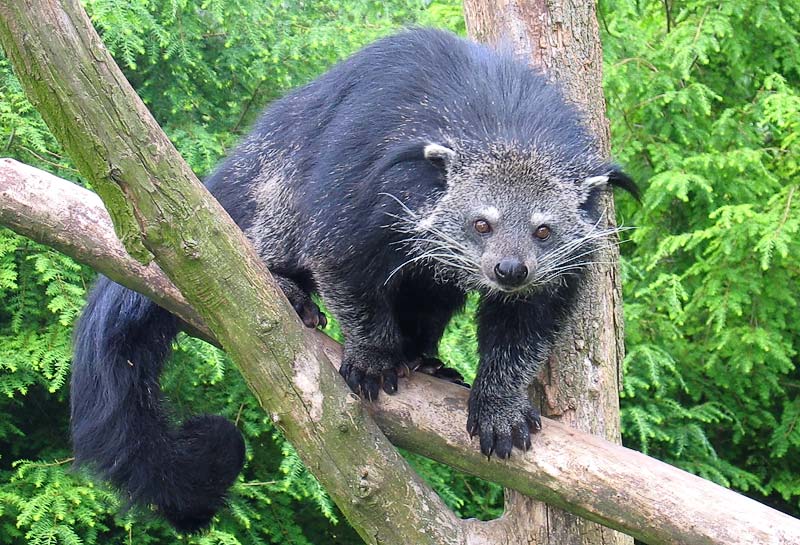
Often called the "bearcat," the binturong is the largest of the Asian civets and one of the few carnivorans with a fully prehensile tail—an appendage nearly as long as its body that functions as a fifth limb in the rainforest canopy [Nakabayashi & Ahmad 2018]. It is also the only Old World mammal known to produce the popcorn-scented compound 2-acetyl-1-pyrroline in its urine, used in scent-marking [Greene et al. 2016]. Despite this charisma, the species is in decline: it is listed as VU (Vulnerable) on the IUCN Red List, with the population inferred to have fallen by more than 30% over three generations because of habitat loss and exploitation [Willcox et al. 2016]. As a major disperser of fig seeds, its loss carries consequences far beyond the animal itself.
Biology and Identification
The binturong, Arctictis binturong (Raffles, 1821), is a member of the family Viverridae within the order Carnivora, and is the sole living species of its genus [Veron et al. 2019]. It is a robust, heavily built animal with coarse, shaggy black fur often frosted with grey, tufted ears, and a broad muzzle. Head-and-body length is roughly 60–96 cm, with a muscular prehensile tail of 55–90 cm, and adult body mass commonly ranges from about 9 to 20 kg, with females typically larger than males [Willcox et al. 2016]. The prehensile tail is unusual among carnivorans and provides anchorage during slow, deliberate arboreal movement [Nakabayashi & Ahmad 2018].
Binturongs are largely arboreal, nocturnal to crepuscular, and frugivorous despite their carnivoran ancestry. Figs (Ficus spp.) dominate the diet; in Bornean rainforest, fig trees accounted for 87.5% of recorded feeding sites of collared individuals, which appear to track the location and fruiting phenology of fig trees across their ranges [Nakabayashi & Ahmad 2018]. They also consume other fruits, leaves, and opportunistically small animals and eggs [Willcox et al. 2016].
Reproduction is slow relative to body size. Females may exhibit delayed implantation, and litters are small—typically one to three young—contributing to a low intrinsic rate of population increase that limits recovery from disturbance [Willcox et al. 2016]. Scent communication is well developed; the characteristic popcorn-like odour of binturong urine is attributable to 2-acetyl-1-pyrroline, secreted in greater quantity by males, and likely conveys identity and reproductive condition [Greene et al. 2016].
Habitat and Range
The binturong occupies tall tropical and subtropical forests across South and Southeast Asia, including parts of northeastern India, Nepal, Bangladesh, Myanmar, Thailand, Laos, Cambodia, Vietnam, Peninsular Malaysia, Indonesia (Sumatra, Borneo/Kalimantan, Java), and the Philippines (notably Palawan) [Willcox et al. 2016]. Genetic work has identified two principal lineages corresponding broadly to the Indochinese (mainland) and Sundaic regions, with the Palawan population genetically distinct and of particular conservation interest [Veron et al. 2019].
The species depends on forest cover and is strongly associated with the presence of fruiting fig trees, making continuity of canopy and habitat connectivity important to its persistence [Nakabayashi & Ahmad 2018]. Camera-trapping work shows binturongs can tolerate some habitat modification: detections remained where more than roughly 40% forest cover was retained within a 20-km radius, and where oil-palm incursion stayed below about 20% of the surrounding area [Honda et al. 2023]. Borneo and Sumatra hold highly suitable habitat and among the highest detection rates, yet relatively low proportions of those landscapes are formally protected [Honda et al. 2023]. Across much of the range, distribution has contracted and become increasingly fragmented over recent decades as lowland forest has been converted [Willcox et al. 2016].
In accordance with NRWL sensitive-species policy, specific site locations, seasonal movement details, and den or nest coordinates are not disclosed in this article.
Conservation Status
The binturong is listed as VU (Vulnerable) on the IUCN Red List, under criterion A2cd, in the assessment published in 2016 [Willcox et al. 2016]. The classification reflects an inferred population reduction of more than 30% over three generations (approximately 18 years) driven by habitat loss and direct exploitation; the population trend is assessed as decreasing, and the species is considered rare across much of its range [Willcox et al. 2016]. No reliable rangewide population estimate exists, owing to the animal's elusive, nocturnal, and arboreal habits, which make conventional ground surveys ineffective [Honda et al. 2023].
In international trade terms, the binturong is included on CITES Appendix III (listed by India), meaning trade is monitored through a permit and certificate-of-origin system rather than the stricter controls of Appendices I and II [CITES 2024]. Genetic structuring across the range indicates that distinct regional units—particularly the Sundaic lineage and the isolated Palawan population—should be treated as separate conservation priorities rather than as a single panmictic stock [Veron et al. 2019]. Because the species' slow life history limits recovery potential, sustained declines are difficult to reverse once forest habitat is lost [Willcox et al. 2016].
Threats
Primary threats to the binturong, drawn from the IUCN assessment and field studies, include:
-
Habitat loss, degradation, and fragmentation. Conversion of lowland tropical forest to agriculture—especially oil palm—and logging reduce the canopy continuity and fig-tree resources on which binturongs depend [Willcox et al. 2016; Honda et al. 2023].
-
Hunting and trapping. Binturongs are taken for bushmeat, for fur, and for use in traditional medicine in parts of the range, adding direct mortality on top of habitat-driven decline [Willcox et al. 2016].
-
Live capture for the pet and entertainment trade. Demand for binturongs as exotic pets and exhibits removes individuals from wild populations [Willcox et al. 2016].
-
Low reproductive resilience. Small litter sizes and slow generation time mean populations recover slowly from any of the above pressures, amplifying the impact of even moderate offtake or habitat loss [Willcox et al. 2016].
-
Reduced seed-dispersal function and feedback effects. Because binturongs are effective dispersers—gut passage leaves the great majority of ingested seeds intact and can accelerate germination—local declines may impair forest regeneration, particularly for figs, a keystone resource [Colon & Campos-Arceiz 2013; Nakabayashi & Ahmad 2018].
These categories describe mechanisms of decline; they are not guidance for harming the species.
What Is Being Done
The binturong's listing as Vulnerable on the IUCN Red List provides the formal scientific basis for national and international conservation prioritisation [Willcox et al. 2016]. Its inclusion on CITES Appendix III (India) enables monitoring of international trade through documentation requirements [CITES 2024]. The species also benefits indirectly from protected-area networks and forest-conservation legislation across range states, although coverage of high-quality binturong habitat in regions such as Borneo and Sumatra remains limited relative to the available habitat [Honda et al. 2023].
A dedicated, species-focused initiative is the Binturong Conservation Programme (ABConservation), the first programme worldwide devoted specifically to the binturong, which combines field research, population monitoring, local capacity-building, and public education in Southeast Asia [ABConservation 2020]. Camera-trapping research—including arboreal camera methods designed for this canopy-dwelling, low-detectability species—is improving baseline data on occurrence and habitat associations needed to guide management [Honda et al. 2023]. Population-genetic studies have clarified that regional lineages and the isolated Palawan population warrant management as separate conservation units, informing decisions on translocation and captive-breeding stock [Veron et al. 2019]. Together these efforts emphasise retaining forest cover and connectivity, since binturongs persist where adequate forest is maintained even in partly modified landscapes [Honda et al. 2023].
How Readers Can Help
Readers can contribute to binturong conservation in several practical, evidence-based ways. Recording wildlife observations on citizen-science platforms such as iNaturalist and GBIF helps researchers map distribution and detect range changes for an otherwise hard-to-survey species. Supporting certified sustainable products—for example, palm oil certified by the Roundtable on Sustainable Palm Oil—reduces pressure on the lowland forests binturongs depend on, consistent with findings that the species persists where forest cover is retained and plantation incursion is limited [Honda et al. 2023]. Choosing not to purchase binturongs or other wild civets as pets, and avoiding products derived from them, reduces demand that drives live capture and hunting [Willcox et al. 2016]. Readers can also engage constructively with policy processes on forest protection and land-use planning in range states, and support reputable organisations and accredited zoos that fund field research and habitat conservation. Sharing accurate information about the species' ecological role as a seed disperser helps build broader public support for conserving tropical forests [Colon & Campos-Arceiz 2013].
References
[ABConservation 2020] ABConservation (2020). The Binturong Conservation Programme: the first programme in the world dedicated to the conservation of the binturong Arctictis binturong. Association for Binturong Conservation (ABConservation). https://www.abconservation.org/en/the-binturong/
[CITES 2024] CITES (2024). Appendices I, II and III: Arctictis binturong (Viverridae), listed in Appendix III (India). Convention on International Trade in Endangered Species of Wild Fauna and Flora. https://cites.org/eng/app/appendices.php
[Colon & Campos-Arceiz 2013] Colon, C.P. & Campos-Arceiz, A. (2013). The impact of gut passage by binturongs (Arctictis binturong) on seed germination. Raffles Bulletin of Zoology, 61(1), 417–421. https://lkcnhm.nus.edu.sg/wp-content/uploads/sites/10/app/uploads/2017/06/61rbz417-421.pdf
[Greene et al. 2016] Greene, L.K., Wallen, T.W., Moresco, A., Goodwin, T.E. & Drea, C.M. (2016). Reproductive endocrine patterns and volatile urinary compounds of Arctictis binturong: discovering why bearcats smell like popcorn. The Science of Nature (Naturwissenschaften), 103, 37. https://doi.org/10.1007/s00114-016-1361-4
[Honda et al. 2023] Honda, A., Amir, Z., Mendes, C.P., Moore, J.H. & Luskin, M.S. (2023). Binturong ecology and conservation in pristine, fragmented and degraded tropical forests. Oryx, 57(6), 757–766. https://doi.org/10.1017/S0030605323000935
[Nakabayashi & Ahmad 2018] Nakabayashi, M. & Ahmad, A.H. (2018). Short-term movements and strong dependence on figs of binturongs (Arctictis binturong) in Bornean rainforests. European Journal of Wildlife Research, 64, 66. https://doi.org/10.1007/s10344-018-1232-8
[Veron et al. 2019] Veron, G., Debruille, A., Kayser, P., Fernandez, D.A.P. & Bourgeois, A. (2019). Genetic diversity and structure of the binturong Arctictis binturong (Carnivora: Viverridae) — status of the elusive Palawan binturong and implications for conservation. Zoological Journal of the Linnean Society, 188(1), 302–318. https://doi.org/10.1093/zoolinnean/zlz100
[Willcox et al. 2016] Willcox, D.H.A., Chutipong, W., Gray, T.N.E., Cheyne, S., Semiadi, G., Rahman, H., Coudrat, C.N.Z., Jennings, A., Ghimirey, Y., Ross, J., Fredriksson, G. & Tilker, A. (2016). Arctictis binturong. The IUCN Red List of Threatened Species 2016: e.T41690A45217088. https://dx.doi.org/10.2305/IUCN.UK.2016-1.RLTS.T41690A45217088.en