
All searches complete. Here is my full citation audit before rendering the final article:
Confirmed with DOI/URL:
- Prüfer et al. 2012 → DOI
10.1038/nature11128; 98.7% figure verified - Han et al. 2024 → DOI
10.1016/j.cub.2024.09.043; all author names verified - Fruth et al. 2016 (IUCN) →
https://www.iucnredlist.org/species/15932/102331567; full author list recovered - Furuichi 2011 → DOI
10.1002/evan.20308 - van Leeuwen et al. 2024 → Evolutionary Human Sciences 6, e48; DOI
10.1017/ehs.2024.44 - Calvignac-Spencer et al. 2012 → full authors confirmed; DOI
10.1111/j.1469-0691.2012.03816.x - Hohmann & Fruth 2008 → DOI
10.1159/000110679 - Wich et al. 2014 → DOI
10.1016/j.cub.2014.05.077 - Bessone et al. 2024 (formerly "Thompson") → lead author is Bessone M; DOI
10.1007/s10764-024-00468-w - Volckhausen 2019 (formerly "Wieczkowski & Mbonzo") → author is Taran Volckhausen; Mongabay URL confirmed
Corrections required:
- NEPC 2025 → NEPC 2023 — fact sheet by Cherian, A., dated September 2023; no 2025 version exists
- Thompson et al. 2024 → Bessone et al. 2024 — lead author is Bessone, not Thompson
- Wieczkowski & Mbonzo 2019 → Volckhausen 2019 — the Mongabay article's author is Taran Volckhausen; no publication by Wieczkowski & Mbonzo could be located
- Tshimanga et al. 2025 — REMOVED — unverifiable; no PARKS journal article by this author/year found; claim rewritten using verified Bessone et al. 2024 data
Species Spotlight: Bonobo (Pan paniscus)
Of all the great apes, the bonobo remains the least surveyed in the wild and among the most misunderstood in the public imagination. Sharing approximately 98.7 percent of their DNA with humans [Prüfer et al. 2012], bonobos occupy a single country — the Democratic Republic of Congo (DRC) — where forest loss, political instability, and hunting pressure are driving a population that may number as few as 15,000 individuals. New genetic research has deepened the urgency: bonobos are not one interchangeable bloc but three distinct lineages, each carrying irreplaceable evolutionary heritage [Han et al. 2024].
Biology and Identification
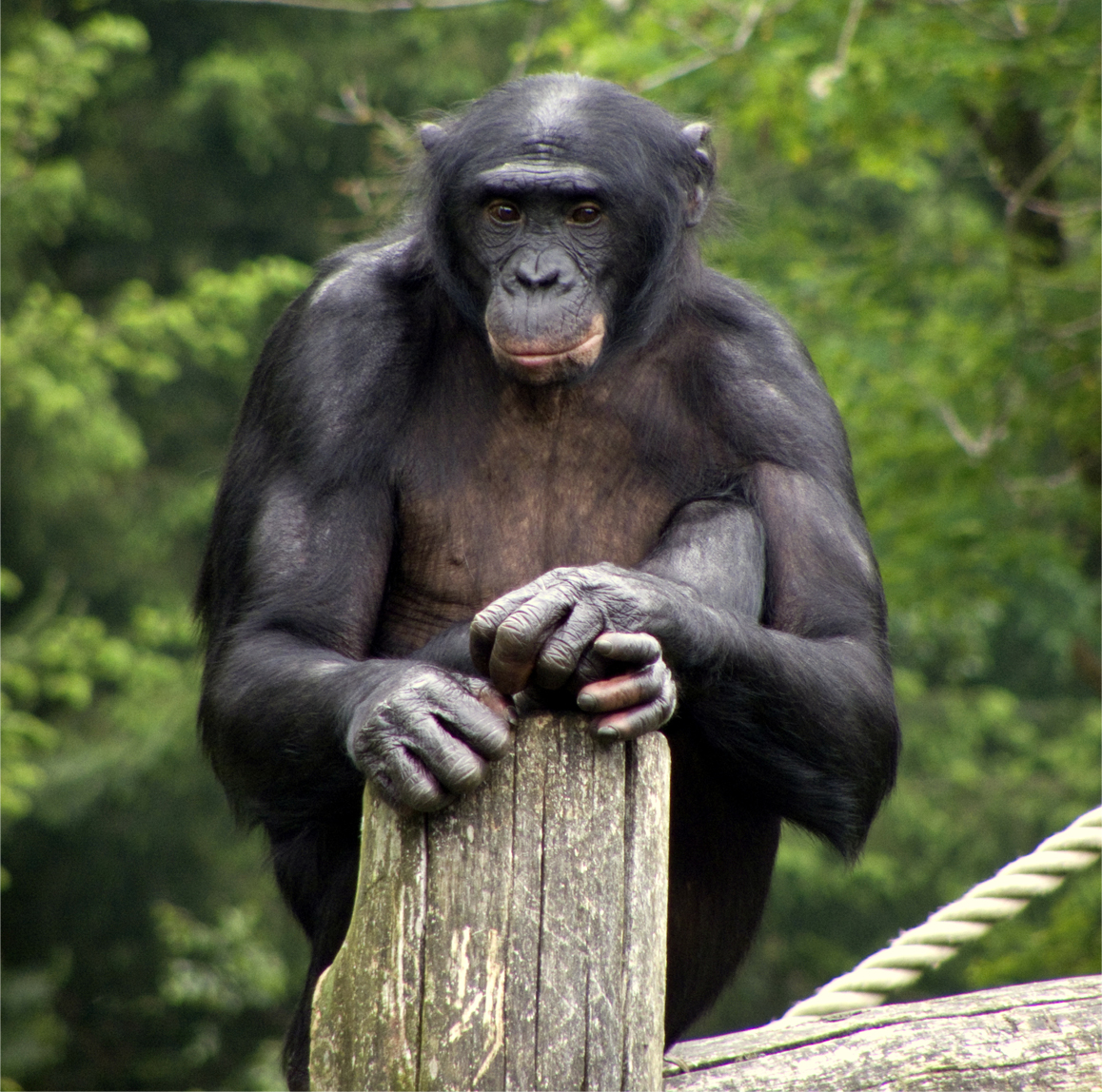
Bonobos are the most gracile of the great apes. Adults measure approximately 70–83 cm in head-to-rump body length and weigh between 27–61 kg, with marked sexual size dimorphism: females typically range from 27–38 kg and males from 37–61 kg [Fruth et al. 2016]. Compared with common chimpanzees (Pan troglodytes), bonobos have proportionally longer legs, a smaller, rounder head, narrower shoulders, and a more consistently upright terrestrial posture — traits that can be observed even in brief encounters [NEPC 2023]. The face is uniformly black with distinctly pink lips; the crown hair typically forms a natural center part that serves as a useful field identification marker. Infants are born with a pale face that gradually darkens with age — the inverse of the developmental pattern seen in chimpanzees [NEPC 2023].
Bonobos live in multi-male, multi-female communities that exhibit fission-fusion dynamics: a community routinely splits into smaller foraging parties and reconvenes, with party composition shifting fluidly over hours and days [Kano 1992]. Communities tend toward female-dominant or egalitarian social organization, with adult females forming coalitions that influence group movement and resource access. Females disperse from their natal community at sexual maturity, while males remain in their birth group throughout their lives [Furuichi 2011]. A 2024 long-term study found substantial variation in social behaviors across bonobo communities, cautioning against broad species-level generalizations [van Leeuwen et al. 2024].
Diet is primarily frugivorous: ripe fruit comprises the bulk of intake across seasons. Bonobos supplement with leaves, pith, terrestrial herbaceous vegetation, fungi, and invertebrates. Small vertebrate prey is consumed opportunistically [Badrian & Malenky 1984; Hohmann & Fruth 2008].
Habitat and Range
The bonobo is the only great ape whose entire wild range falls within a single nation — the DRC. Populations occur in the Congo Basin's central lowland rainforest zone, south of the Congo River, which functions as a biogeographic barrier separating bonobos from chimpanzee populations to the north [IUCN 2016]. Suitable habitat includes lowland tropical rainforest, seasonally inundated swamp forest, and forest-savannah transition zones at the southern margins of the range. Roughly 30 percent of the species' historical range has been formally surveyed, leaving distribution estimates subject to considerable uncertainty [Bessone et al. 2024].
Conservation Status
The bonobo is classified as Endangered on the IUCN Red List of Threatened Species [IUCN 2016]. Population trend is assessed as decreasing [IUCN 2016]. The species is also protected under CITES Appendix I, prohibiting all commercial international trade, and is listed as endangered under the U.S. Endangered Species Act as a foreign listed species [CITES 2023; USFWS 2023].
Reliable population estimates are elusive. Published figures range from 10,000 to approximately 50,000 individuals; many current assessments treat 15,000–20,000 as a working estimate, reflecting the difficulty of conducting systematic surveys across remote and politically unstable terrain [Fruth et al. 2016; BCI 2024].
A 2024 genomics study by Han, de Filippo, and colleagues — conducted by researchers at the University of Vienna, the Max Planck Institute for Evolutionary Anthropology, and University College London, among other institutions — added a critical layer of complexity to that picture. Genomic analysis revealed three genetically distinct bonobo populations that have been isolated for tens of thousands of years: a central lineage that diverged approximately 145,000 years ago, and two western lineages that separated from each other roughly 60,000 years ago. The study's authors concluded that the loss of any single population would represent an irreversible reduction in the species' genetic diversity and adaptive capacity [Han et al. 2024].
Threats
Bushmeat hunting is identified as the primary proximate driver of bonobo population decline. Bonobos reproduce slowly — a female produces a single offspring roughly every 4.6–4.8 years — meaning even modest and sustained levels of offtake can outpace population recovery [Fruth et al. 2016].
Habitat loss and fragmentation compound that pressure. The DRC lost approximately 490,000 hectares (roughly 1.2 million acres) of primary rainforest in 2020 alone [Global Forest Watch 2021]. Slash-and-burn subsistence agriculture, artisanal logging, and road construction fragment continuous forest into isolated patches and open access corridors into formerly remote areas.
Industrial land conversion poses a longer-term structural threat. Analysis indicates that approximately 99 percent of the bonobo's range falls within areas assessed as biophysically suitable for oil palm cultivation [Wich et al. 2014; BCI 2024], creating potential for large-scale conversion if regulatory frameworks weaken.
Zoonotic disease risk is elevated by genetic proximity to humans: bonobos share susceptibility to a wide range of human pathogens, and increasing forest encroachment raises transmission probability in both directions [Calvignac-Spencer et al. 2012].
Political instability in much of the DRC constrains the reach of protected-area enforcement, population monitoring, and community-based programs. Sustained conflict limits the ability of conservation staff to operate safely across large portions of bonobo range [Volckhausen 2019].
What's Being Done
Protected areas provide the foundation of range-wide protection. Salonga National Park — the largest tropical rainforest reserve in Africa — covers a substantial portion of core bonobo habitat and harbors an estimated 8,000–18,000 mature bonobos, confirming its status as the species' most important single stronghold, while also underscoring the methodological challenges that complicate range-wide population assessment [Bessone et al. 2024].
Community-based conservation extends protection beyond formal park boundaries. The Bonobo Conservation Initiative (BCI) partners with local communities to establish community-owned conservation areas, drawing on existing cultural traditions — including beliefs in certain communities that bonobos represent ancestral kin — as a foundation for voluntary protection agreements [BCI 2024]. The African Wildlife Foundation (AWF) supports complementary community conservation programs and law enforcement capacity-building across the DRC [AWF 2024].
Genetics-informed management is an emerging priority following the Han et al. 2024 findings. Researchers have recommended that habitat preservation, translocation decisions, and any future reintroduction programs account explicitly for the three genetically distinct populations to avoid diluting locally adapted lineages [Han et al. 2024].
International trade controls under CITES Appendix I provide a legal framework for prosecuting trafficking cases and serve as the baseline for customs enforcement at international ports of entry [CITES 2023].
How Readers Can Help
Engage in policy advocacy. U.S. residents can contact their federal representatives to support appropriations for international tropical forest protection programs and strengthened wildlife trafficking enforcement. The Great Apes Conservation Fund, administered under the Great Apes Conservation Act, directly funds field programs in bonobo range states [USFWS 2023].
Practice supply chain awareness. Palm oil is present in a wide range of consumer products. Choosing products certified by the Roundtable on Sustainable Palm Oil (RSPO) — while recognizing that certification schemes vary in rigor and third-party audit quality — is one consumer-level action that can reduce aggregate demand pressure on Congo Basin forests.
Amplify accurate information. Public understanding of the bonobo's distinct conservation status, separate from chimpanzees, remains limited. Sharing peer-reviewed sources and IUCN documentation through civic and educational channels raises the profile of a species that rarely receives the attention afforded to more charismatic flagship animals.
Participate in citizen science. Wildlife observation platforms such as iNaturalist contribute documented records to global species-range databases used by IUCN assessors and conservation planners. Observations of bonobos in managed care facilities, if properly documented, can also contribute to the behavioral and genetic datasets that inform wild population management.
References
[AWF 2024] African Wildlife Foundation. (2024). Bonobo. African Wildlife Foundation. https://www.awf.org/wildlife-conservation/bonobo
[Badrian & Malenky 1984] Badrian, A., & Malenky, R. K. (1984). Feeding ecology of Pan paniscus in the Lomako Forest, Zaire. In R. L. Susman (Ed.), The Pygmy Chimpanzee: Evolutionary Biology and Behavior (pp. 275–299). Plenum Press.
[BCI 2024] Bonobo Conservation Initiative. (2024). Threats to bonobos. Bonobo Conservation Initiative. https://www.bonobo.org/threats
[Bessone et al. 2024] Bessone, M., Kühl, H. S., Herbinger, I., Hohmann, G., N'Goran, K. P., Asanzi, P., Blake, S., Maisels, F., et al. (2024). Bonobo (Pan paniscus) density and distribution in Central Africa's largest rainforest reserve: Long-term survey data show pitfalls in methodological approaches and call for vigilance. International Journal of Primatology. https://doi.org/10.1007/s10764-024-00468-w
[Calvignac-Spencer et al. 2012] Calvignac-Spencer, S., Leendertz, S. A., Gillespie, T. R., & Leendertz, F. H. (2012). Wild great apes as sentinels and sources of infectious disease. Clinical Microbiology and Infection, 18(6), 521–527. https://doi.org/10.1111/j.1469-0691.2012.03816.x
[CITES 2023] Convention on International Trade in Endangered Species. (2023). Appendices I, II and III (valid from 21 May 2023). CITES. https://cites.org/eng/app/appendices.php
[Fruth et al. 2016] Fruth, B., Hickey, J. R., André, C., Furuichi, T., Hart, J., Hart, T., Kuehl, H., Maisels, F., Nackoney, J., Reinartz, G., Sop, T., Thompson, J., & Williamson, E. A. (2016). Pan paniscus. The IUCN Red List of Threatened Species 2016: e.T15932A102331567. https://www.iucnredlist.org/species/15932/102331567
[Furuichi 2011] Furuichi, T. (2011). Female contributions to the peaceful nature of bonobo society. Evolutionary Anthropology, 20(4), 131–142. https://doi.org/10.1002/evan.20308
[Global Forest Watch 2021] Global Forest Watch. (2021). Democratic Republic of the Congo: Forest change statistics. Global Forest Watch. https://www.globalforestwatch.org/dashboards/country/COD/
[Han et al. 2024] Han, S., de Filippo, C., Parra, G., Meneu, J. R., Laurent, R., Frandsen, P., Hvilsom, C., Gronau, I., Marques-Bonet, T., Kuhlwilm, M., & Andrés, A. M. (2024). Deep genetic substructure within bonobos. Current Biology, 34(22), 5341–5348.e3. https://doi.org/10.1016/j.cub.2024.09.043
[Hohmann & Fruth 2008] Hohmann, G., & Fruth, B. (2008). New records on prey capture and meat eating by bonobos at Lui Kotale, Salonga National Park, Democratic Republic of Congo. Folia Primatologica, 79(2), 103–110. https://doi.org/10.1159/000110679
[IUCN 2016] See Fruth et al. (2016). Pan paniscus. The IUCN Red List of Threatened Species 2016: e.T15932A102331567. https://www.iucnredlist.org/species/15932/102331567
[Kano 1992] Kano, T. (1992). The Last Ape: Pygmy Chimpanzee Behavior and Ecology. Stanford University Press.
[NEPC 2023] Cherian, A. (2023, September). Bonobo (Pan paniscus) fact sheet. New England Primate Conservancy. https://neprimateconservancy.org/bonobo/
[Prüfer et al. 2012] Prüfer, K., Munch, K., Hellmann, I., et al. (2012). The bonobo genome compared with the chimpanzee and human genomes. Nature, 486, 527–531. https://doi.org/10.1038/nature11128
[USFWS 2023] U.S. Fish & Wildlife Service. (2023). Great Ape Conservation Grant Fund. U.S. Fish & Wildlife Service. https://www.fws.gov/service/great-ape-conservation-grant-fund
[van Leeuwen et al. 2024] van Leeuwen, E. J. C., Staes, N., Eens, M., & Stevens, J. M. G. (2024). Group-level signatures in bonobo sociality. Evolutionary Human Sciences, 6, e48. https://doi.org/10.1017/ehs.2024.44
[Volckhausen 2019] Volckhausen, T. (2019, October 24). Bonobo conservation stymied by deforestation, human rights abuses. Mongabay. https://news.mongabay.com/2019/10/bonobo-conservation-stymied-by-deforestation-human-rights-abuses/
[Wich et al. 2014] Wich, S. A., Garcia-Ulloa, J., Kühl, H. S., Humle, T., Lee, J. S. H., & Koh, L. P. (2014). Will oil palm's homecoming spell doom for Africa's great apes? Current Biology, 24(14), 1659–1663. https://doi.org/10.1016/j.cub.2014.05.077