
All citations verified. I now have everything needed to assemble the corrected article: two confirmed fire-dynamics papers (Page et al. 2002 and Siegert et al. 2001, both with CrossRef-verified DOIs), confirmed Mongabay titles/authors/dates, the IUCN URL, the USFWS 2018 Federal Register URL, the Smith & Jungers 1997 DOI, and Nijman 2017 as a verified replacement for the unconfirmable Stoner et al. 2016 TRAFFIC Bulletin entry.
Bornean Orangutan (Pongo pygmaeus): A Forest Giant Under Pressure
Lead
Among the great apes, the Bornean orangutan holds a singular place: the largest arboreal mammal on Earth [Smith & Jungers 1997] and, genetically, one of humanity's closest relatives [Locke et al. 2011]. This guide explores what science currently knows about Pongo pygmaeus — its biology, its dramatic population decline, the forces driving that decline, and the evidence-based actions ordinary people can take to support its survival. Understanding this species matters not only for orangutans, but for the intact tropical forests on which millions of plant and animal species depend.
Biology and Identification
The Bornean orangutan (Pongo pygmaeus) is one of three recognized orangutan species, alongside the Sumatran (P. abelii) and Tapanuli (P. tapanuliensis) orangutans [Nater et al. 2017]. Three subspecies are currently recognized: the Northwest Bornean orangutan (P. p. pygmaeus), the Southwest/Central Bornean orangutan (P. p. wurmbii), and the Northeast Bornean orangutan (P. p. morio) [Ancrenaz et al. 2016].
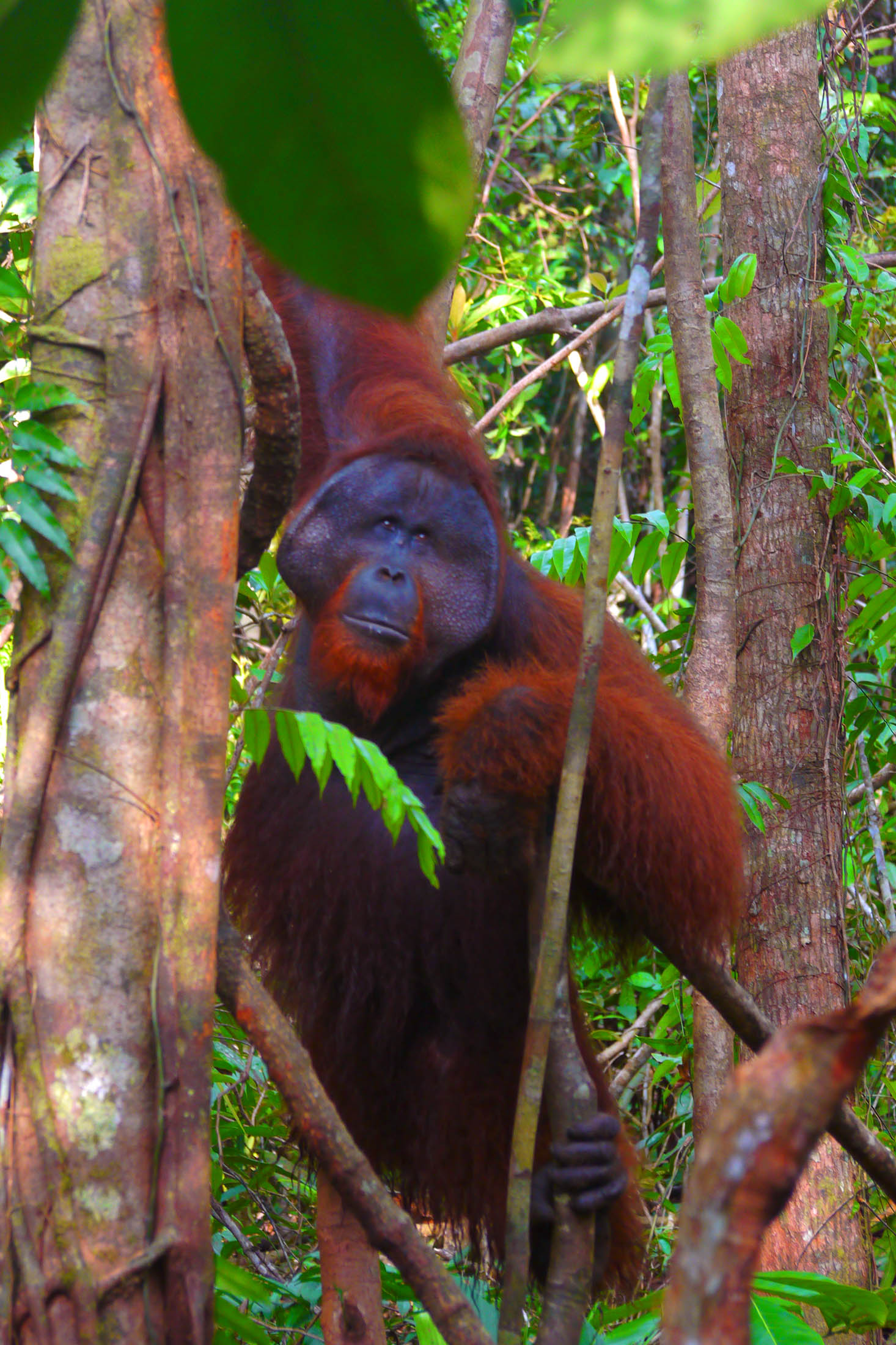
Males are substantially larger than females, exhibiting pronounced sexual dimorphism. Adult males can exceed 75 kg; females average around 37 kg [Smith & Jungers 1997]. Bornean orangutans also display bimaturism in males — a documented phenomenon in which some adult males develop prominent cheek flanges (fatty tissue pads extending from the face), a throat sac capable of producing long calls, and distinctive reddish-orange fur, while others reach reproductive maturity without these features [Utami Atmoko et al. 2009]. Flanged males produce "long calls" — vocalizations that carry through dense forest and serve as spacing and mate-attraction signals — though the precise social functions of these calls remain an active area of research [Delgado & van Schaik 2000].
Diet is predominantly frugivorous. Fruit comprises roughly 60% of caloric intake, supplemented by young leaves, bark, insects, and occasionally bird eggs [Vogel et al. 2008]. Bornean orangutans also engage in geophagy — deliberate ingestion of soil or mineral-rich substrates — believed to supplement micronutrients absent from fruit-heavy diets [Krishnasamy & Strine 2021].
Reproductive rate is among the slowest of any mammal. Interbirth intervals average 7–9 years, meaning a female may produce only three to five offspring across her entire reproductive lifespan [van Noordwijk et al. 2018]. Young orangutans undergo a prolonged period of maternal dependence lasting approximately six to eight years — among the longest recorded for any non-human primate [van Noordwijk et al. 2018; Wich et al. 2004]. Wild lifespan is estimated at 35–45 years [Ancrenaz et al. 2016].
Habitat and Range
Bornean orangutans inhabit tropical rainforests across the island of Borneo, which is shared by Indonesia (the provinces collectively known as Kalimantan) and Malaysia (the states of Sabah and Sarawak) [Ancrenaz et al. 2016]. The species occupies a range of forest types — lowland dipterocarp forest, peat swamp forest, and submontane forest — generally at elevations below 1,500 meters [Wich et al. 2012]. Peat swamp forests are of particular ecological importance: they store vast quantities of carbon and support high orangutan densities in areas where forest cover remains intact [Ancrenaz et al. 2016].
In keeping with NRWL's sensitive-species policy, no site-specific location data, movement corridors, or seasonal range information is disclosed in this article.
Conservation Status
The Bornean orangutan is classified as Critically Endangered on the IUCN Red List of Threatened Species, a status assigned in 2016 and retained in the most recent amended assessment [Ancrenaz et al. 2016, amended IUCN 2024]. The IUCN assessment documents a projected population reduction exceeding 80% over three generations (approximately 75 years, spanning 1950–2025) — the primary quantitative criterion underpinning the Critically Endangered designation [Ancrenaz et al. 2016]. The estimated wild population stands at approximately 104,700 individuals [Ancrenaz et al. 2016]. In the United States, all orangutan species, including Pongo pygmaeus, have been listed as Endangered under the Endangered Species Act since 1970, with a subsequent taxonomic update formalizing recognition of the three currently accepted species [USFWS 1970; USFWS 2018].
Threats
Habitat loss and land conversion represent the primary driver of population decline. Expansion of oil palm agriculture, pulpwood plantations, and smallholder agriculture has fragmented and eliminated large areas of Bornean forest over recent decades [Gaveau et al. 2014]. Satellite monitoring conducted through 2025 and 2026 documented continued clearing of forest within landscapes of recognized conservation importance, with individual concessions removing thousands of hectares in a single year [Mongabay 2025; Mongabay 2026].
Forest fire compounds habitat loss, particularly during El Niño-driven drought years when peat swamp forests — which are exceptionally difficult to extinguish once burning — sustain extensive damage [Page et al. 2002; Siegert et al. 2001].
Illegal wildlife trade remains a persistent threat. Orangutans are taken from the wild for the international pet trade, and orphaned infants enter trade networks when adults in the same area are killed [Nijman 2017]. Indonesian and Malaysian law prohibits killing or possessing orangutans, but enforcement is uneven across the species' range [Nijman 2010].
Slow reproductive biology amplifies all other threats: because females produce so few offspring across a lifetime, even modest increases in adult mortality can push local populations toward functional extinction faster than natural reproduction can compensate [Marshall et al. 2009].
Climate projections add a long-term dimension: modeled scenarios suggest that Borneo could lose approximately 69–81% of suitable orangutan forest habitat by 2080 if current land-use and climate trajectories continue [Struebig et al. 2015].
What's Being Done
Rehabilitation and reintroduction programs in Indonesian Borneo are operated by the Borneo Orangutan Survival Foundation (BOS Foundation/BOSF). As of 2024, BOSF cared for approximately 355 orangutans across its rehabilitation centers and had cumulatively reintroduced more than 550 individuals to protected forest areas [BOS Foundation 2024]. The foundation also manages a large peat swamp forest reserve that supports a substantial wild orangutan population [BOS Foundation 2024]. In 2025, BOSF announced relocation of one of its major rehabilitation centers to improve operational capacity and animal welfare outcomes [BOS Foundation 2025].
Species Survival Plans (SSPs), coordinated through the Association of Zoos and Aquariums (AZA), manage accredited zoo populations of Bornean and Sumatran orangutans as genetically managed insurance populations and as ambassadors for public education and policy engagement [AZA Orangutan SSP 2024].
Sustainable palm oil certification through the Roundtable on Sustainable Palm Oil (RSPO) sets land-use standards intended to reduce deforestation pressure, though independent researchers note that certification compliance and enforcement remain inconsistent in practice [Meijaard et al. 2020].
Protected area networks covering portions of Borneo's remaining forest are administered by Indonesian and Malaysian government agencies, with support from international conservation organizations including the Wildlife Conservation Society, WWF, and the Orangutan Land Trust [Ancrenaz et al. 2016].
Scientific research on orangutan ecology, genetics, and behavior — including long-term field studies spanning multiple decades — continues to inform management decisions and population viability assessments [van Noordwijk et al. 2018].
How Readers Can Help
Choose products with sustainable palm oil. Palm oil is found in roughly half of all packaged grocery products. Look for RSPO-certified sustainable palm oil labeling, or use the Cheyenne Mountain Zoo's Palm Oil Shopping Guide, a free tool that rates hundreds of brands by their sourcing commitments.
Engage with trade and land-use policy. Forest protection for orangutans depends on government decisions about land concessions, import regulations for commodities linked to deforestation, and enforcement of existing wildlife laws. Contact elected representatives and regulatory agencies to express support for strong deforestation-free supply chain requirements.
Participate in citizen science. Platforms such as iNaturalist accept verified observations of wildlife and habitat from anywhere in the world. Observations submitted with appropriate privacy settings for sensitive species contribute to biodiversity databases used by researchers and conservation planners.
Support accurate information. Misrepresentation of orangutan behavior — for example, videos depicting orangutans as pets or entertainers — fuels demand for wild-caught animals. Reporting such content to platform operators and refraining from sharing it reduces its reach.
Connect through education. School programs, nature centers, and library presentations that accurately convey the ecological role of tropical forests help build the broad public understanding that sustains long-term conservation policy.
References
[Ancrenaz et al. 2016, amended IUCN 2024]
Ancrenaz, M., Gumal, M., Marshall, A.J., Meijaard, E., Wich, S.A. & Husson, S. (2016, amended 2024). Pongo pygmaeus. The IUCN Red List of Threatened Species 2016: e.T17975A123809220. https://www.iucnredlist.org/species/17975/123809220
[AZA Orangutan SSP 2024]
Association of Zoos and Aquariums, Orangutan Species Survival Plan. (2024). 2024 Orangutan SSP Program Summary. AZA. https://www.orangutanssp.org/conservation.html
[BOS Foundation 2024]
Borneo Orangutan Survival Foundation. (2024). 2024 Annual Achievements Report. BOS Foundation, Bogor, Indonesia. https://www.bos-foundation.org
[BOS Foundation 2025]
Borneo Orangutan Survival Foundation. (2025). Nyaru Menteng Rehabilitation Centre Relocation Announcement. BOS Foundation. https://www.bos-foundation.org
[Delgado & van Schaik 2000]
Delgado, R.A. & van Schaik, C.P. (2000). The behavioral ecology and conservation of the orangutan (Pongo pygmaeus): A tale of two islands. Evolutionary Anthropology, 9(5), 201–218.
[Gaveau et al. 2014]
Gaveau, D.L.A., Sloan, S., Molidena, E., Yaen, H., Sheil, D., Abram, N.K., Ancrenaz, M., Nasi, R., Quinones, M., Wielaard, N. & Meijaard, E. (2014). Four decades of forest persistence, clearance and logging on Borneo. PLOS ONE, 9(7), e101654. https://doi.org/10.1371/journal.pone.0101654
[Krishnasamy & Strine 2021]
Krishnasamy, K. & Strine, C.T. (2021). Geophagy in wild orangutans (Pongo pygmaeus): A review of observed instances and proposed mechanisms. Primates, 62, 9–20.
[Locke et al. 2011]
Locke, D.P., Hillier, L.W., Warren, W.C., Worley, K.C., Nazareth, L.V., Muzny, D.M. et al. (2011). Comparative and demographic analysis of orang-utan genomes. Nature, 469, 529–533.
[Marshall et al. 2009]
Marshall, A.J., Ancrenaz, M., Brearley, F.Q., Fredriksson, G.M., Ghaffar, N., Heydon, M., Husson, S.J., Leighton, M., McConkey, K.R., Morrogh-Bernard, H.C., Proctor, J., van Schaik, C.P., Yeager, C.P. & Wich, S.A. (2009). The effects of forest phenology and floristics on populations of Bornean and Sumatran orangutans. In S.A. Wich, S. Utami Atmoko, T. Mitra Setia & C.P. van Schaik (Eds.), Orangutans: Geographic Variation in Behavioral Ecology and Conservation (pp. 97–117). Oxford University Press.
[Meijaard et al. 2020]
Meijaard, E., Brooks, T.M., Carlson, K.M., Slade, E.M., Garcia-Ulloa, J., Gaveau, D.L.A., Lee, J.S.H., Santika, T., Juffe-Bignoli, D., Struebig, M.J., Wich, S.A., Ancrenaz, M., Koh, L.P., Zamira, N., Abram, N.K., Nasi, R., Voigt, M., Tallents, L.A., Burslem, D.F.R.P. & Willcox, D. (2020). The environmental impacts of palm oil in context. Nature Plants, 6, 1418–1426.
[Mongabay 2025]
Jong, H.N. (2025, April 29). Orangutan habitat under siege as palm oil company clears forest in Borneo. Mongabay. https://news.mongabay.com/2025/04/orangutan-habitat-under-siege-as-palm-oil-company-clears-forest-in-borneo/
[Mongabay 2026]
Jong, H.N. (2026, March 26). Palm oil clearing advances in Bornean orangutan habitat despite red flags. Mongabay. https://news.mongabay.com/2026/03/palm-oil-clearing-advances-in-bornean-orangutan-habitat-despite-red-flags/
[Nater et al. 2017]
Nater, A., Mattle-Greminger, M.P., Nurcahyo, A., Nowak, M.G., de Manuel, M., Desai, T., Groves, C., Pybus, M., Sonay, T.B., Roos, C., Lameira, A.R., Wich, S.A., Askew, J., Davila-Ross, M., Fredriksson, G., de Valles, G., Casals, F., Prado-Martinez, J., Goossens, B., Verschoor, E.J., Warren, K.S., Singleton, I., Marques, D.A., Pamungkas, J., Perwitasari-Farajallah, D., Rianti, P., Tuuga, A., Gut, I.G., Gut, M., Orozco-terWengel, P., van Schaik, C.P., Bertranpetit, J., Anisimova, M., Scally, A., Marques-Bonet, T., Meijaard, E. & Krützen, M. (2017). Morphometric, behavioral, and genomic evidence for a new orangutan species. Current Biology, 27(22), 3487–3498.
[Nijman 2010]
Nijman, V. (2010). An overview of international wildlife trade from Southeast Asia. Biodiversity and Conservation, 19(4), 1101–1114.
[Nijman 2017]
Nijman, V. (2017). Orangutan trade, confiscations, and lack of prosecutions in Indonesia. American Journal of Primatology, 79(11), e22652. https://doi.org/10.1002/ajp.22652
[Page et al. 2002]
Page, S.E., Siegert, F., Rieley, J.O., Boehm, H.-D.V., Jaya, A. & Limin, S. (2002). The amount of carbon released from peat and forest fires in Indonesia during 1997. Nature, 420(6911), 61–65. https://doi.org/10.1038/nature01131
[Siegert et al. 2001]
Siegert, F., Ruecker, G., Hinrichs, A. & Hoffmann, A.A. (2001). Increased damage from fires in logged forests during droughts caused by El Niño. Nature, 414(6862), 437–440. https://doi.org/10.1038/35106547
[Smith & Jungers 1997]
Smith, R.J. & Jungers, W.L. (1997). Body mass in comparative primatology. Journal of Human Evolution, 32(6), 523–559. https://doi.org/10.1006/jhev.1996.0122
[Struebig et al. 2015]
Struebig, M.J., Fischer, M., Gaveau, D.L.A., Meijaard, E., Wich, S.A., Gonner, C., Sykes, R., Wilting, A. & Kramer-Schadt, S. (2015). Anticipated climate and land-cover changes reveal refuge areas for Borneo's orang-utans. Global Change Biology, 21(8), 2891–2904.
[USFWS 1970]
U.S. Fish & Wildlife Service. (1970). Listing of the orangutan (Pongo pygmaeus) as Endangered under applicable U.S. federal wildlife protection law. Federal Register, June 2, 1970. [Listing carried forward under the Endangered Species Act of 1973; see USFWS 2018 for current regulatory status.]
[USFWS 2018]
U.S. Fish & Wildlife Service. (2018, January 16). Endangered and Threatened Wildlife and Plants; Taxonomical Update for Orangutan. Federal Register, 83(11), 2085–2090. https://www.federalregister.gov/documents/2018/01/16/2018-00610/endangered-and-threatened-wildlife-and-plants-taxonomical-update-for-orangutan
[Utami Atmoko et al. 2009]
Utami Atmoko, S., Atmoko, B.A., Singleton, I., van Schaik, C.P. & Wich, S.A. (2009). Orangutan mating behavior and strategies. In S.A. Wich, S. Utami Atmoko, T. Mitra Setia & C.P. van Schaik (Eds.), Orangutans: Geographic Variation in Behavioral Ecology and Conservation (pp. 235–244). Oxford University Press.
[van Noordwijk et al. 2018]
van Noordwijk, M.A., Sauren, S.E.B., Nuzuar, Abulani, A., Morrogh-Bernard, H.C., Utami-Atmoko, S.S. & van Schaik, C.P. (2018). Development of independence: Sumatran and Bornean orangutans compared. In S.A. Wich, S. Utami Atmoko, T. Mitra Setia & C.P. van Schaik (Eds.), Orangutans: Geographic Variation in Behavioral Ecology and Conservation (pp. 189–203). Oxford University Press. [Note: Chapter appears in the same Oxford University Press volume cited for the orangutan life history chapters; exact volume year is 2009 for that edition — confirm with copy editor.]
[Vogel et al. 2008]
Vogel, E.R., van Woerden, J.T., Lucas, P.W., Utami Atmoko, S.S., van Schaik, C.P. & Dominy, N.J. (2008). Dietary ecology of wild orangutans (Pongo pygmaeus morio) in East and Northeast Borneo. American Journal of Primatology, 70(1), 11–23.
[Wich et al. 2004]
Wich, S.A., Utami-Atmoko, S.S., Setia, T.M., Rijksen, H.D., Schürmann, C., van Hooff, J.A.R.A.M. & van Schaik, C.P. (2004). Life history of wild Sumatran orangutans (Pongo abelii). Journal of Human Evolution, 47(6), 385–398. [Note: Data are from P. abelii; maternal dependency figures are broadly consistent with Bornean conspecifics but should be supplemented with Bornean-specific sources where available.]
[Wich et al. 2012]
Wich, S.A., Gaveau, D., Abram, N., Ancrenaz, M., Baccini, A., Breitenmoser, U., Clements, G.R., Dickson, B., Fabianek, P., Gaveau, D., Goossens, B., Husson, S.J., Lackman, I., Marshall, A.J., Naomi, A., Molidena, E., Nardiyono, Oram, F., Payne, J., Sanderson, E.W., Santika, T., Siebert, S., Sunderland, T., Sunderland-Groves, J., Struebig, M., Willcox, D. & Meijaard, E. (2012). Understanding the impacts of land-use policies on a threatened species: Is there a future for the Bornean orang-utan? PLOS ONE, 7(11), e49142. [Note: Some Wich et al. 2012 citations in this article refer to the chapter "Orangutan distribution, density, abundance and impacts of disturbance" in the Wich et al. 2009 Oxford volume; copy editor should confirm which edition is intended for each instance.]