
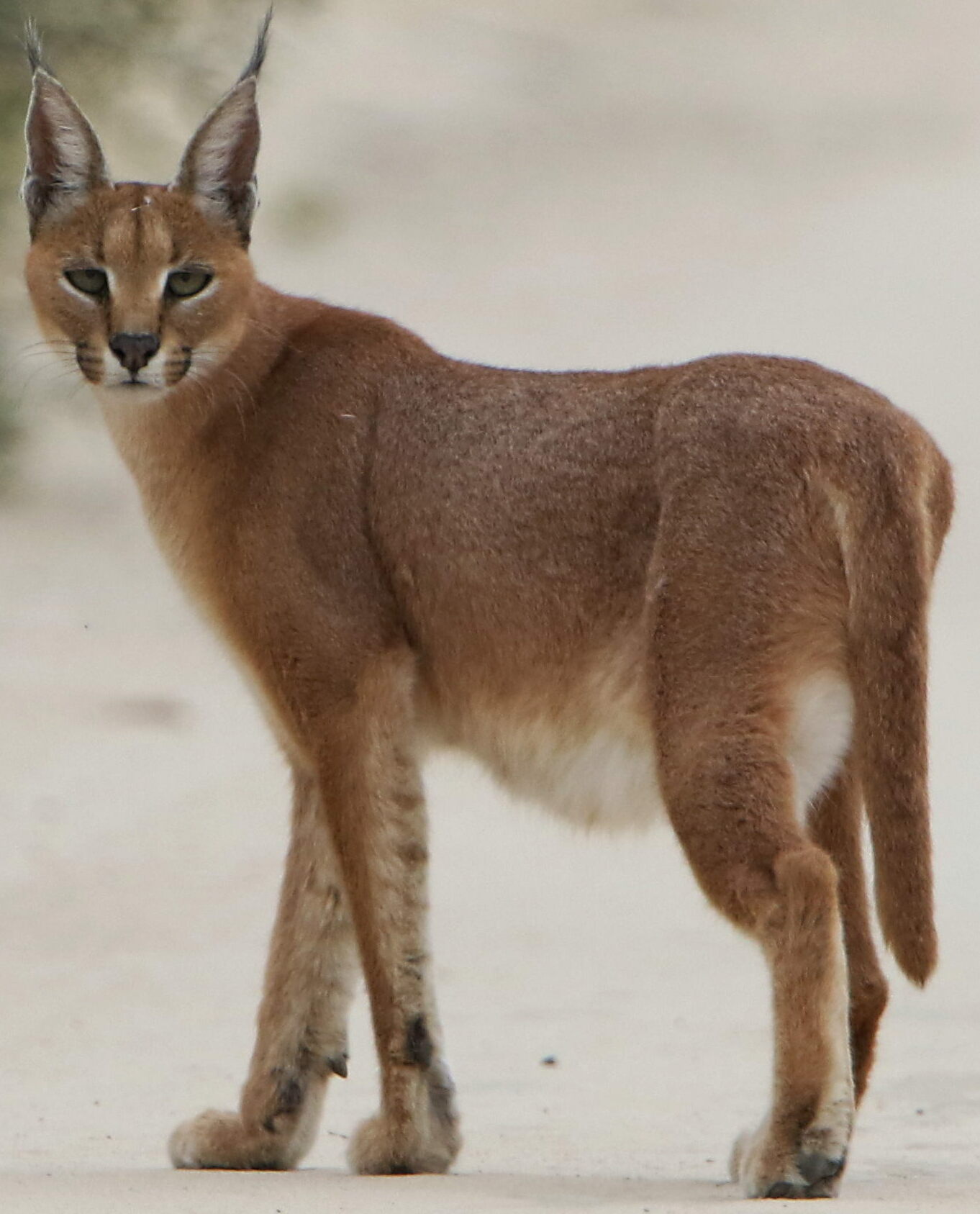
The caracal is a medium-sized, tawny cat of the deserts, savannahs, and scrublands of Africa and Asia, instantly recognizable by the long black tufts crowning its tapered ears. Renowned for explosive vertical leaps that let it pluck birds from the air, it is one of the most widely distributed wild cats on two continents — yet its fortunes diverge sharply by region, remaining common across much of sub-Saharan Africa while declining steeply at the eastern and northern range margins in India, Central Asia, and North Africa [Avgan et al. 2016; Khandal et al. 2020]. This profile examines the caracal's biology, its adaptability to human-dominated landscapes, and the pressures shaping its future.
Biology and Identification
The caracal is a slender, long-legged felid with a short tail and a coat ranging from pale tawny to brick-red, with white underparts and dark facial markings. Body mass typically falls between 6 and 18 kg, head-body length spans roughly 80–100 cm, and the tail adds another 20–34 cm; males are consistently larger than females [Avgan et al. 2016]. Its defining feature is the pair of triangular ears tipped with 4–5 cm tufts of black hair, thought to aid communication.
The caracal is best known for its leaping ability — it can spring two meters or more straight upward to knock flying birds out of the air [Avgan et al. 2016]. Its diet centers on small to medium prey under about 5 kg — hares, rodents, hyraxes, and birds — though it occasionally takes prey as large as young antelope, dietary breadth that lets it persist across many habitats. Home ranges vary enormously with prey density, from around 316 km² for males in arid Namibia to 31–65 km² in more productive South African landscapes [Avgan et al. 2016]. The species is largely solitary and predominantly nocturnal, making it notoriously difficult to study.
Habitat and Range
The caracal occupies semi-deserts, steppes, savannahs, scrubland, dry forests, and woodlands across more than 50 range countries, avoiding only true deserts and tropical rainforest [Avgan et al. 2016]. Its distribution spans most of Africa, the Arabian Peninsula, the Middle East, Central Asia, and into northwestern India — making it one of the most geographically widespread of all wild cats.
Regional status varies dramatically. Populations remain robust across central and southern Africa, where caracals persist in agricultural and peri-urban mosaics. At the range margins the picture differs sharply: in India, historical records once spanned 13 states, but reliable reports since 2001 are confined to just three — mainly Rajasthan and Gujarat — a contraction of the documented extent of occurrence by more than 95% over two decades [Khandal et al. 2020]. The species is similarly at risk across North Africa and parts of Central and Southwest Asia.
In accordance with NRWL sensitive-species policy, specific site locations, corridor routes, and seasonal movement details are not disclosed in this article.
Conservation Status
The caracal is listed as Least Concern on the IUCN Red List, a global assessment reflecting its wide distribution and relative stability across much of Africa, where localized declines are not yet thought to affect the species as a whole [Avgan et al. 2016]. That classification, however, masks severe regional contractions: Asian and North African populations are declining sharply [Khandal et al. 2020].
International trade is regulated under CITES. Asian populations of the caracal are listed on CITES Appendix I, prohibiting commercial international trade, while all other populations are listed on Appendix II, allowing regulated trade [Avgan et al. 2016].
Because the caracal is cryptic and nocturnal, population estimates are scarce. Camera-trap surveys in Ranthambore Tiger Reserve, India, estimated roughly 28 individuals at a density of about 4.8 caracals per 100 km² [Singh et al. 2015], while the isolated urban-edge population on South Africa's Cape Peninsula numbers only an estimated 48–64 individuals [Leighton et al. 2023].
Threats
Habitat loss and fragmentation drive the steepest declines, particularly at the range margins. In India, agricultural expansion and land-use change have reduced the species to a few isolated strongholds, with the documented extent of occurrence collapsing to roughly 16,700 km² by 2020 [Khandal et al. 2020].
Human–wildlife conflict is the dominant pressure across the African range. Where larger predators have been removed, caracals become significant predators of sheep, goats, and poultry, prompting widespread retaliatory killing through traps, poisons, and shooting [McManus et al. 2015].
Anthropogenic toxicants pose an insidious threat in urbanizing landscapes. In Cape Town, 92% of tested caracals carried anticoagulant rodenticides, with proximity to vineyards — where commercial hospitality structures deploy rat poisons — the leading exposure risk factor [Serieys et al. 2019]. Urban caracals also face elevated road mortality and shifts in diet toward lower-trophic-level prey such as guinea fowl and Egyptian geese, a "trophic downgrading" linked to human food subsidies [Leighton et al. 2023].
Illegal capture for the exotic-pet trade affects the species internationally. Caracals appear prominently among CITES-listed cats marketed as status-symbol pets, including across Middle Eastern social-media platforms, fueling demand that drives illegal capture and trafficking [Spee et al. 2019].
What Is Being Done
Urban ecology research. The Urban Caracal Project, launched in 2014 through the University of Cape Town's Institute for Communities and Wildlife in Africa and associated with the Cape Leopard Trust, uses GPS collaring, genetic analysis, and necropsies to understand how caracals persist on the edge of a growing city. Its findings on rodenticide exposure and dietary shifts have made the Cape Peninsula population one of the best-documented wild-cat populations on Earth [Serieys et al. 2019; Leighton et al. 2023]. Researchers have also reconstructed individual foraging histories from sequentially sampled whiskers, revealing how urbanization reshapes diet over time [Leighton et al. 2025].
India recovery planning. India has identified the caracal as a national conservation priority, with Rajasthan's Thar desert and the Greater Ranthambore landscape designated as core recovery zones. Historical-occurrence mapping has established the baseline needed to focus protection on the species' last viable Indian strongholds [Khandal et al. 2020], while habitat-suitability modeling helps prioritize conservation areas across the subcontinent [Bhattacharya et al. 2022].
Non-lethal conflict mitigation. On South African livestock farms, trials of guardian animals and protective collars have reduced depredation costs substantially compared with lethal control, demonstrating a practical, economically favorable path to coexistence [McManus et al. 2015].
How Readers Can Help
Citizen science. Photograph and log wildlife observations through platforms such as iNaturalist. Verified records for a cryptic species like the caracal contribute directly to range-mapping efforts and conservation assessments.
Reject the exotic-pet trade. Never purchase wild cats as pets and avoid amplifying social-media content that glamorizes keeping caracals, servals, or other wild felids, which fuels documented demand and illegal capture [Spee et al. 2019].
Support coexistence. Promote non-lethal livestock-protection measures — guardian animals, protective collars, and improved husbandry — which reduce predator conflict more cost-effectively than lethal control [McManus et al. 2015].
Reduce rodenticide use. Anticoagulant rat poisons move up the food chain into predators. Choosing non-toxic rodent control reduces a major, often invisible threat to urban-edge caracals [Serieys et al. 2019].
Education outreach. Share accurate, science-based information about the ecological role of small and mid-sized predators, helping shift the perceptions that drive retaliatory killing.
References
[Avgan et al. 2016] Avgan, B., Henschel, P. & Ghoddousi, A. (2016). Caracal caracal. The IUCN Red List of Threatened Species 2016: e.T3847A102424310. https://dx.doi.org/10.2305/IUCN.UK.2016-2.RLTS.T3847A50650230.en
[Bhattacharya et al. 2022] Bhattacharya, A., Chatterjee, N., Rana, M., Naha, D., Kaur, M. & Goyal, S.P. (2022). Hunting of hunted: an ensemble modeling approach to evaluate suitable habitats for caracals in India. Ecological Processes, 11, 50. https://doi.org/10.1186/s13717-022-00396-8
[Khandal et al. 2020] Khandal, D., Dhar, I. & Reddy, G.V. (2020). Historical and current extent of occurrence of the Caracal Caracal caracal (Schreber, 1776) (Mammalia: Carnivora: Felidae) in India. Journal of Threatened Taxa, 12(16), 17173–17193. https://doi.org/10.11609/jott.6477.12.16.17173-17193
[Leighton et al. 2023] Leighton, G.R.M., Froneman, W., Serieys, L.E.K. & Bishop, J.M. (2023). Trophic downgrading of an adaptable carnivore in an urbanising landscape. Scientific Reports, 13, 21582. https://doi.org/10.1038/s41598-023-48868-x
[Leighton et al. 2025] Leighton, G.R.M., Brooke, A.R., Froneman, P.W., Serieys, L.E.K. & Bishop, J.M. (2025). The Cat's Whiskers: Stable Isotopes Reveal Individual Specialisation of Adaptable Caracals (Caracal caracal) Foraging in an Urbanising Landscape. Ecology and Evolution, 15(3), e71154. https://doi.org/10.1002/ece3.71154
[McManus et al. 2015] McManus, J.S., Dickman, A.J., Gaynor, D., Smuts, B.H. & Macdonald, D.W. (2015). Dead or alive? Comparing costs and benefits of lethal and non-lethal human–wildlife conflict mitigation on livestock farms. Oryx, 49(4), 687–695. https://doi.org/10.1017/S0030605313001610
[Serieys et al. 2019] Serieys, L.E.K., Bishop, J., Okes, N., Broadfield, J., Winterton, D.J., Poppenga, R.H., Sanchez-Vicente, S. & Riley, S.P.D. (2019). Widespread anticoagulant poison exposure in predators in a rapidly growing South African city. Science of the Total Environment, 666, 581–590. https://doi.org/10.1016/j.scitotenv.2019.02.122
[Singh et al. 2015] Singh, R., Qureshi, Q., Sankar, K., Krausman, P.R. & Goyal, S.P. (2015). Estimating occupancy and abundance of caracal in a semi-arid habitat, Western India. European Journal of Wildlife Research, 61, 915–918. https://doi.org/10.1007/s10344-015-0956-y
[Spee et al. 2019] Spee, L.B., Hazel, S.J., Dal Grande, E., Boardman, W.S.J. & Chaber, A.-L. (2019). Endangered Exotic Pets on Social Media in the Middle East: Presence and Impact. Animals, 9(8), 480. https://doi.org/10.3390/ani9080480