
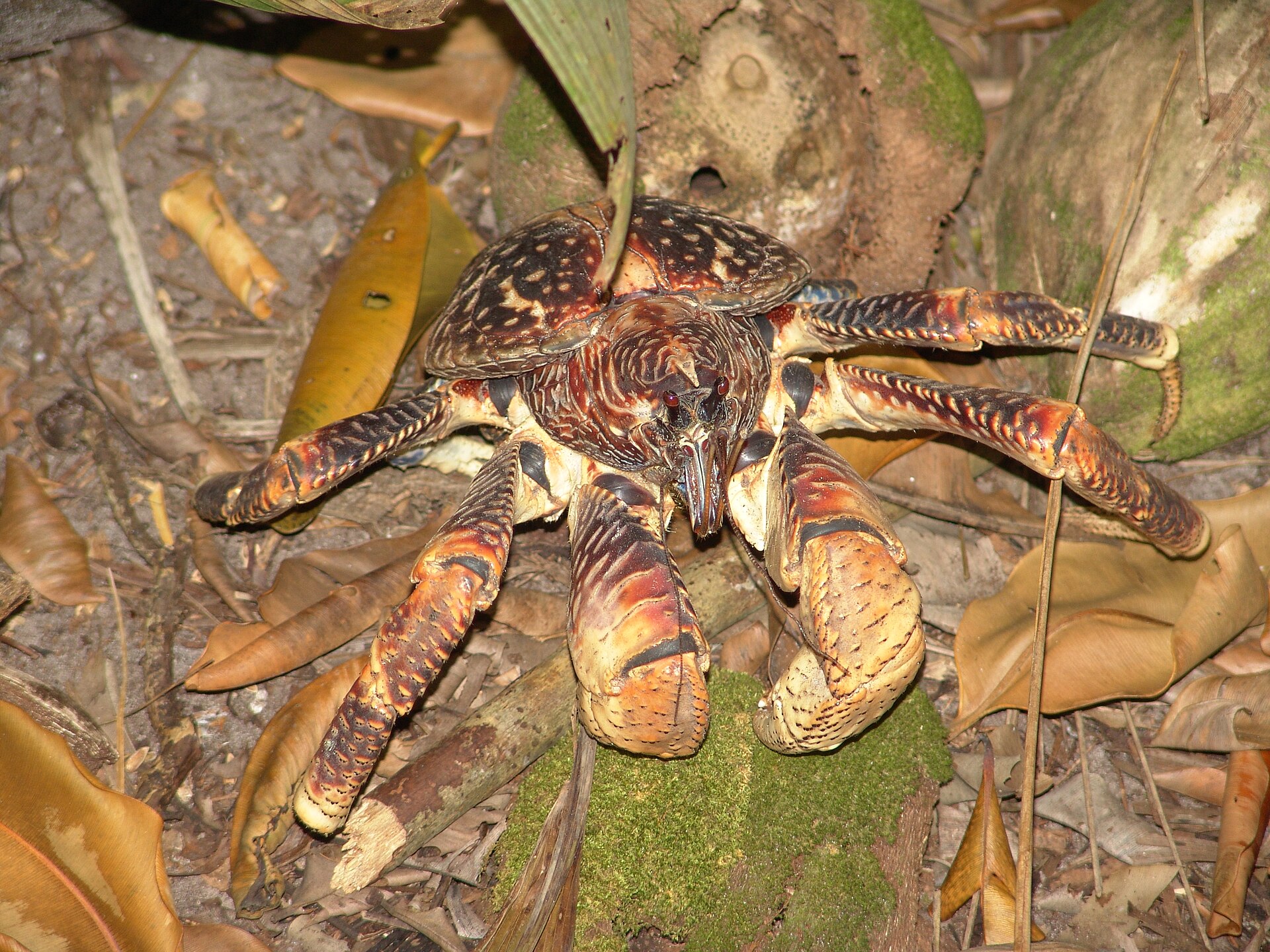
The coconut crab is the largest terrestrial arthropod on Earth and one of the most extraordinary invertebrates in the tropical Indo-Pacific, a creature that has abandoned the sea so completely that it will drown if held underwater as an adult. As a long-lived, slow-maturing island specialist, it plays an outsized ecological role in seed dispersal, scavenging, and nutrient cycling on remote atolls and coastlines [Drew & Stensmyr 2010]. Yet these same traits — late maturity, dependence on a single oceanic larval window, and the loss of a protective shell as adults — make it acutely vulnerable to human pressure. In 2018 the IUCN moved the species from Data Deficient to Vulnerable after a comprehensive global reassessment documented widespread, island-by-island declines [Cumberlidge et al. 2022]. Its story is a rare conservation case study of a giant invertebrate whose fate is tied to the health of small, fragile island ecosystems.
Biology and Identification
Birgus latro is the sole species in its genus and a member of the hermit crab family Coenobitidae, distinguished as both the largest living terrestrial arthropod and the largest terrestrial invertebrate. Adults can reach a body weight of up to roughly 4 kg and a leg span exceeding 0.9 m from leg tip to leg tip [Drew & Stensmyr 2010]. Although it begins life as a shell-carrying juvenile like other hermit crabs, at a thoracic length of around 10 mm the abdomen and thorax harden into a tough, calcified exoskeleton, and the animal discards the borrowed gastropod shell permanently — a developmental transition unique among coenobitids [Drew & Stensmyr 2010].
The species is best known for its powerful, asymmetrical claws (chelae). The larger pinching claw generates exceptional force, with measurements in large adults documenting some of the highest pinch forces recorded for any animal of comparable size. These claws allow the crab to husk and crack coconuts and to climb trees, behaviors that gave rise to its common names "coconut crab" and "robber crab" [Drew & Stensmyr 2010].
Coconut crabs respire using a modified structure called a branchiostegal lung, an air-breathing organ lined with tissue resembling gill filaments. As obligate air-breathers, adults cannot survive prolonged submersion in water [Drew & Stensmyr 2010]. They also possess a highly developed sense of smell. Research on the brain architecture of B. latro has shown a prominent central olfactory pathway and antennal sensory structures convergent with those of insects, an adaptation to detecting food odors carried through air rather than water [Krieger et al. 2010].
Reproduction remains tied to the sea despite the species' terrestrial life. Females carry fertilized eggs on the abdomen and release larvae into the ocean, where they spend several weeks in a planktonic phase before settling and beginning the transition to land [Drew & Stensmyr 2010]. The crabs are extremely long-lived and slow to mature, taking roughly five years to reach maturity and potentially living for many decades — life-history traits that make populations slow to recover from losses [Cumberlidge et al. 2022].
Habitat and Range
The coconut crab is widely distributed across islands and atolls of the Indian and Pacific Oceans, ranging as far west as Zanzibar and the western Indian Ocean and as far east as the Gambier Islands in the central Pacific [Cumberlidge et al. 2022]. It is fundamentally an island species, generally absent from large continental landmasses and most abundant on small islands lacking heavy human disturbance or introduced predators.
Adults occupy coastal forests, vegetated terraces, and rocky shorelines, sheltering by day in burrows, rock crevices, and cavities among tree roots, and emerging to forage at night [Drew & Stensmyr 2010]. Their diet is broad and opportunistic, dominated by fallen fruits, nuts, seeds, and plant pith but also including carrion and the molted exoskeletons of other crabs. Through this feeding the species contributes to seed dispersal and nutrient turnover in island ecosystems [Cumberlidge et al. 2022].
Because the crabs depend on intact coastal forest near the shore and on undisturbed beaches for larval release, their distribution is patchy and increasingly fragmented. Healthy populations today are concentrated on remote or protected islands, while populations near human settlements have contracted or disappeared [Caro et al. 2021].
Conservation Status
The Coconut Crab is listed as Vulnerable on the IUCN Red List, assessed under criteria A2cd+4cd in the 2018 global assessment, which uplisted the species from its previous Data Deficient classification [IUCN 2020; Cumberlidge et al. 2022]. The species is not listed on the CITES Appendices. The global population trend is assessed as decreasing. While the species remains widespread and locally abundant in some protected localities, the assessment concluded that documented declines across much of the range, combined with the absence of management in most jurisdictions, met the threshold for a Vulnerable listing [Cumberlidge et al. 2022]. Localized case studies illustrate the pattern: surveys on Zanzibar found the species severely depleted and confined to a small remnant area, consistent with extirpations reported on other accessible islands [Caro et al. 2021].
Threats
Overexploitation. Coconut crabs are harvested for food and sold as a delicacy across much of their range. Because the species is slow-growing, late-maturing, and easily caught by hand at night, harvest pressure rapidly outpaces the population's ability to replenish itself, leading to local depletion and extirpation near human centers [Cumberlidge et al. 2022; Caro et al. 2021].
Habitat loss and coastal fragmentation. Coastal development, tourism infrastructure, and clearing of shoreline forest reduce and fragment the burrowing and foraging habitat the crabs require, while also limiting access to beaches needed for larval release. Increasing island human populations intensify these pressures [Cumberlidge et al. 2022].
Introduced predators and road mortality. Non-native rats, pigs, and other introduced animals prey on eggs, larvae, and juveniles, suppressing recruitment on affected islands. On inhabited islands, adult crabs moving between forest and shore are frequently killed on roads, an additive source of mortality for a long-lived, slow-reproducing species [Cumberlidge et al. 2022].
Climate change. Projected sea-level rise threatens the low-lying coastal and atoll habitats central to the species' range, while ocean acidification may affect the marine larval stage on which all recruitment depends. These longer-term stressors compound the immediate anthropogenic threats [Cumberlidge et al. 2022].
What Is Being Done
The 2018 IUCN reassessment, synthesized and published by an international team of carcinologists, was itself a major conservation step: it provided the first authoritative global extinction-risk evaluation for the species and a baseline against which future change can be measured [Cumberlidge et al. 2022]. Conservation scientists have argued that this reassessment offers broader lessons for the under-studied field of invertebrate conservation [Caro & Cumberlidge 2022].
In several jurisdictions, national and local regulations restrict harvest through minimum-size limits, seasonal closures protecting egg-bearing females, and outright protection in reserves. Such measures exist in parts of Australia, the Pacific Islands, and elsewhere, though enforcement and coverage are uneven across the range [Cumberlidge et al. 2022].
Protected areas play a central role. Populations persist most strongly on islands within reserves or on remote, uninhabited islands where harvest and introduced predators are limited. Site-based case studies, such as the Zanzibar assessment, have been used to identify candidate areas for local protection and community-based management [Caro et al. 2021].
Researchers continue to study the species' biology, distribution, and population status to inform management. Ongoing work on reproduction, growth rates, and the marine larval phase is essential for designing harvest rules and predator-control programs that match the species' slow life history [Drew & Stensmyr 2010; Cumberlidge et al. 2022].
How Readers Can Help
-
Support citizen science and monitoring. Reporting coconut crab sightings to platforms such as iNaturalist helps researchers track distribution and detect local declines, contributing observational data from islands that are difficult for scientists to survey.
-
Engage with policy and protected areas. Support the establishment and enforcement of marine and coastal protected areas, harvest size limits, and protections for egg-bearing females in countries within the species' range, and back invasive-predator control programs on islands.
-
Make informed consumer choices. Where travel or residence overlaps the species' range, declining to purchase or consume coconut crab reduces demand on a slow-recovering, Vulnerable species. Choosing operators and accommodations that avoid serving it helps shift market pressure.
-
Promote education and awareness. Sharing accurate information about the coconut crab's extreme longevity, slow maturation, and ecological role helps build the public understanding needed to support invertebrate conservation, a field that has historically received far less attention than vertebrate wildlife.
References
[Caro et al. 2021] Caro, T., Hamad, H., Rashid, R.S., Kloiber, U., Morgan, V.M., Nokelainen, O., Caro, B., Pretelli, I., Cumberlidge, N., & Borgerhoff Mulder, M. (2021). A case study of the coconut crab Birgus latro on Zanzibar highlights global threats and conservation solutions. Oryx, 55(4), 556–563. https://doi.org/10.1017/S0030605319000863
[Caro & Cumberlidge 2022] Caro, T., & Cumberlidge, N. (2022). Upgrading Birgus: lessons for invertebrate conservation. Biodiversity and Conservation, 31, 2545–2548. https://doi.org/10.1007/s10531-022-02480-z
[Cumberlidge et al. 2022] Cumberlidge, N., Caro, T., Watson-Zink, V.M., Naruse, T., Ng, P.K.L., Orchard, M., Rahayu, D.L., Wowor, D., Yeo, D.C.J., & White, T. (2022). Troubled giants: the updated conservation status of the coconut crab (Birgus latro). Raffles Bulletin of Zoology, 70, 1–21. https://doi.org/10.26107/RBZ-2022-0001
[Drew & Stensmyr 2010] Drew, M.M., Harzsch, S., Stensmyr, M., Erland, S., & Hansson, B.S. (2010). A review of the biology and ecology of the Robber Crab, Birgus latro (Linnaeus, 1767) (Anomura: Coenobitidae). Zoologischer Anzeiger, 249(1), 45–67. https://doi.org/10.1016/j.jcz.2010.03.001
[IUCN 2020] IUCN (2020). Birgus latro. The IUCN Red List of Threatened Species. Assessed 2018, published 2020. https://www.iucnredlist.org/species/2811/126813586
[Krieger et al. 2010] Krieger, J., Sandeman, R.E., Sandeman, D.C., Hansson, B.S., & Harzsch, S. (2010). Brain architecture of the largest living land arthropod, the Giant Robber Crab Birgus latro (Crustacea, Anomura, Coenobitidae): evidence for a prominent central olfactory pathway? Frontiers in Zoology, 7, 25. https://doi.org/10.1186/1742-9994-7-25