
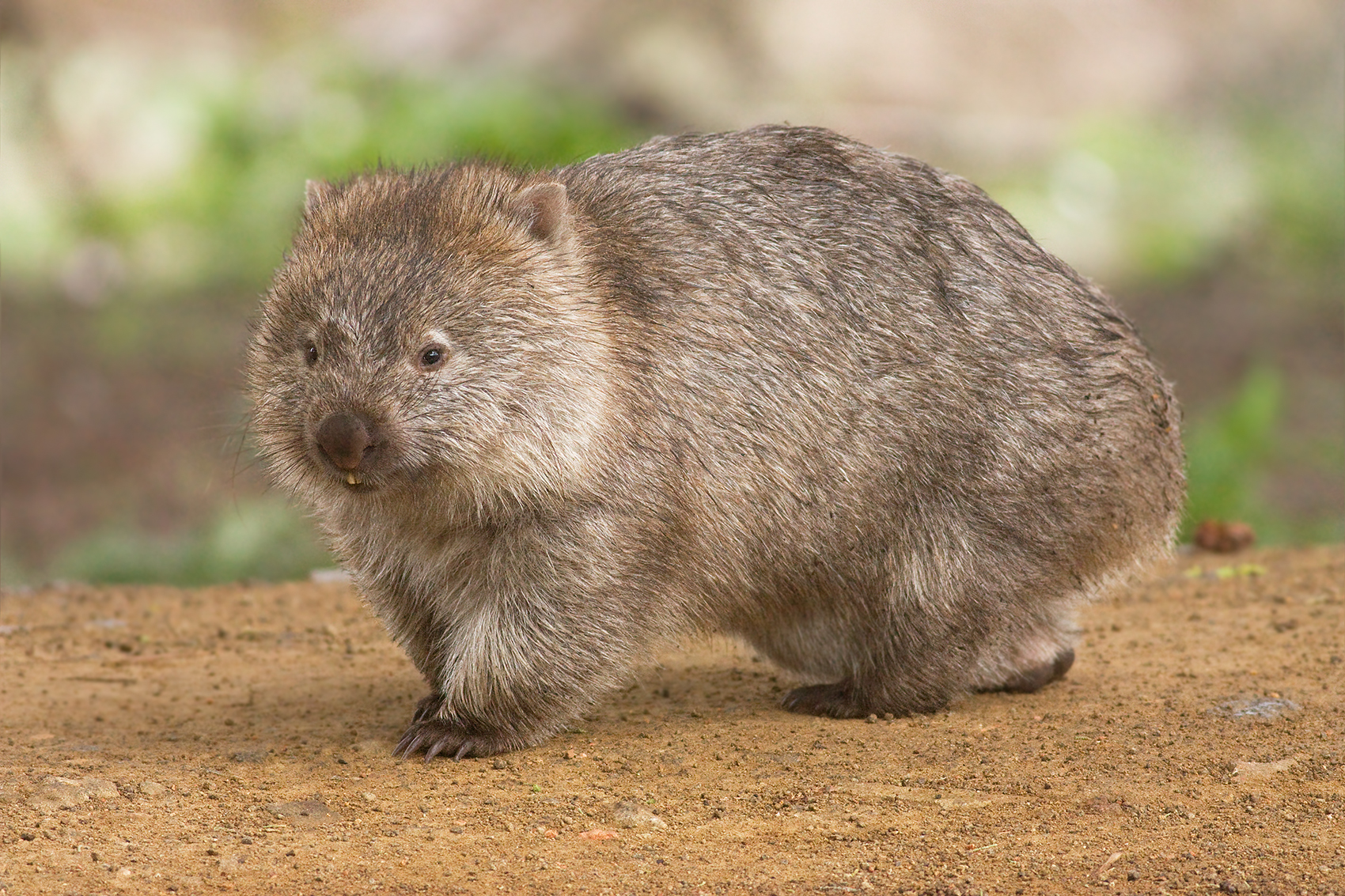
The common wombat — also known as the bare-nosed wombat — is among the largest burrowing herbivorous mammals on Earth, a stocky, muscular marsupial that engineers entire ecosystems through its digging, grazing, and famously cube-shaped droppings [Carver et al. 2024]. Endemic to the cool, temperate forests and grasslands of south-eastern Australia and Tasmania, it remains widespread yet faces a distinctive and worsening disease pressure. This profile examines the wombat's unusual biology, the regional declines hidden beneath a stable national picture, and the science working to keep this iconic fossorial mammal common.
Biology and Identification
The common wombat is a heavily built, short-legged marsupial belonging to the family Vombatidae within the order Diprotodontia [Carver et al. 2024]. Mainland animals are the largest, reaching body lengths near 1.2 m and masses up to roughly 35 kg, while the Tasmanian form averages closer to 85 cm and 20 kg, and the Bass Strait island form is smaller still [Wikipedia 2025]. The species is distinguished from the two hairy-nosed wombats (Lasiorhinus spp.) by its bare, granular nose pad and coarser fur.
As a fossorial herbivore, the wombat subsists on grasses, snow tussocks, sedges, and other low vegetation. It carries one of the lowest metabolic rates recorded for a mammal exceeding 10 kg — a metabolic depression thought to confer advantages in nutrient-poor environments and to complement its energy-conserving, burrow-dwelling lifestyle [Carver et al. 2024]. Wombats are predominantly nocturnal and crepuscular but will emerge during daylight in cooler weather, with emergence timing strongly governed by daily maximum temperature [Simpson et al. 2016].
The species is best known for a trait shared by no other animal: it produces cube-shaped scat. Biomechanical study of the wombat intestine showed that the final portion of the gut has regions of non-uniform stiffness — with localised increases in wall thickness and a several-fold increase in stiffness — and that these stiffer and softer zones, acting on the drying faecal mass during rhythmic contractions, mould the distinctive corners of the cubes before excretion [Yang et al. 2021]. These flat-sided pellets resist rolling away, which appears to support the olfactory communication and scent-marking central to wombat social and reproductive behaviour [Carver et al. 2024].
Habitat and Range
The common wombat is endemic to south-eastern Australia, ranging from south-eastern Queensland through eastern New South Wales and Victoria into south-eastern South Australia, together with Tasmania and certain Bass Strait islands [AFD 2025; Carver et al. 2024]. Three subspecies are recognised: a mainland form, a Tasmanian form, and an island form of the Bass Strait region [Wikipedia 2025]. The species occupies a broad range of temperate habitats, including eucalypt forest, woodland, heath, and montane grassland, and excavates extensive burrow systems whose tunnels may extend many metres with multiple entrances [Carver et al. 2024].
While the species is widespread and locally abundant across much of its core range, its distribution has contracted and fragmented since European settlement, and there is evidence of decline at the periphery — including western Victoria, South Australia, and south-eastern Queensland [Old et al. 2025].
In accordance with NRWL sensitive-species policy, specific burrow locations, warren coordinates, and seasonal movement details are not disclosed in this article.
Conservation Status
The common wombat is assessed as Least Concern on the IUCN Red List, in an assessment published in 2025 (taxon ID 40556; assessment e.T40556A258654868) [Old et al. 2025]. The species qualifies for this category because it is common, has a wide distribution, tolerates a broad range of habitats, and is not considered to be undergoing a population reduction approaching a threatened threshold at the national scale. The common wombat is not listed on any CITES appendix.
This favourable global picture nonetheless conceals serious localised threats. Sarcoptic mange has driven catastrophic declines in some populations, and edge-of-range contraction continues in several states [Old et al. 2025; Martin et al. 2018]. Conservation attention therefore focuses less on national extinction risk than on disease, road mortality, and the resilience of peripheral and island populations.
Threats
Sarcoptic mange is the most prominent threat to wombat health and the focus of sustained research. The disease is caused by the burrowing mite Sarcoptes scabiei, producing hair loss, thickened and cracked skin, secondary infection, and death [Simpson et al. 2016]. Diseased animals show poorer body condition, spend more time scratching and drinking, feed more slowly, and lose substantially more body heat to the environment because their damaged coat provides diminished insulation [Simpson et al. 2016]. Mange also disrupts the bacterial and fungal communities of the skin, compounding the physiological burden [Næsborg-Nielsen et al. 2022]. At the population scale the impact can be severe: a travelling wave of mange through a wombat population in northern Tasmania was associated with a decline of roughly 94% [Martin et al. 2018].
Road mortality is a recurring and locally significant pressure. Citizen-science mapping has been used to identify vehicle-collision hotspots and the environmental factors associated with them [Mayadunnage et al. 2024].
Habitat loss, fragmentation, and persecution have reduced the species' range since European settlement and continue to erode peripheral populations through agricultural conversion and competition with introduced grazers [Old et al. 2025].
What Is Being Done
Disease treatment science. Researchers have tested remote, in-field delivery of acaricidal treatments — such as moxidectin applied through flaps fitted over burrow entrances — to treat mange without capturing animals. A population-scale trial found that while such treatment could temporarily suppress the disease, the logistics of repeated dosing made durable control difficult, and concluded that a combination of longer-acting drugs and improved delivery would be needed for effective management [Martin et al. 2019].
Surveillance and citizen science. The WomSAT platform allows members of the public to record wombat sightings, mange observations, and roadkill, generating spatial and temporal data on disease occurrence and collision risk across the species' range [Mayadunnage et al. 2024]. These datasets support targeted intervention and help track where local populations are most at risk.
Foundational biology. Comprehensive synthesis of wombat physiology, ecology, digging, and communication provides the scientific baseline that underpins management decisions and clarifies why this species is so vulnerable to a skin disease despite its abundance [Carver et al. 2024].
How Readers Can Help
Citizen science. Record wombat sightings, signs of mange, and roadkill through dedicated platforms such as WomSAT, or general tools such as iNaturalist. Verified observations contribute directly to disease surveillance, roadkill-hotspot mapping, and range monitoring [Mayadunnage et al. 2024].
Careful driving. A large share of wombat mortality occurs on roads. Reducing speed at dusk and dawn in known wombat country lowers collision risk for a species whose peak activity overlaps low-light hours [Simpson et al. 2016].
Support evidence-based management. Back wildlife agencies and accredited research programs that develop and deliver scientifically validated mange treatment and monitoring, rather than ad hoc intervention [Martin et al. 2019].
Education outreach. Share accurate, science-based information about wombat biology and the threat posed by sarcoptic mange. Clear public understanding improves the quality of citizen-science records and builds support for habitat protection.
References
[AFD 2025] Australian Faunal Directory. (2025). Vombatus ursinus (Shaw, 1800) — Common Wombat. Australian Biological Resources Study, Department of Climate Change, Energy, the Environment and Water. https://biodiversity.org.au/afd/taxa/Common_Wombat
[Carver et al. 2024] Carver, S., Stannard, G.L. & Martin, A.M. (2024). The Distinctive Biology and Characteristics of the Bare-Nosed Wombat (Vombatus ursinus). Annual Review of Animal Biosciences, 12, 135–160. https://doi.org/10.1146/annurev-animal-021022-042133
[Martin et al. 2018] Martin, A.M., Burridge, C.P., Ingram, J., Fraser, T.A. & Carver, S. (2018). Invasive pathogen drives host population collapse: Effects of a travelling wave of sarcoptic mange on bare-nosed wombats. Journal of Applied Ecology, 55(1), 331–341. https://doi.org/10.1111/1365-2664.12968
[Martin et al. 2019] Martin, A.M., Richards, S.A., Fraser, T.A., Polkinghorne, A., Burridge, C.P. & Carver, S. (2019). Population-scale treatment informs solutions for control of environmentally transmitted wildlife disease. Journal of Applied Ecology, 56(10), 2363–2375. https://doi.org/10.1111/1365-2664.13467
[Mayadunnage et al. 2024] Mayadunnage, S., Stannard, H.J., West, P. & Old, J.M. (2024). Spatial and temporal patterns of sarcoptic mange in wombats using the citizen science tool, WomSAT. Integrative Zoology, 19(3), 387–399. https://doi.org/10.1111/1749-4877.12776
[Næsborg-Nielsen et al. 2022] Næsborg-Nielsen, C., Eisenhofer, R., Fraser, T.A., Wilkinson, V., Burridge, C.P. & Carver, S. (2022). Sarcoptic mange changes bacterial and fungal microbiota of bare-nosed wombats (Vombatus ursinus). Parasites & Vectors, 15, 323. https://doi.org/10.1186/s13071-022-05452-y
[Old et al. 2025] Old, J., Stannard, H., Woinarski, J.C.Z. & Burbidge, A.A. (2025). Vombatus ursinus. The IUCN Red List of Threatened Species 2025: e.T40556A258654868. https://dx.doi.org/10.2305/IUCN.UK.2025-1.RLTS.T40556A258654868.en
[Simpson et al. 2016] Simpson, K., Johnson, C.N. & Carver, S. (2016). Sarcoptes scabiei: The Mange Mite with Mighty Effects on the Common Wombat (Vombatus ursinus). PLOS ONE, 11(3), e0149749. https://doi.org/10.1371/journal.pone.0149749
[Wikipedia 2025] Wikipedia contributors. (2025). Common wombat (Vombatus ursinus) — subspecies and body size. https://en.wikipedia.org/wiki/Common_wombat
[Yang et al. 2021] Yang, P.J., Lee, A.B., Chan, M., Kowalski, M., Qiu, K., Waid, C., Cervantes, G., Magondu, B., Biagioni, M., Vogelnest, L., Martin, A., Edwards, A., Carver, S. & Hu, D.L. (2021). Intestines of non-uniform stiffness mold the corners of wombat feces. Soft Matter, 17(3), 475–488. https://doi.org/10.1039/D0SM01230K