
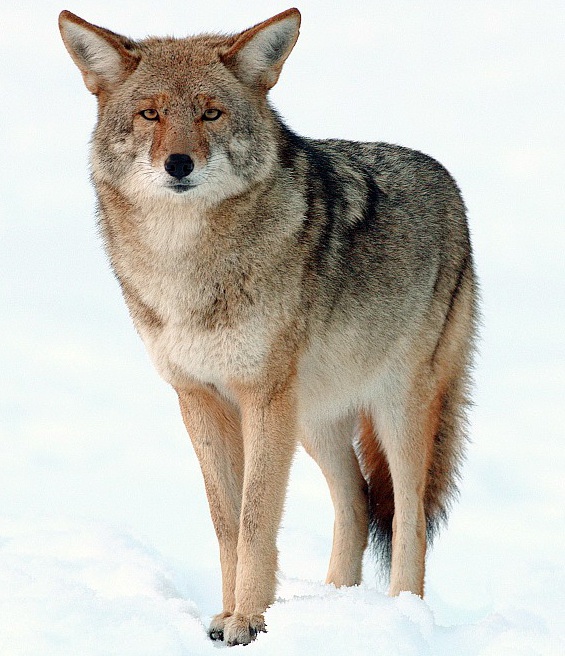
The coyote is among the most behaviourally and ecologically flexible carnivores in the Western Hemisphere, and over the past century it has undergone one of the most extensive range expansions documented for any North American mammal [Hody & Kays 2018]. Once associated chiefly with the arid grasslands and open country of the continent's interior, it now occurs from Alaska to Panama and thrives in the heart of major cities. This profile examines the biology behind that adaptability, the realities of human–coyote coexistence, and why a species expanding its range still merits careful, evidence-based management.
Biology and Identification
The coyote is a medium-sized canid, noticeably smaller and more lightly built than the gray wolf. Adults typically measure 750–1,000 mm in head-and-body length, with body mass commonly ranging from about 7 to 20 kg; males average slightly larger than females [Bekoff 1977]. The pelage is generally grizzled gray to tawny, with a paler underside, rufous-tinged legs and ears, and a bushy, black-tipped tail that is usually carried low when running — a useful field distinction from domestic dogs and wolves.
Body size varies geographically. Animals in the northeastern part of the range tend to be larger than their southwestern counterparts, a difference linked to a documented history of hybridization with eastern and Great Lakes wolves as coyotes colonized the northeast [Kays et al. 2010]. Genetic surveys of eastern populations reveal a three-way ancestry of coyote, wolf, and domestic dog, with a pattern of sex-biased admixture [Monzón et al. 2014].
Coyotes are dietary generalists. Their diet shifts opportunistically with local availability and can include small mammals, rabbits and hares, deer (often as carrion or as fawns), birds, reptiles, insects, and fruit, as well as anthropogenic food in developed areas [Bekoff 1977]. This flexibility, combined with a high reproductive rate and adaptable social structure, underpins the species' capacity to persist across an exceptionally wide range of habitats.
Habitat and Range
The coyote occupies nearly all of North America outside the polar regions, ranging across Canada, the contiguous United States, and Mexico, and extending south through Central America [Kays 2018]. Beginning around 1900, the species expanded northward into taiga forest, eastward into the deciduous forests of eastern North America, westward into coastal temperate rainforest, and southward into the human-modified tropics [Hody & Kays 2018]. The extirpation of apex predators such as wolves and cougars, together with widespread forest fragmentation and land conversion, helped open these landscapes to colonization.
The southern frontier of this expansion is ecologically significant: coyotes have established in deforested portions of eastern Panama, and continued documentation across southern Mexico, Guatemala, and Belize shows them increasingly occupying human-modified landscapes near the threshold of South America [Hody & Kays 2018; Rodríguez-Luna et al. 2026]. Coyotes have also colonized large metropolitan areas, where they maintain home ranges within urban and suburban mosaics [Gehrt et al. 2009].
In accordance with NRWL sensitive-species policy, specific den-site locations, urban pack-territory coordinates, and seasonal movement details are not disclosed in this article.
Conservation Status
The coyote is listed as Least Concern on the IUCN Red List, reflecting its very wide distribution, large and stable-to-increasing population, presence in numerous protected areas, and tolerance of a broad range of habitats including human-modified environments [Kays 2018]. The IUCN records the global population trend as increasing. The species is not listed on any CITES appendix, and it carries no special protection under the U.S. Endangered Species Act [USFWS 2024].
This favourable global status does not mean coyotes are free of management concern. Their range expansion brings them into closer contact with people, pets, and livestock, and population persistence under heavy localized control reflects high reproductive resilience rather than the absence of pressure [Kays 2018]. The conservation conversation for this species is therefore framed less around extinction risk and more around informed, ecologically grounded coexistence.
Threats
Unlike most species profiled by conservation organizations, the coyote faces no plausible risk of extinction; the relevant pressures concern individual welfare, ecological balance, and human–wildlife conflict rather than population collapse.
Lethal control and persecution are widespread. Coyotes are subject to extensive hunting, trapping, and government predator-control programs across much of their range. Populations typically rebound through migration and elevated reproduction following localized removal, which means indiscriminate culling is frequently ineffective at achieving sustained reductions [Kays 2018].
Human–wildlife conflict intensifies as coyotes occupy developed landscapes. Attacks on people are rare but documented; an analysis of incidents across the United States and Canada found that most occurred at or adjacent to a residence and were associated with circumstances such as intentional or unintentional feeding that reduced an animal's wariness of humans [White & Gehrt 2009]. Conflict with pet owners and livestock producers also drives demand for control.
Vehicle collisions, disease, and incidental harm affect coyotes in human-dominated areas. Studies of urban populations show individuals navigating roads, residential parcels, and other hazards as they exploit the city environment [Thompson et al. 2021].
What Is Being Done
Long-term urban research. Sustained studies of metropolitan coyote populations — including multi-year work in the Chicago region — have transformed understanding of how the species uses cities, documenting home-range size, movement, and the conditions that separate coexistence from conflict [Gehrt et al. 2009]. Comparable research in other urban areas continues to refine that picture [Thompson et al. 2021].
Coexistence and management guidance. Findings on the circumstances surrounding rare attacks have informed practical guidance emphasizing the removal of attractants, securing of refuse and pet food, and hazing of bold individuals, rather than reliance on broad culling [White & Gehrt 2009]. Many municipalities have adopted coexistence-based coyote management plans built on this evidence.
Range and genetic monitoring. Mapping efforts using museum specimens, occurrence records, and field surveys track the ongoing expansion and help anticipate where coyotes will arrive next, including the approach toward South America [Hody & Kays 2018; Rodríguez-Luna et al. 2026]. Genomic studies of expansion fronts document the high genetic diversity and adaptive variation associated with the colonization process [Heppenheimer et al. 2018].
Ecological context. Research on mesopredator dynamics has clarified the coyote's functional role: where coyotes persist in fragmented landscapes, they can suppress smaller predators such as foxes and free-ranging cats, with measurable benefits for ground-nesting and scrub-breeding birds [Crooks & Soulé 1999].
How Readers Can Help
Reduce attractants. Securing garbage, compost, fallen fruit, and pet food, and feeding pets indoors, removes the food rewards that lead coyotes to lose wariness of people — the factor most consistently linked to conflict in the published record [White & Gehrt 2009].
Support coexistence-based policy. Where management decisions are made locally, evidence-based coexistence plans tend to be more effective and durable than indiscriminate removal, which populations readily offset [Kays 2018].
Contribute to citizen science. Logging verified wildlife observations through platforms such as iNaturalist adds to the occurrence records that researchers use to map coyote distribution and expansion over time [Hody & Kays 2018].
Share accurate information. Communicating the difference between rare, attractant-linked incidents and ordinary coyote presence helps communities respond proportionately and reduces unnecessary persecution [White & Gehrt 2009].
References
[Bekoff 1977] Bekoff, M. (1977). Canis latrans. Mammalian Species, 79, 1–9. https://doi.org/10.2307/3503817
[Crooks & Soulé 1999] Crooks, K.R. & Soulé, M.E. (1999). Mesopredator release and avifaunal extinctions in a fragmented system. Nature, 400, 563–566. https://doi.org/10.1038/23028
[Gehrt et al. 2009] Gehrt, S.D., Anchor, C. & White, L.A. (2009). Home range and landscape use of coyotes in a metropolitan landscape: conflict or coexistence? Journal of Mammalogy, 90(5), 1045–1057. https://doi.org/10.1644/08-MAMM-A-277.1
[Heppenheimer et al. 2018] Heppenheimer, E., Brzeski, K.E., Hinton, J.W., Patterson, B.R., Rutledge, L.Y., DeCandia, A.L., Wheeldon, T., Fain, S.R., Hohenlohe, P.A., Kays, R., White, B.N., Chamberlain, M.J. & vonHoldt, B.M. (2018). High genomic diversity and candidate genes under selection associated with range expansion in eastern coyote (Canis latrans) populations. Ecology and Evolution, 8(24), 12641–12655. https://doi.org/10.1002/ece3.4688
[Hody & Kays 2018] Hody, J.W. & Kays, R. (2018). Mapping the expansion of coyotes (Canis latrans) across North and Central America. ZooKeys, 759, 81–97. https://doi.org/10.3897/zookeys.759.15149
[Kays 2018] Kays, R. (2018). Canis latrans (errata version published 2020). The IUCN Red List of Threatened Species 2018: e.T3745A163508579. https://dx.doi.org/10.2305/IUCN.UK.2018-2.RLTS.T3745A163508579.en
[Kays et al. 2010] Kays, R., Curtis, A. & Kirchman, J.J. (2010). Rapid adaptive evolution of northeastern coyotes via hybridization with wolves. Biology Letters, 6(1), 89–93. https://doi.org/10.1098/rsbl.2009.0575
[Monzón et al. 2014] Monzón, J., Kays, R. & Dykhuizen, D.E. (2014). Assessment of coyote–wolf–dog admixture using ancestry-informative diagnostic SNPs. Molecular Ecology, 23(1), 182–197. https://doi.org/10.1111/mec.12570
[Rodríguez-Luna et al. 2026] Rodríguez-Luna, C.R. et al. (2026). Coyote range expansion in the human-modified tropics of Mesoamerica. Ecology and Evolution. https://doi.org/10.1002/ece3.73184
[Thompson et al. 2021] Thompson, C.A., Malcolm, J.R. & Patterson, B.R. (2021). Individual and temporal variation in use of residential areas by urban coyotes. Frontiers in Ecology and Evolution, 9, 687504. https://doi.org/10.3389/fevo.2021.687504
[USFWS 2024] U.S. Fish & Wildlife Service. Coyote (Canis latrans) — Species profile (ECOS). https://www.fws.gov/species/coyote-canis-latrans
[White & Gehrt 2009] White, L.A. & Gehrt, S.D. (2009). Coyote attacks on humans in the United States and Canada. Human Dimensions of Wildlife, 14(6), 419–432. https://doi.org/10.1080/10871200903055326