
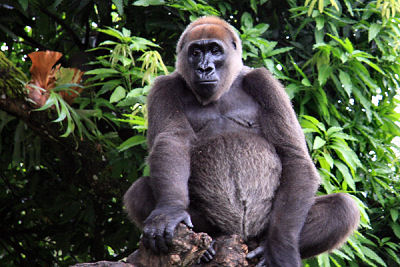
The Cross River gorilla is the northernmost and most isolated population of any gorilla, restricted to a cluster of rugged forested hills straddling the border between Nigeria and Cameroon [Bergl et al. 2016]. Fewer than 250 mature individuals are thought to remain, scattered across roughly eleven small subpopulations — a total that makes it the rarest of all great apes [Bergl et al. 2016; APES Atlas 2024]. First described as a distinct form in 1904 and confirmed through genetic and morphological work as a separate subspecies of the western gorilla, it occupies a tiny fraction of the historical gorilla range yet has become one of the most intensively studied conservation cases in Central Africa [Sarmiento & Oates 2000; Alvarez-Estape et al. 2023].
Its persistence in a densely settled landscape, rather than a remote wilderness, defines both its peril and the approach needed to keep it alive. The animals survive in steep terrain that has historically been difficult for people to clear or hunt — a refuge of topography more than of protection [Dunn et al. 2014].
Biology and Identification
The Cross River gorilla is a large, robust ape. Adult males develop the silver saddle of mature "silverbacks," reaching roughly 1.4–1.7 m in standing height and on the order of 140–200 kg, while females are markedly smaller, averaging around 100 kg [NEPC 2024]. Compared with the more numerous western lowland gorilla, this subspecies shows subtle skull differences, including a smaller cranial vault and shorter palate, the traits originally used to distinguish it [Sarmiento & Oates 2000].
Diet is predominantly plant-based, built on fruit when available and shifting toward leaves, herbaceous stems, bark, and pith — including ginger-family plants in the genus Aframomum — during leaner seasons [NEPC 2024]. Groups are typically led by a single dominant male and number a handful of individuals, though larger associations of up to roughly 20 occur where habitat is rich [NEPC 2024]. Reproduction is slow: a single infant follows a gestation of roughly eight and a half to nine months, with multi-year nursing intervals between births, so populations recover only gradually from losses [NEPC 2024].
Habitat and Range
The subspecies is confined to montane and submontane forest along the upper Cross River drainage on the Nigeria–Cameroon frontier [Bergl et al. 2016]. The broader mountainous landscape it occupies spans on the order of 12,000 km², but the area the gorillas habitually use is far smaller and concentrated in rugged highland forest [APES Atlas 2024; Bergl et al. 2016].
Occupied sites include the Mbe Mountains, the Afi Mountain Wildlife Sanctuary, and the Okwangwo forest in Nigeria's Cross River State, and the Takamanda and Mone River areas and adjacent forest in Cameroon [WCS Nigeria 2024; Dunn et al. 2014]. In keeping with sensitive-species practice, NRWL does not publish precise locations of groups, nests, or movement corridors. The population is fragmented into subpopulations separated by valleys, farmland, and roads, a structure confirmed by genetic clustering, and a substantial share of animals occurs outside formally protected areas [Alvarez-Estape et al. 2023; APES Atlas 2024].
Conservation Status
The Cross River gorilla is assessed as Critically Endangered on the IUCN Red List, most recently evaluated in 2016 under criterion C2a(i) [Bergl et al. 2016]. The listing reflects a population of fewer than 250 mature individuals, divided among approximately eleven subpopulations that each likely hold fewer than 50 mature animals, with an overall declining trend [Bergl et al. 2016]. The IUCN-led regional planning process similarly described a range-wide total numbering fewer than 300 individuals [IUCN 2014]. Survey-based work documented a population decline of about 59% between 1995 and 2010, underscoring the long-term downward trajectory the assessment describes [Dunn et al. 2014].
Whole-genome analysis of shed-hair samples has confirmed reduced genetic diversity and recent inbreeding, evident in long runs of homozygosity (greater than 10 Mb), consistent with a small and fragmented population [Alvarez-Estape et al. 2023].
Threats
The principal pressures are illegal hunting and habitat loss [Bergl et al. 2016]. Even low levels of hunting are significant for a population this small and slow-breeding, where the loss of a few breeding individuals can affect an entire subpopulation; wire snares set for other game remain an ongoing hazard [Bergl et al. 2016; WCS Nigeria 2024]. Habitat is eroded by conversion to agriculture, logging, and road construction, which also deepens the fragmentation that isolates groups from one another [Bergl et al. 2016; Dunn et al. 2014].
Small, fragmented populations carry added risks: reduced genetic diversity and inbreeding can lower resilience, and proximity to people and livestock raises the potential for disease transmission [Alvarez-Estape et al. 2023; Dunn et al. 2014].
What Is Being Done
Conservation here is transboundary and community-centered. A revised Regional Action Plan for 2014–2019, produced by the IUCN SSC Primate Specialist Group and the Wildlife Conservation Society with partners, set out priorities including strengthened law enforcement, protection of forest corridors linking subpopulations, disease and health monitoring, research, and community engagement [Dunn et al. 2014; IUCN 2014]. Protected areas have been established or expanded across the range, including the Afi Mountain Wildlife Sanctuary (2000) and, in Cameroon, Takamanda National Park and the Kagwene Gorilla Sanctuary, both designated in 2008 [WCS Nigeria 2024].
Field teams use non-invasive genetic sampling and surveys to study groups without disturbing them, and genomic findings have reinforced the case for maintaining and restoring connectivity between isolated subpopulations [Alvarez-Estape et al. 2023; APES Atlas 2024]. Because the gorillas live among farming communities, local participation — including community guardian networks, education programs, and alternative-livelihood initiatives — has been central to the strategy [WCS Nigeria 2024; Dunn et al. 2014].
How You Can Help
Support for organizations conducting long-term field monitoring, anti-poaching patrols, and community conservation in the Cross River landscape contributes to the work this subspecies depends on. Sharing accurate, well-sourced information helps counter misinformation about great apes. Products with credible deforestation-free sourcing reduce pressure on tropical forests broadly. NRWL presents these as informational options, not directives, and provides no financial, legal, or veterinary advice.
References
[Bergl et al. 2016] Bergl, R.A., Dunn, A., Fowler, A., Imong, I., Ndeloh, D., Nicholas, A. & Oates, J.F. (2016). Gorilla gorilla ssp. diehli (Cross River Gorilla). The IUCN Red List of Threatened Species 2016: e.T39998A102326240. https://dx.doi.org/10.2305/IUCN.UK.2016-2.RLTS.T39998A17989492.en
[Dunn et al. 2014] Dunn, A., Bergl, R., Byler, D., Eben-Ebai, S., Etiendem, D.N., Fotso, R., et al. (2014). Revised Regional Action Plan for the Conservation of the Cross River Gorilla (Gorilla gorilla diehli) 2014–2019. IUCN SSC Primate Specialist Group and Wildlife Conservation Society, New York. https://portals.iucn.org/library/node/44661
[Alvarez-Estape et al. 2023] Alvarez-Estape, M., et al. (2023). Past Connectivity but Recent Inbreeding in Cross River Gorillas Determined Using Whole Genomes from Single Hairs. Genes, 14(3): 743. https://pmc.ncbi.nlm.nih.gov/articles/PMC10048488/
[Sarmiento & Oates 2000] Sarmiento, E.E. & Oates, J.F. (2000). The Cross River gorillas: a distinct subspecies, Gorilla gorilla diehli Matschie 1904. American Museum Novitates, 3304: 1–55. https://digitallibrary.amnh.org/handle/2246/2958
[NEPC 2024] New England Primate Conservancy. (2024). Cross River Gorilla, Gorilla gorilla diehli. https://neprimateconservancy.org/cross-river-gorilla/
[IUCN 2014] IUCN. (2014). World's Rarest Gorilla Gets New Roadmap for Survival. International Union for Conservation of Nature. https://iucn.org/content/worlds-rarest-gorilla-gets-new-roadmap-survival
[APES Atlas 2024] IUCN SSC A.P.E.S. Portal. (2024). Cross River Gorilla. https://apesatlas.iucnapesportal.org/index.php/Cross_River_Gorilla
[WCS Nigeria 2024] Wildlife Conservation Society Nigeria. (2024). Cross River Gorilla. https://nigeria.wcs.org/wildlife/cross-river-gorilla.aspx