
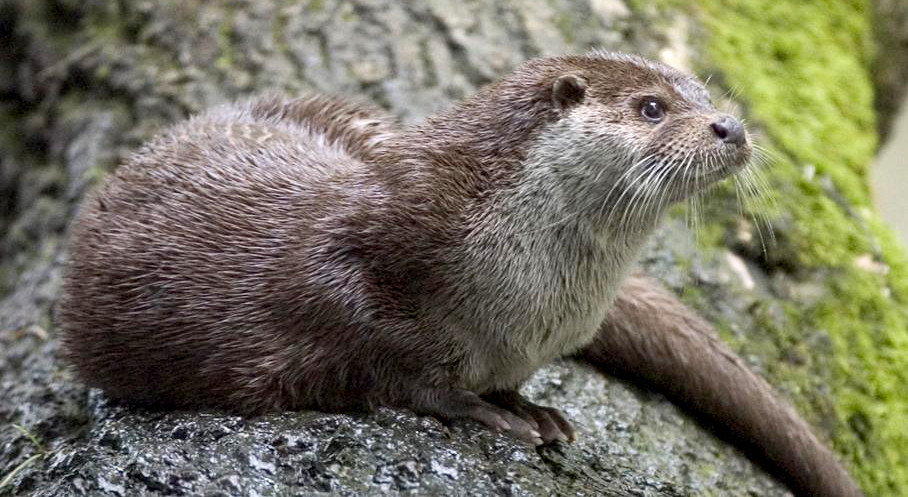
The Eurasian otter is one of conservation biology's most instructive recovery narratives: a top freshwater predator that vanished from much of western and central Europe during the 1960s and 1970s as organochlorine pesticides and PCBs accumulated in aquatic food webs, then recolonised many of those same rivers once those pollutants were banned [Roos et al. 2001]. Distributed across more than 70 countries from Ireland to Japan, it is the most widely ranging otter on Earth [Hung & Law 2016]. Globally it is listed as NT (Near Threatened) on the IUCN Red List, with a population still classified as decreasing despite strong regional rebounds [Roos et al. 2015]. Because it sits near the apex of riparian ecosystems and is sensitive to water quality, the species is widely treated as a sentinel of freshwater health.
Biology and Identification
Lutra lutra (Linnaeus, 1758) is a semiaquatic carnivore in the family Mustelidae, subfamily Lutrinae [Hung & Law 2016]. Adults typically measure 57–95 cm in head-and-body length with a muscular, tapering tail of 35–45 cm, and weigh roughly 7–12 kg; large old males occasionally approach 17 kg, and females are consistently smaller than males [Hung & Law 2016]. The pelage is dense and dark brown above, paling to cream on the throat and underside, and traps an insulating air layer essential for thermoregulation in cold water [Hung & Law 2016]. Adaptations to aquatic life include webbed feet, a streamlined body, valvular ears and nostrils that close on submersion, and increased bone density (osteosclerosis) that reduces buoyancy [Hung & Law 2016].
The diet is dominated by fish, supplemented seasonally by amphibians, crustaceans, birds, and small mammals, with prey composition tracking local availability [Hung & Law 2016]. Otters are largely solitary and strongly territorial, marking linear riparian ranges with scent-laden spraints.
Reproduction is aseasonal across much of the temperate range, and the cycle includes a period of delayed implantation; gestation is approximately nine weeks once implantation occurs [Hauer et al. 2002]. Litters typically number one to three cubs, which are born altricial in a riverbank holt, open their eyes after about a month, and remain dependent on the mother for roughly a year [Hauer et al. 2002]. Reproductive output is low and recruitment slow, a life-history trait that makes populations slow to recover from declines [Hauer et al. 2002].
Habitat and Range
The Eurasian otter has the broadest distribution of any otter species, occurring across Europe, much of temperate and tropical Asia, and parts of North Africa, from Ireland and Iberia eastward to the Russian Far East, the Korean Peninsula, Japan, and south to Sri Lanka and parts of Southeast Asia [Roos et al. 2015]. It occupies an exceptionally wide range of aquatic habitats, including rivers, streams, lakes, marshes, estuaries, and rocky marine coastlines, provided that prey is abundant and bankside cover for resting sites and natal holts is available [Roos et al. 2015].
The species' distribution has changed dramatically within living memory. Through the mid-twentieth century it was continuous across most of Europe, but populations collapsed between the 1950s and 1980s, with otters disappearing entirely from large areas of central and western Europe; in Sweden, intensive contamination by ΣDDT and PCBs coincided closely with steep declines in both numbers and range [Roos et al. 2001]. Following pollution controls and legal protection, range contraction reversed in many countries from the 1990s onward, and recolonisation of formerly vacant catchments has been documented across Britain, the Netherlands, Germany, and Scandinavia [IUCN Otter Specialist Group 2025]. Recovery remains uneven, however, and significant gaps persist in heavily urbanised, intensively farmed, or chronically polluted catchments, while several Asian subpopulations continue to decline [Roos et al. 2015].
Conservation Status
The Eurasian otter is listed as NT (Near Threatened) on the IUCN Red List, assessed in 2015, with a global population trend recorded as decreasing [Roos et al. 2015]. It qualifies as Near Threatened because, although still widespread, it has experienced substantial historical declines and continues to face ongoing threats across much of its Asian range, approaching the thresholds for a threatened category [Roos et al. 2015]. The species is listed on CITES Appendix I, the strictest category of international trade protection, prohibiting commercial trade in wild-sourced specimens [Roos et al. 2015; CITES 2023].
The IUCN does not publish a single global population estimate, reflecting the difficulty of surveying a cryptic, nocturnal, and wide-ranging animal; status is instead assessed from national distribution surveys and trend data [Roos et al. 2015]. Regional pictures diverge sharply. In much of Europe, otters have recolonised river systems they vacated decades earlier, and the IUCN SSC Otter Specialist Group documents the European recovery as a notable conservation success driven by pollutant bans and habitat protection [IUCN Otter Specialist Group 2025]. By contrast, several Asian subpopulations remain in decline owing to habitat loss and exploitation [Roos et al. 2015]. The species is additionally protected under the EU Habitats Directive (Annexes II and IV) and the Bern Convention across its European range [European Union 1992].
Threats
Eurasian otter populations are shaped by a combination of historical and ongoing pressures:
-
Persistent organic pollutants. Organochlorines such as DDT/DDE and dieldrin, and especially PCBs, accumulate up the aquatic food chain and impair otter reproduction; population recovery in Sweden tracked the decline of PCB concentrations in the environment, implicating these compounds as a primary driver of the twentieth-century collapse [Roos et al. 2001].
-
Emerging contaminants. Per- and polyfluoroalkyl substances (PFAS) are now detected in otter tissues; in England and Wales, PFAS were found in all individuals analysed, with PFOS dominating the contaminant profile, raising concern about chronic sub-lethal effects [O'Rourke et al. 2022].
-
Incidental drowning in fishing gear (bycatch). Otters readily enter fyke nets, eel traps, and creels and drown; in western Norway, bycatch has disrupted natural reestablishment of the species, and many such deaths go unreported [Landa & Guidos 2020].
-
Road mortality. Vehicle collisions are a leading cause of death where roads cross riparian corridors, accounting for the large majority of recorded otter mortality in some recovering populations [Roos et al. 2015].
-
Habitat degradation. Channelisation, wetland drainage, removal of bankside vegetation, and reduced prey availability diminish foraging and breeding habitat [Roos et al. 2015].
These mechanisms are described as threat categories for awareness; this page does not provide instructions for harming wildlife.
What Is Being Done
Recovery of the Eurasian otter rests largely on policy and habitat measures rather than captive intervention. The phase-out of organochlorine pesticides and PCBs under national bans and international agreements removed the principal driver of the mid-century decline, and improving water quality has allowed natural recolonisation across much of Europe [Roos et al. 2001]. Legal protection is foundational: across the European Union the species is listed on Annexes II and IV of the Habitats Directive (Council Directive 92/43/EEC), requiring designation of Special Areas of Conservation and strict protection of individuals, while the Bern Convention affords parallel protection across the wider European region [European Union 1992].
International trade is constrained by the species' listing on CITES Appendix I, which prohibits commercial trade in wild specimens [CITES 2023]. The IUCN SSC Otter Specialist Group coordinates monitoring, research, and the recurring European Otter Workshops, and has documented the European recovery as a structured conservation success underpinned by sustained survey effort and habitat restoration [IUCN Otter Specialist Group 2025]. National monitoring programmes, including long-running distribution surveys and post-mortem schemes that analyse contaminant burdens in otters found dead, continue to track recovery and detect emerging risks such as PFAS [O'Rourke et al. 2022]. Riparian habitat restoration, the installation of otter underpasses and ledges at road crossings, and otter-exclusion devices on fishing gear are increasingly applied to reduce bycatch and road mortality [Landa & Guidos 2020].
How Readers Can Help
Members of the public can contribute meaningfully to otter conservation, primarily through observation and informed engagement. Reporting otter sightings and, importantly, records of otters found dead to national biological recording schemes and the IUCN Otter Specialist Group supports the distribution surveys and contaminant studies that underpin conservation decisions [IUCN Otter Specialist Group 2025]. Many countries maintain citizen-science platforms and wildlife-recording portals where such observations can be logged.
Supporting clean-water and freshwater-habitat policy, and choosing sustainably sourced seafood that reduces pressure on the fish stocks otters depend on, both align individual choices with the species' long-term needs. Where local fisheries operate, advocating for otter-guard fittings on nets and traps can reduce accidental drownings [Landa & Guidos 2020]. Maintaining vegetated, undisturbed riverbanks on private or community land provides the cover otters require for resting and breeding. These constructive steps complement, rather than replace, the legislative and habitat measures that drive population recovery.
References
[CITES 2023] Convention on International Trade in Endangered Species of Wild Fauna and Flora (CITES) (2023). Appendices I, II and III — Lutra lutra (Appendix I). CITES Secretariat, Geneva. https://cites.org/eng/app/appendices.php
[European Union 1992] European Union (1992). Council Directive 92/43/EEC of 21 May 1992 on the conservation of natural habitats and of wild fauna and flora (Habitats Directive), Annexes II and IV. Official Journal of the European Communities, L 206, 7–50. https://eur-lex.europa.eu/legal-content/EN/TXT/?uri=CELEX:31992L0043
[Hauer et al. 2002] Hauer, S., Ansorge, H. & Zinke, O. (2002). Reproductive performance of otters Lutra lutra (Linnaeus, 1758) in Eastern Germany: low reproduction in a long-term strategy. Biological Journal of the Linnean Society, 77(3), 329–340. https://doi.org/10.1046/j.1095-8312.2002.00097.x
[Hung & Law 2016] Hung, N. & Law, C.J. (2016). Lutra lutra (Carnivora: Mustelidae). Mammalian Species, 48(940), 109–122. https://doi.org/10.1093/mspecies/sew011
[IUCN Otter Specialist Group 2025] IUCN SSC Otter Specialist Group (2025). The Eurasian Otter in Europe: a conservation success story. IUCN, Gland, Switzerland. https://iucn.org/sites/default/files/2025-11/15-2025-iucn-ssc-success-story_id-5_otter-sg_publication.pdf
[Landa & Guidos 2020] Landa, A. & Guidos, S. (2020). Bycatch in local fishery disrupts natural reestablishment of Eurasian otter in western Norway. Conservation Science and Practice, 2(7), e208. https://doi.org/10.1111/csp2.208
[O'Rourke et al. 2022] O'Rourke, E., Hynes, J., Losada, S., Barber, J.L., Pereira, M.G., Kean, E.F., Hailer, F. & Chadwick, E.A. (2022). Anthropogenic drivers of variation in concentrations of perfluoroalkyl substances in otters (Lutra lutra) from England and Wales. Environmental Science & Technology, 56(3), 1675–1687. https://doi.org/10.1021/acs.est.1c05410
[Roos et al. 2001] Roos, A., Greyerz, E., Olsson, M. & Sandegren, F. (2001). The otter (Lutra lutra) in Sweden — population trends in relation to ΣDDT and total PCB concentrations during 1968–99. Environmental Pollution, 111(3), 457–469. https://doi.org/10.1016/S0269-7491(00)00085-3
[Roos et al. 2015] Roos, A., Loy, A., de Silva, P., Hajkova, P. & Zemanová, B. (2015). Lutra lutra. The IUCN Red List of Threatened Species 2015: e.T12419A21935287. https://dx.doi.org/10.2305/IUCN.UK.2015-2.RLTS.T12419A21935287.en