
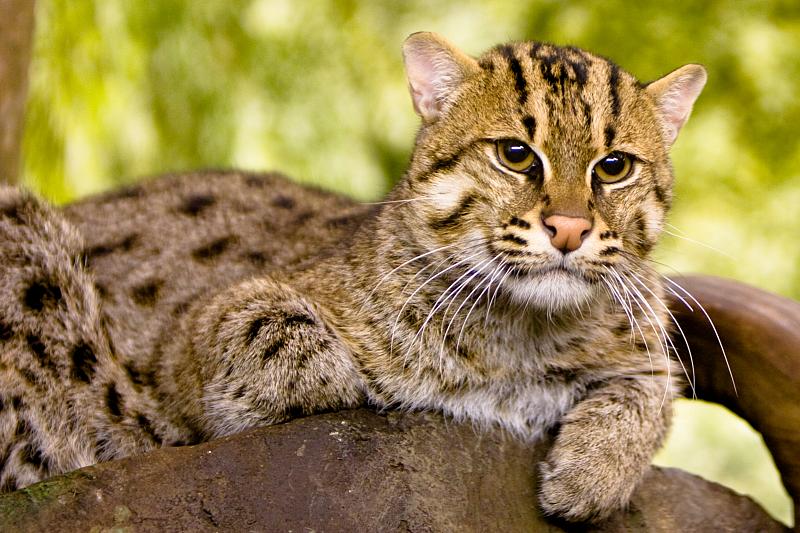
Across the marshes, mangroves, and reed-fringed waterways of South and Southeast Asia lives a medium-sized cat that has built its ecology around water. The fishing cat (Prionailurus viverrinus) is a capable swimmer that forages at the water's edge, taking fish, rodents, birds, and other aquatic prey, with fish making up the large majority of its recorded diet [CatSG 2024][Mishra et al. 2022]. Roughly twice the size of a domestic cat, it is among the most water-associated of the wild felids, and its prospects are tied directly to the health of the wetlands it occupies [CatSG 2024].
Because the species is closely linked to lowland wetlands, some of the most heavily converted ecosystems on Earth, its populations have become increasingly fragmented and few remain across parts of its former range [IUCN 2024][Mongabay 2025].
Biology and Identification
The fishing cat is a stocky, short-legged felid with a deep-chested build. Head-and-body length is generally about 57–78 cm, with a relatively short tail of roughly 20–30 cm; males typically weigh more than females, with reported masses ranging up to roughly 17 kg in males and about 5–9 kg in females [Wikipedia 2026]. Its coat is olive-grey, patterned with dark elongated spots that align into rows along the body, and a series of dark stripes runs from the crown over the neck [CatSG 2024].
Several features relate to its aquatic foraging. The fur is dense, and the feet show limited webbing between the toes, though sources note this webbing is only modestly developed [CatSG 2024]. At the water's margin the species scoops or seizes fish and other prey, and it has been recorded entering water and swimming readily [CatSG 2024]. Fish dominate the recorded diet, supplemented by rodents, birds, molluscs, reptiles, amphibians, and carrion [CatSG 2024][Wikipedia 2026].
Habitat and Range
The fishing cat is a wetland specialist, recorded in densely vegetated swamps and marshes, reedbeds, mangrove forests, oxbow lakes, rivers, and streams [CatSG 2024][FCCA 2024]. Its distribution is patchy across South and Southeast Asia, with records in countries including Sri Lanka, India, Nepal, Bangladesh, Myanmar, Thailand, and Cambodia [FCCA 2024]. Within Southeast Asia, numbers appear comparatively small, while the bulk of the global population is thought to occur in South Asia [CatSG 2024].
In keeping with NRWL's sensitive-species protocol, this page describes distribution only at the level of country and biome. Notably, much of the species' suitable habitat lies outside formal protected areas. A national-scale analysis in Nepal estimated that only a small fraction of the country offers suitable habitat, and that roughly two-thirds of predicted suitable habitat falls outside protected areas, where it receives limited survey effort and protection [Mishra et al. 2022]. Similar patterns are reported from eastern India, where research in human-dominated wetlands has documented substantial fishing cat numbers beyond reserve boundaries [Mongabay 2025][Adhya et al. 2024]. This makes human-dominated wetlands and aquaculture mosaics central to the species' survival.
Conservation Status
The fishing cat is assessed as Vulnerable on the IUCN Red List, in the most recent assessment, dated 2024, a category it has held since 2016 [IUCN 2024]. The global population is estimated at roughly 3,194–7,527 mature individuals, with a decreasing population trend [CatSG 2024][IUCN 2024]. The assessment indicates the population is thought to have declined by approximately 30% over a recent three-generation window during 2010–2015, driven primarily by wetland loss and direct killing [IUCN 2024][Wikipedia 2026].
The species is also listed on CITES Appendix II, which regulates international trade, and it receives legal protection under national wildlife legislation across several range states [FCCA 2024].
Threats
The dominant threat is the loss and degradation of wetlands. Marshes, reedlands, and mangroves are drained, encroached upon, and converted for agriculture, aquaculture, and urban or industrial development; in East Kolkata, for example, a substantial area of wetland was lost to conversion over recent decades [Mongabay 2025]. Conversion to commercial aquaculture is a particular pressure across coastal habitats [IUCN 2024].
Direct killing is a second major driver. Fishing cats are killed in retaliation over perceived or actual conflict around poultry, livestock, and pond fish, and are sometimes targeted for bushmeat or the captive-wildlife trade [FCCA 2024][IUCN 2024]. Such persecution has been documented across human-dominated landscapes, including in Bangladesh, where rescued individuals are sometimes released back to the wild [Aziz et al. 2025]. Misidentification contributes to the conflict: a local name interpreted as "tiger-like" has been linked to fear-driven killings, even though researchers report no documented case of a fishing cat attacking a person [Mongabay 2025]. In human-dominated landscapes, vehicle collisions are an increasingly recognized cause of death [Mongabay 2025].
What Is Being Done
Conservation efforts combine habitat protection, conflict reduction, and research. Specialist groups such as the IUCN SSC Cat Specialist Group track the species' status and distribution, while alliances and field organizations work directly in range states [CatSG 2024][FCCA 2024]. Reported measures include protecting and restoring wetland habitat, reducing snaring and poisoning, and easing tensions where the cats overlap with fisheries and farms [FCCA 2024].
Research is also clarifying where the species persists. A participatory-science camera-trap study in the Chilika lagoon of eastern India produced one of the first robust density estimates for the species in a non-protected, human-dominated wetland, underscoring how important such landscapes are [Adhya et al. 2024]. In India, community-facing work includes campaigns promoting a neutral local name meaning "fish-eating cat," awareness signage citing legal protections, and proposals for local biodiversity zones along river stretches [Mongabay 2025]. Because so much occupied habitat lies outside reserves, conservation increasingly focuses on coexistence in working landscapes rather than on protected areas alone [Mishra et al. 2022][Mongabay 2025].
How You Can Help
The most directly useful contributions are wetland protection and credible information. Supporting the conservation of marshes, mangroves, and reedbeds, and the organizations and specialist groups working on fishing cats, helps maintain the habitats the species depends on [FCCA 2024][CatSG 2024]. Sharing accurate information, including the point that fishing cats are not known to be a danger to people, can reduce the misidentification and fear that lead to retaliatory killings [Mongabay 2025]. Where you live near or visit wetland landscapes, treating these habitats as the species' core resource is itself a meaningful form of support.
References
[IUCN 2024] Mukherjee, S.; Appel, A.; Adhya, T.; Aziz, M.A.; Borah, J.; Chakraborty, S.; Dey, A.; Herranz Muñoz, V.; Kantimahanti, M.; Kittle, A.; Mahar, J.A.; Mishra, R.; Naing Lin; Ngoprasert, D.; Phosri, K.; Qureshi, Q.; Rana, D.; Ratnayaka, A.; Tantipisanuh, N.; Watson, A.C. (2024). Prionailurus viverrinus (Fishing Cat). The IUCN Red List of Threatened Species 2024: e.T18150A268618387. https://www.iucnredlist.org/species/18150/268618387
[CatSG 2024] IUCN SSC Cat Specialist Group. (2024). Living Species — Fishing Cat (Prionailurus viverrinus). https://www.catsg.org/living-species-fishingcat
[FCCA 2024] Fishing Cat Conservation Alliance. (2024). The Fishing Cat. https://fishingcat.org/the-fishing-cat/
[Mishra et al. 2022] Mishra, R.; de Iongh, H.H.; Leirs, H.; Lamichhane, B.R.; Subedi, N.; Kolipaka, S.S. (2022). Fishing cat Prionailurus viverrinus distribution and habitat suitability in Nepal. Ecology and Evolution, 12(4): e8857. https://doi.org/10.1002/ece3.8857
[Adhya et al. 2024] Adhya, T.; Banerjee, M.; Dey, P.; Nanda, P.; Santra, P.; Nesha, M.K. (2024). Density estimation of the globally threatened fishing cat Prionailurus viverrinus through a participatory science approach in the Chilika lagoon, eastern India. Endangered Species Research, 54: 27–37. https://www.int-res.com/abstracts/esr/v54/esr01322
[Aziz et al. 2025] Persecution, rescue and release of globally vulnerable fishing cats in human-dominated landscapes of Bangladesh. (2025). Global Ecology and Conservation. https://www.sciencedirect.com/science/article/pii/S2351989425005803
[Mongabay 2025] Mongabay India. (2025, March). Conserving fishing cats outside protected areas. https://india.mongabay.com/2025/03/conserving-fishing-cats-outside-protected-areas/
[Wikipedia 2026] Wikipedia contributors. (2026). Fishing cat. Wikipedia, The Free Encyclopedia. https://en.wikipedia.org/wiki/Fishing_cat