
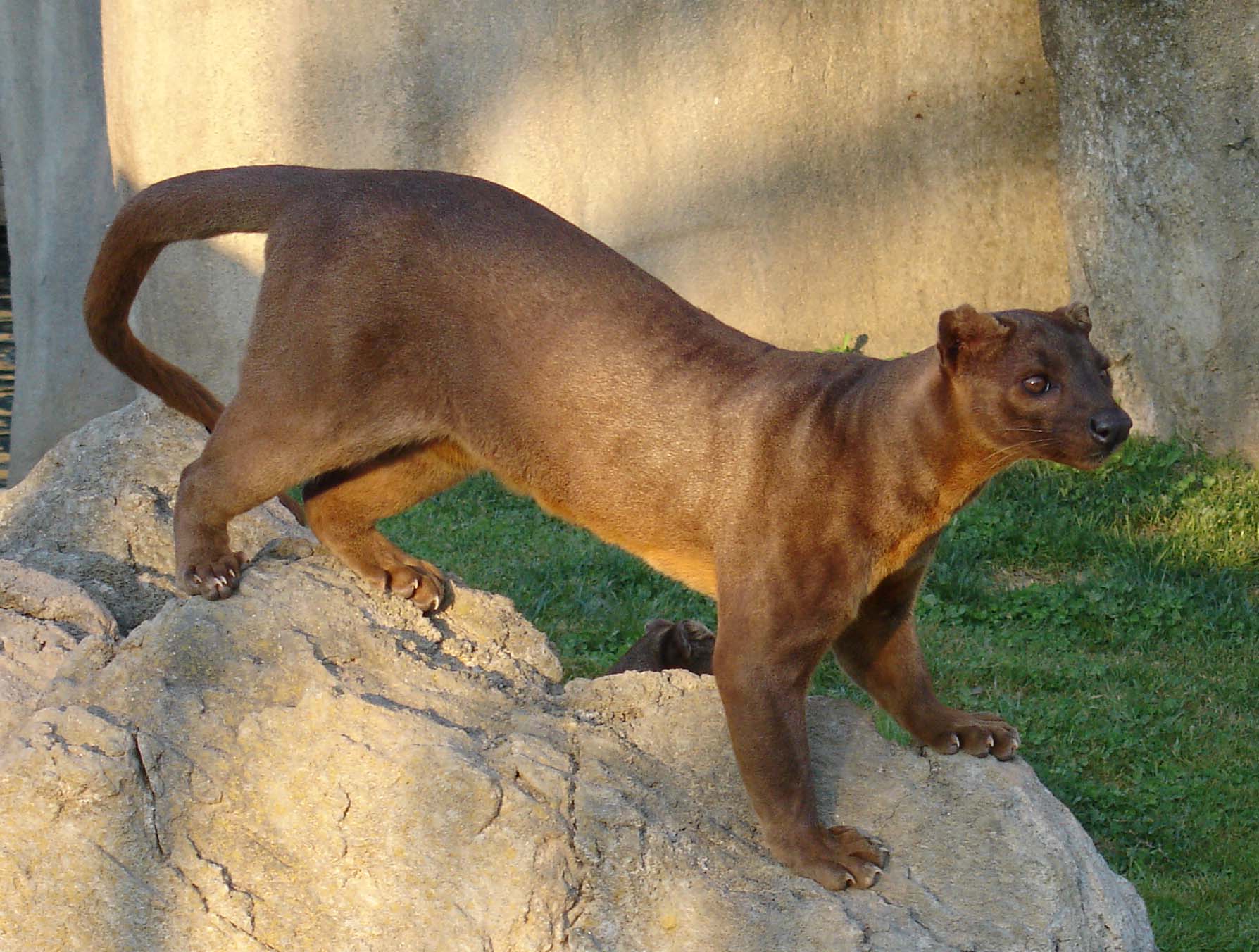
The fossa is the largest carnivore native to Madagascar and the apex predator of the island's forests — a lithe, cat-like euplerid capable of hunting every living lemur species, including the largest [Hawkins 2016; Hawkins & Racey 2008]. Found nowhere else on Earth, it descends from a single carnivoran lineage that reached Madagascar from Africa more than 18 million years ago [Yoder et al. 2003]. This profile examines the fossa's distinctive biology, the accelerating habitat loss and hunting pressure that threaten it, and the protected-area and breeding programs working to secure its future.
Biology and Identification
The fossa is a slender, long-bodied predator with a tail nearly as long as its head and body. Head-body length measures roughly 70–80 cm, the tail adds a comparable length, and adult body mass ranges from about 5.5 kg in females to 8.6 kg in males [Köhncke & Leonhardt 1986]. Its short reddish-brown to dark-brown coat, semi-retractable claws, and partially reversible hind ankle joints make it an agile climber, allowing it to pursue prey through the canopy as readily as on the ground [Köhncke & Leonhardt 1986].
Although superficially feline, the fossa belongs to the family Eupleridae, a radiation of Malagasy carnivorans that molecular phylogenetics has shown to be monophyletic and most closely related to the mongoose family Herpestidae [Yoder et al. 2003]. It is the largest member of that endemic lineage.
The diet is dominated by vertebrates, with lemurs making up more than half of identified prey items; the fossa is the only predator able to take adults of every extant lemur species, alongside tenrecs, rodents, reptiles, and birds [Hawkins & Racey 2008]. Prey composition shifts seasonally, with a higher proportion of tenrecs in the wet season [Hawkins & Racey 2008]. Gestation lasts six to seven weeks, two to four young are typically born, and because offspring remain with the mother through their first year, females generally breed only every other year; sexual maturity is reached at three to four years [Hawkins 2016].
The fossa is largely solitary and primarily nocturnal, though it shows more daytime activity during the October–December breeding season [Hawkins 2016]. GPS tracking has revealed that male home ranges are larger than those of females and overlap extensively with those of other males, and that some adult males form persistent spatial associations — an unusual degree of sociality for a "solitary" carnivore [Lührs & Kappeler 2013]. Researchers have also documented cooperative hunting, with three males jointly pursuing and sharing a large arboreal lemur over a sustained chase [Lührs & Dammhahn 2010].
Habitat and Range
The fossa is the most widely distributed of the Malagasy carnivores, occurring across western and eastern forests and, more rarely, in the central plateau and spiny southern forests [Hawkins 2016]. It has been recorded from sea level to above 2,000 m elevation, though it becomes scarce at higher altitudes [Hawkins 2016]. The species persists in both dry deciduous and humid rainforest, and individuals have been camera-trapped in contiguous, fragmented, and degraded forest, sometimes moving through human-modified landscapes between patches [Gerber et al. 2012; Hawkins 2016].
Population densities are characteristically low. A multi-year mark-recapture study in the dry deciduous forest of the Menabe region estimated about 0.18 adults per km² (0.26 individuals per km²), among the lowest densities recorded for a carnivore of its size [Hawkins & Racey 2005]. Densities around Ranomafana National Park were similar in primary (0.12 per km²) and selectively logged forest (0.09 per km²), but the species was absent from fragments more than 15 km from intact forest [Gerber et al. 2012].
In accordance with NRWL sensitive-species policy, specific den-site locations, breeding-tree coordinates, and seasonal movement details are not disclosed in this article.
Conservation Status
The fossa is listed as Vulnerable on the IUCN Red List (assessment published 2016; taxon ID 5760), under criteria reflecting an inferred population decline of more than 30% over three generations (about 21 years), driven principally by habitat loss compounded by hunting, persecution, and introduced carnivores [Hawkins 2016]. The population trend is assessed as decreasing [Hawkins 2016]. The species is also listed on CITES Appendix II, regulating its international trade [CITES 2023; Hawkins 2016].
A range-wide modelling exercise estimated the total adult population at between roughly 2,635 individuals (the number thought to occur in protected areas) and 8,626 individuals, distributed across some 70 forest populations in rainforest and dry forest [Gerber et al. 2012]. Few protected areas are large enough to hold more than 300 adults, leaving most subpopulations small and dependent on the integrity of surrounding forest [Gerber et al. 2012; Hawkins 2016].
Threats
Habitat loss and fragmentation are the leading drivers of decline. The conversion of forest to agriculture and pasture, together with selective logging, has reduced and degraded the fossa's range; because the species requires extensive forest and occurs at naturally low density, even moderate forest loss has outsized effects [Hawkins 2016]. In the central Menabe — one of the most important strongholds — analysis of satellite imagery showed annual forest loss accelerating from about 0.78 km² per year in 2003–2006 to 2.55 km² per year by 2008–2010 [Zinner et al. 2014]. Deforestation across the species' range rose markedly after 2009 amid weakened governance, illegal rosewood logging, and artisanal mining [Hawkins 2016].
Hunting and persecution add direct pressure. The fossa is taken as bushmeat and for traditional medicine, and household surveys in eastern Madagascar found that a substantial share of respondents had eaten fossa in the preceding year [Hawkins 2016]. Because it preys on domestic poultry, it is also killed as a pest, often by collective group hunting; camera-trap images frequently show animals bearing snare nooses and injuries from attempted killings [Hawkins 2016].
Introduced carnivores — feral dogs and cats and the small Indian civet — compete with the fossa, prey on shared species, and may transmit disease. High overlap in nocturnal activity raises the potential for interference and pathogen exchange, and free-ranging dogs and cats are associated with reduced fossa presence in degraded landscapes [Merson et al. 2020; Hawkins 2016].
What Is Being Done
Protected areas. The fossa occurs in many of Madagascar's protected areas, including Kirindy Forest and Ranomafana, Masoala, and Ankarafantsika National Parks, which provide the core of its remaining secure habitat [Hawkins 2016]. Maintaining and better protecting these little-encroached forests — and the connectivity between them — is identified as a conservation priority [Hawkins 2016; Gerber et al. 2012].
Research and monitoring. Long-term camera-trap and GPS-tracking studies have transformed understanding of fossa density, occupancy, and spatial behaviour, providing the baseline data on which population estimates and threat assessments depend [Gerber et al. 2012; Lührs & Kappeler 2013; Hawkins & Racey 2005]. Occupancy modelling that incorporates exotic-carnivore pressure helps target management toward the factors most strongly associated with fossa decline [Merson et al. 2020].
Ex situ breeding. The fossa is the subject of a coordinated international captive-breeding programme managed through an international studbook, which maintains a genetically managed insurance population in zoos and supports field research and awareness efforts [Hawkins 2016].
Awareness and pest mitigation. Programmes promoting the fossa's value in controlling rodents and other pests, and reducing conflict around livestock, are recognised as needed complements to habitat protection, particularly because national legal protection remains inconsistent [Hawkins 2016].
How Readers Can Help
Citizen science. Photograph and log wildlife observations through platforms such as iNaturalist. Verified occurrence records contribute to range mapping and to the data underpinning IUCN assessments.
Support forest conservation. Back reputable organisations and protected-area programmes working to halt deforestation and illegal logging in Madagascar, which addresses the single largest threat to the fossa and to the lemurs it depends on.
Informed consumer choices. Avoid products linked to illegal tropical-timber harvesting, such as uncertified rosewood, and choose wood and paper goods carrying recognised sustainability certification.
Education outreach. Share accurate, science-based information about the ecological role of apex predators and Madagascar's endemic wildlife with schools, community groups, and social networks. Misperceptions about predators are a documented contributor to retaliatory killing of carnivores worldwide.
References
[CITES 2023] CITES. (2023). Appendices I, II and III. Convention on International Trade in Endangered Species of Wild Fauna and Flora. https://cites.org/eng/app/appendices.php
[Gerber et al. 2012] Gerber, B.D., Karpanty, S.M. & Randrianantenaina, J. (2012). The impact of forest logging and fragmentation on carnivore species composition, density and occupancy in Madagascar's rainforests. Oryx, 46(3), 414–422. https://doi.org/10.1017/S0030605311001116
[Hawkins 2016] Hawkins, F. (2016). Cryptoprocta ferox. The IUCN Red List of Threatened Species 2016: e.T5760A45197189. https://dx.doi.org/10.2305/IUCN.UK.2016-1.RLTS.T5760A45197189.en
[Hawkins & Racey 2005] Hawkins, C.E. & Racey, P.A. (2005). Low population density of a tropical forest carnivore, Cryptoprocta ferox: implications for protected area management. Oryx, 39(1), 35–43. https://doi.org/10.1017/S0030605305000074
[Hawkins & Racey 2008] Hawkins, C.E. & Racey, P.A. (2008). Food habits of an endangered carnivore, Cryptoprocta ferox, in the dry deciduous forests of western Madagascar. Journal of Mammalogy, 89(1), 64–74. https://doi.org/10.1644/06-MAMM-A-366.1
[Köhncke & Leonhardt 1986] Köhncke, M. & Leonhardt, K. (1986). Cryptoprocta ferox. Mammalian Species, 254, 1–5. https://doi.org/10.2307/3503919
[Lührs & Dammhahn 2010] Lührs, M.L. & Dammhahn, M. (2010). An unusual case of cooperative hunting in a solitary carnivore. Journal of Ethology, 28(2), 379–383. https://doi.org/10.1007/s10164-009-0190-8
[Lührs & Kappeler 2013] Lührs, M.L. & Kappeler, P.M. (2013). Simultaneous GPS tracking reveals male associations in a solitary carnivore. Behavioral Ecology and Sociobiology, 67(11), 1731–1743. https://doi.org/10.1007/s00265-013-1581-y
[Merson et al. 2020] Merson, S.D., Dollar, L.J., Tan, C.K.W. & Macdonald, D.W. (2020). Effects of habitat alteration and disturbance by humans and exotic species on fosa Cryptoprocta ferox occupancy in Madagascar's deciduous forests. Oryx, 54(6), 828–836. https://doi.org/10.1017/S003060531800100X
[Yoder et al. 2003] Yoder, A.D., Burns, M.M., Zehr, S., Delefosse, T., Veron, G., Goodman, S.M. & Flynn, J.J. (2003). Single origin of Malagasy Carnivora from an African ancestor. Nature, 421(6924), 734–737. https://doi.org/10.1038/nature01303
[Zinner et al. 2014] Zinner, D., Wygoda, C., Razafimanantsoa, L., Rasoloarison, R., Andrianandrasana, H.T., Ganzhorn, J.U. & Torkler, F. (2014). Analysis of deforestation patterns in the central Menabe, Madagascar, between 1973 and 2010. Regional Environmental Change, 14(1), 157–166. https://doi.org/10.1007/s10113-013-0475-x