
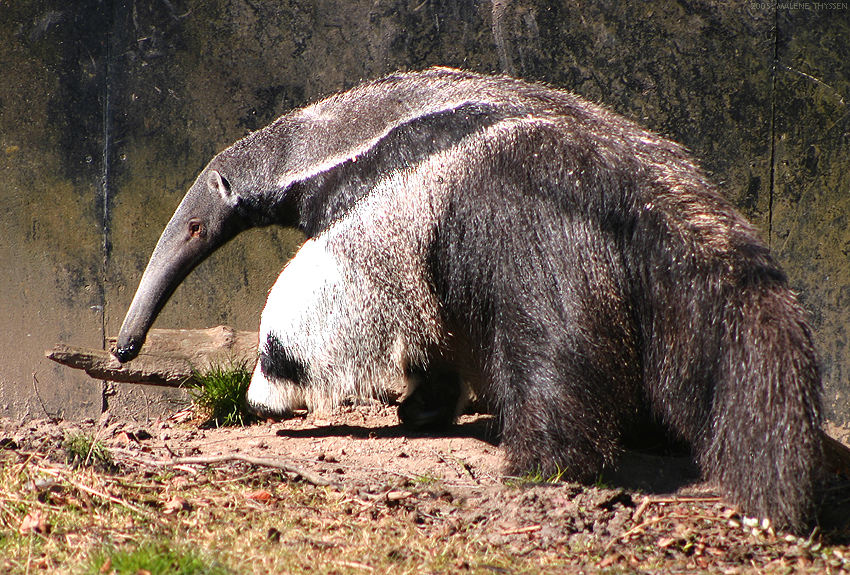
The giant anteater is the largest of the world's anteaters and one of the most ecologically distinctive mammals of the Neotropical savannas and forests it inhabits. A specialized predator of ants and termites, it ranges from Central America through much of South America, yet its numbers are falling across that range under pressure from habitat conversion, fire, and roads [IUCN 2025; Miranda et al. 2014]. This profile examines the species' unusual biology, the threats driving its decline, and the conservation work underway to keep it on the landscape.
Biology and Identification
The giant anteater is unmistakable. Adults reach a total length of roughly 182–217 cm including the long, bushy tail, with males weighing about 33–50 kg and females 27–47 kg [Gardner 2008]. The coat is grayish-brown with a bold black band, outlined in white, running diagonally from the throat across the shoulder. The snout is greatly elongated, the eyes and ears small, and the tail nearly as long as the body.
The species has no teeth. It feeds by tearing open ant and termite nests with powerful foreclaws, then extracting prey with a tongue that can extend around 60 cm and is coated in sticky saliva [Gardner 2008]. A single individual may consume many thousands of insects per day, sampling each nest only briefly before moving on — a foraging pattern that limits damage to any one colony and reflects the species' role as a specialist insectivore [Redford 1985].
Giant anteaters are generally solitary. Activity is flexibly diurnal or nocturnal: in warmer, more disturbed landscapes individuals tend toward nocturnal foraging, shifting to daytime activity in cooler conditions and less-populated areas [Camilo-Alves & Mourão 2006]. Females give birth to a single young after a gestation of roughly 170–190 days and carry the offspring on the back for an extended dependency period [Gardner 2008].
Habitat and Range
The giant anteater occupies a broad latitudinal range, from Honduras in Central America south through much of South America to northern Argentina and Uruguay [IUCN 2025]. It uses a wide variety of habitats, including tropical moist forest, dry forest, savanna, and grassland, but reaches its greatest densities in open and mosaic landscapes such as the Cerrado and the Pantanal where ant and termite biomass is high [Miranda et al. 2014].
Despite this wide distribution, the species has been lost from parts of its former range, including portions of Central America and the more heavily settled regions of southern and eastern South America [IUCN 2025]. Remaining populations are increasingly confined to protected areas and to landscapes where suitable open habitat persists.
In accordance with NRWL sensitive-species policy, specific site locations, den sites, and seasonal movement details are not disclosed in this article.
Conservation Status
The giant anteater is listed as Vulnerable on the IUCN Red List under criterion A2c, reflecting an inferred population reduction of at least 30% over the past decade driven by habitat loss, fire, and road mortality [IUCN 2025]. The species is included on CITES Appendix II, regulating international trade [CITES 2023].
A range-wide population total has not been established, and the assessment notes that further monitoring is needed. The IUCN classifies the overall population trend as decreasing [IUCN 2025]. Local studies illustrate the pressure: in landscapes bisected by highways, population viability analyses indicate that road mortality alone can reduce population growth rates to zero or below, undermining persistence even where habitat remains [Pinto et al. 2022]. In the United States, the giant anteater does not occur, but the species is afforded national protection in several range states.
Threats
Habitat loss and conversion are the leading pressures. Expansion of cattle ranching, soy, sugarcane, and other large-scale agriculture has fragmented the savanna and forest mosaics the species depends on, particularly across the Cerrado [Miranda et al. 2014].
Wildfire poses an acute and direct danger. Giant anteaters move slowly and cannot easily escape fast-moving grassland fires; large fire events in the Cerrado and Pantanal have caused substantial documented mortality and habitat loss [Miranda et al. 2014].
Road mortality is a major and well-quantified threat. Giant anteaters are frequently struck on highways that cross open habitat, and modeling shows roadkill can be sufficient on its own to drive local declines [Pinto et al. 2022].
Additional pressures include retaliatory and opportunistic killing, attacks by domestic dogs, and exposure to agrochemicals — factors that compound the effects of habitat change across much of the range [IUCN 2025].
What Is Being Done
Red List assessment and specialist coordination. The IUCN SSC Anteater, Sloth and Armadillo Specialist Group coordinates research and conservation planning for the giant anteater and its relatives, maintaining the species accounts and assessments that underpin national action [Xenarthrans SG 2024].
Protected areas. Large reserves across the Cerrado, Pantanal, and Amazonian range provide core habitat. Long-term occurrence work, including documentation of the species in Atlantic Forest highland protected areas, has refined understanding of where populations persist and where range gaps have opened [Miranda et al. 2014].
Road-mitigation and viability research. Studies quantifying road mortality have informed proposals for wildlife crossings, fencing, and speed management along highways through giant anteater habitat, translating viability modeling into concrete infrastructure recommendations [Pinto et al. 2022].
Population monitoring. Camera-trap surveys and density estimation are increasingly used to track populations and guide management at the reserve and landscape scale, addressing the data gaps highlighted in the global assessment [IUCN 2025].
How Readers Can Help
Citizen science. Photograph and log wildlife observations through platforms such as iNaturalist. Verified occurrence records contribute directly to range-mapping efforts and IUCN assessments.
Policy engagement. Support measures that conserve Cerrado and other Neotropical savanna habitats, fund wildlife-crossing infrastructure on highways through wildlife range, and uphold CITES Appendix II trade controls.
Informed consumer choices. Favor products linked to deforestation-free and fire-responsible supply chains, particularly for commodities such as beef and soy produced in giant anteater range countries.
Education outreach. Share accurate, science-based information about the ecological role of insectivorous mammals and the specific risks — fire and roads — that most affect this slow-moving species.
References
[Camilo-Alves & Mourão 2006] Camilo-Alves, C.S.P. & Mourão, G.M. (2006). Responses of a specialized insectivorous mammal (Myrmecophaga tridactyla) to variation in ambient temperature. Biotropica, 38(1), 52–56. https://doi.org/10.1111/j.1744-7429.2006.00106.x
[CITES 2023] CITES. (2023). Appendices I, II and III. Convention on International Trade in Endangered Species of Wild Fauna and Flora. https://cites.org/eng/app/appendices.php
[Gardner 2008] Gardner, A.L. (ed.) (2008). Mammals of South America, Volume 1: Marsupials, Xenarthrans, Shrews, and Bats. University of Chicago Press. https://press.uchicago.edu/ucp/books/book/chicago/M/bo5760463.html
[IUCN 2025] Miranda, F., Bertassoni, A. & Abba, A.M. (2025). Myrmecophaga tridactyla. The IUCN Red List of Threatened Species 2025: e.T14224A210444314. https://www.iucnredlist.org/species/14224/210444314
[Miranda et al. 2014] Miranda, F.R., Casali, D.M., Perini, F.A., Machado, F.A. & Santos, F.R. (2014). The Vulnerable giant anteater Myrmecophaga tridactyla: new records from the Atlantic Forest highlands and an overview of its occurrence in protected areas in Brazil. Oryx, 50(2), 1–7. https://doi.org/10.1017/S0030605315000095
[Pinto et al. 2022] Pinto, F.A.S., Bager, A., Clevenger, A.P. & Grilo, C. (2022). Assessing the impact of roadkill on the persistence of wildlife populations: a case study on the giant anteater. Perspectives in Ecology and Conservation, 20(3), 248–256. https://doi.org/10.1016/j.pecon.2022.06.001
[Redford 1985] Redford, K.H. (1985). Feeding and food preference in captive and wild giant anteaters (Myrmecophaga tridactyla). Journal of Zoology, 205(4), 559–572. https://doi.org/10.1111/j.1469-7998.1985.tb03544.x
[Xenarthrans SG 2024] IUCN SSC Anteater, Sloth and Armadillo Specialist Group. (2024). Giant Anteater Myrmecophaga tridactyla species account. https://xenarthrans.org/