
Conservation's Most Famous Logo — and a Genuine Downlisting Success
The giant panda is the most recognisable conservation symbol in the world — the WWF logo since 1961 — and one of the few large mammals whose IUCN status has improved in recent decades. In 2016 the IUCN downlisted the species from Endangered to Vulnerable, reflecting a documented wild-population increase to approximately 1,864 adults in the 2014 Chinese national survey, up from an estimated ~1,100 in the 1980s [Swaisgood et al. 2016; State Forestry Administration of China 2015]. China's own assessment went further, reclassifying the panda from "Endangered" to "Vulnerable" in its national species list in 2021 [China National Forestry and Grassland Administration 2021].
The downlisting was contested by some who feared it would reduce conservation urgency, but it rested on real survey data: sustained habitat protection, an expanding reserve network, and a successful captive-breeding-and-release program produced a measurable population recovery. The panda is the clearest large-mammal case for the proposition that intensive, well-funded, government-led conservation works.
Biology and identification
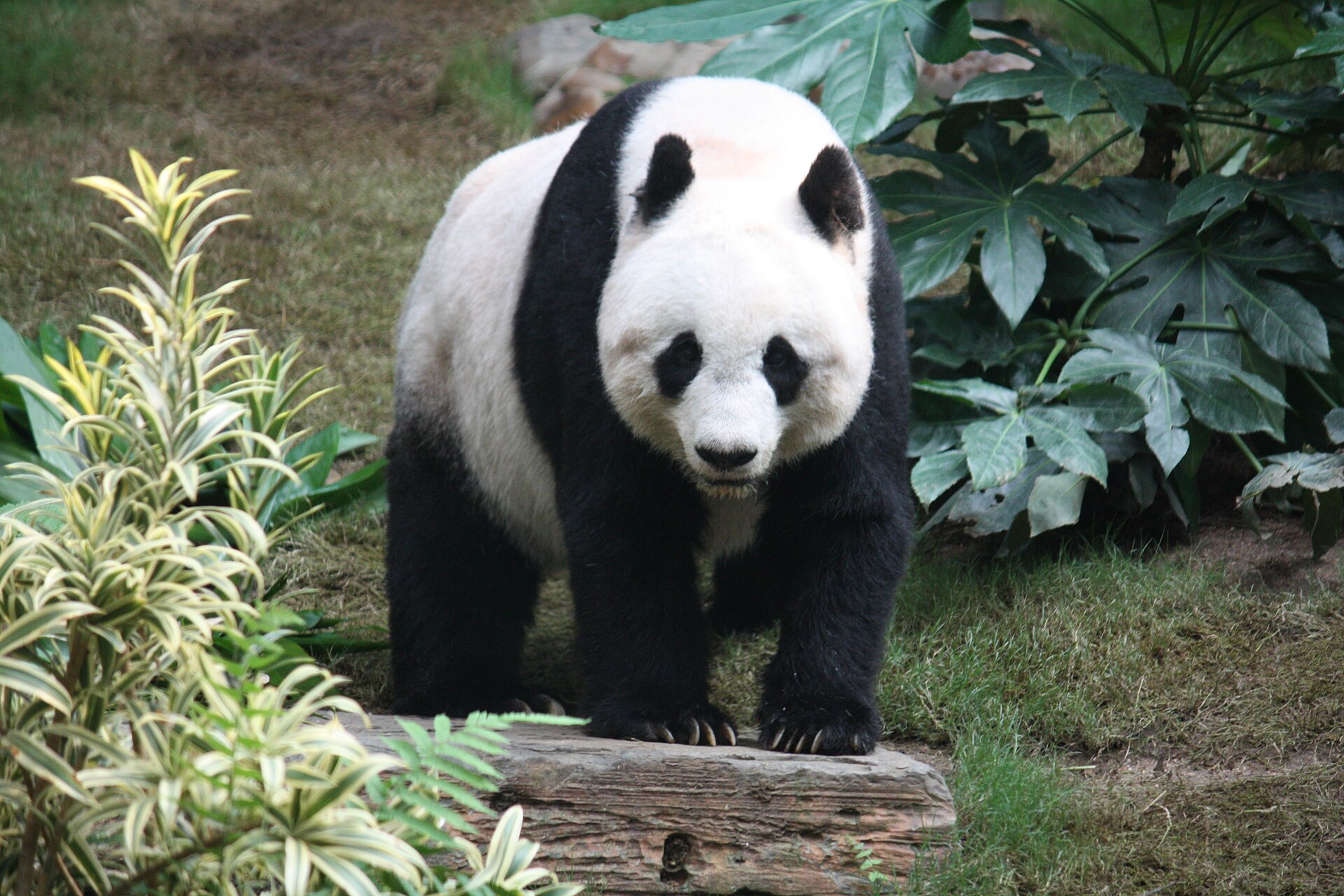
Ailuropoda melanoleuca is a member of the bear family (Ursidae), distinguished by its iconic black-and-white pelage: black ears, eye patches, muzzle, legs, and shoulder band on a white body. Adults reach 1.2–1.9 m in length and 70–125 kg [Schaller et al. 1985].
The panda's defining biological feature is its near-total dietary specialisation on bamboo — approximately 99% of the diet by volume — despite retaining the digestive tract of a carnivore. Pandas have a "pseudo-thumb" (an enlarged radial sesamoid bone) used to grip bamboo stems, and a low-efficiency digestive system that requires them to eat 12–38 kg of bamboo per day and spend up to 14 hours daily feeding [Schaller et al. 1985]. This specialisation makes pandas acutely dependent on the health and continuity of bamboo forests — and vulnerable to bamboo die-offs (bamboo species flower and die synchronously at multi-decade intervals).
Reproduction is slow: females are fertile for only 1–3 days per year, typically produce a single surviving cub every 2 years, and cubs are born extraordinarily small (~100 g, ~1/900 of the mother's weight). This low reproductive rate was historically a barrier to captive breeding, since overcome through improved husbandry and artificial insemination techniques.
Habitat and range
Endemic to a small area of central China — the mountain ranges of Sichuan, Shaanxi, and Gansu provinces, principally the Minshan and Qinling ranges, at elevations of 1,200–3,400 m in temperate montane forest with bamboo understory [Swaisgood et al. 2016]. The historical range was far larger (extending across much of eastern and southern China and into northern Vietnam and Myanmar) but contracted to the current montane refugia under millennia of human population growth and habitat conversion.
Current wild distribution is fragmented across approximately 30+ subpopulations, many small and isolated by roads, agriculture, and infrastructure. Habitat fragmentation — which impedes the gene flow between subpopulations needed for long-term viability — remains the principal ongoing concern even as total numbers have risen.
Conservation status
The giant panda is listed as Vulnerable on the IUCN Red List (downlisted from Endangered in 2016) [Swaisgood et al. 2016]. China lists it as a first-class protected species and reclassified it from Endangered to Vulnerable nationally in 2021. CITES Appendix I prohibits international commercial trade.
The 2014 Chinese national panda survey — the fourth such decadal survey — recorded 1,864 wild adults plus dependent young, an increase of approximately 17% over the third survey (2003). The reserve network protecting panda habitat expanded substantially over the same period, and in 2021 China formally established the Giant Panda National Park — a ~22,000 km² protected area consolidating dozens of previously-separate reserves into a connected landscape [China NFGA 2021].
Threats
Habitat fragmentation is now the principal threat — not total habitat loss (which has stabilised in protected areas) but the division of habitat into isolated patches by roads, railways, hydropower infrastructure, agriculture, and tourism development. Fragmentation isolates small subpopulations, reducing gene flow and raising local-extinction risk for the smallest groups [Swaisgood et al. 2016].
Bamboo die-offs and climate change. Bamboo species flower and die synchronously every few decades; a die-off in a fragmented landscape can trap a panda subpopulation without an accessible alternative bamboo stand. Climate-change modelling projects significant northward and upward shifts in suitable bamboo habitat over the coming century, with the risk that protected-area boundaries (fixed in space) may not contain the future bamboo range [Songer et al. 2012].
Infrastructure development within and around panda range — roads, tourism facilities, hydropower — continues to pressure habitat connectivity despite the National Park designation.
Historical poaching has been largely controlled through strict enforcement; pandas are occasionally caught in snares set for other species (musk deer, bears), a residual bycatch threat.
What is being done
- Giant Panda National Park (2021) — the flagship measure: a ~22,000 km² connected protected landscape across Sichuan, Shaanxi, and Gansu, consolidating 60+ previously-fragmented reserves and explicitly designed to restore habitat connectivity between subpopulations [China NFGA 2021].
- China Conservation and Research Center for the Giant Panda (Wolong and other bases) — the captive-breeding hub. Captive breeding, once a notorious failure, was transformed through husbandry research; the captive population now exceeds 600 and supports an active reintroduction program.
- Reintroduction program — captive-bred pandas trained in semi-wild enclosures and released into the wild to reinforce small subpopulations, with documented (if mixed) survival outcomes.
- WWF China — has worked on panda conservation since 1980 (the first international NGO invited to work in China), focused on habitat-corridor restoration connecting fragmented subpopulations.
- Panda "diplomacy" loan revenue — pandas loaned to international zoos generate fees (typically ~$1M/year per pair) that are directed to in-country conservation, a self-funding mechanism unusual among endangered species.
How readers can help
- Support WWF and the broader China habitat-corridor work. The remaining conservation challenge is connectivity, not raw numbers; corridor restoration between subpopulations is the highest-leverage work.
- Visit pandas at accredited zoos rather than roadside attractions. Accredited zoos (members of WAZA / AZA / EAZA) channel panda-loan fees to in-country conservation and maintain the captive-breeding genetics program. Roadside or unaccredited panda-display operations do not.
- Support climate policy. The long-term threat to panda habitat is climate-driven bamboo-range shift. Climate mitigation protects the future bamboo forests the species depends on.
- Be skeptical of "panda is saved" narratives. The downlisting to Vulnerable is real and earned, but the species remains dependent on continued intensive management and faces a climate-driven habitat challenge over the coming century. Sustained funding matters precisely because the success could erode.
- Support broader Chinese biodiversity work. The panda's umbrella-species role means that protecting panda habitat protects thousands of co-occurring species (golden snub-nosed monkey, takin, red panda, many endemic plants). Organizations working on the Giant Panda National Park benefit the whole ecosystem.
Last verified: 2026-05-24 Conservation status: Vulnerable (IUCN Red List 2016 assessment; downlisted from Endangered); ~1,864 wild adults (2014 China national survey).
References
- China National Forestry and Grassland Administration (2021). Establishment of Giant Panda National Park and national species reclassification. Beijing.
- Schaller, G. B., Hu, J., Pan, W., & Zhu, J. (1985). The Giant Pandas of Wolong. University of Chicago Press.
- Songer, M., Delion, M., Biggs, A., & Huang, Q. (2012). Modeling impacts of climate change on giant panda habitat. International Journal of Ecology 2012: 108752.
- State Forestry Administration of China (2015). Results of the Fourth National Giant Panda Survey. Beijing.
- Swaisgood, R., Wang, D., & Wei, F. (2016). Ailuropoda melanoleuca. IUCN Red List of Threatened Species. e.T712A45033386.