
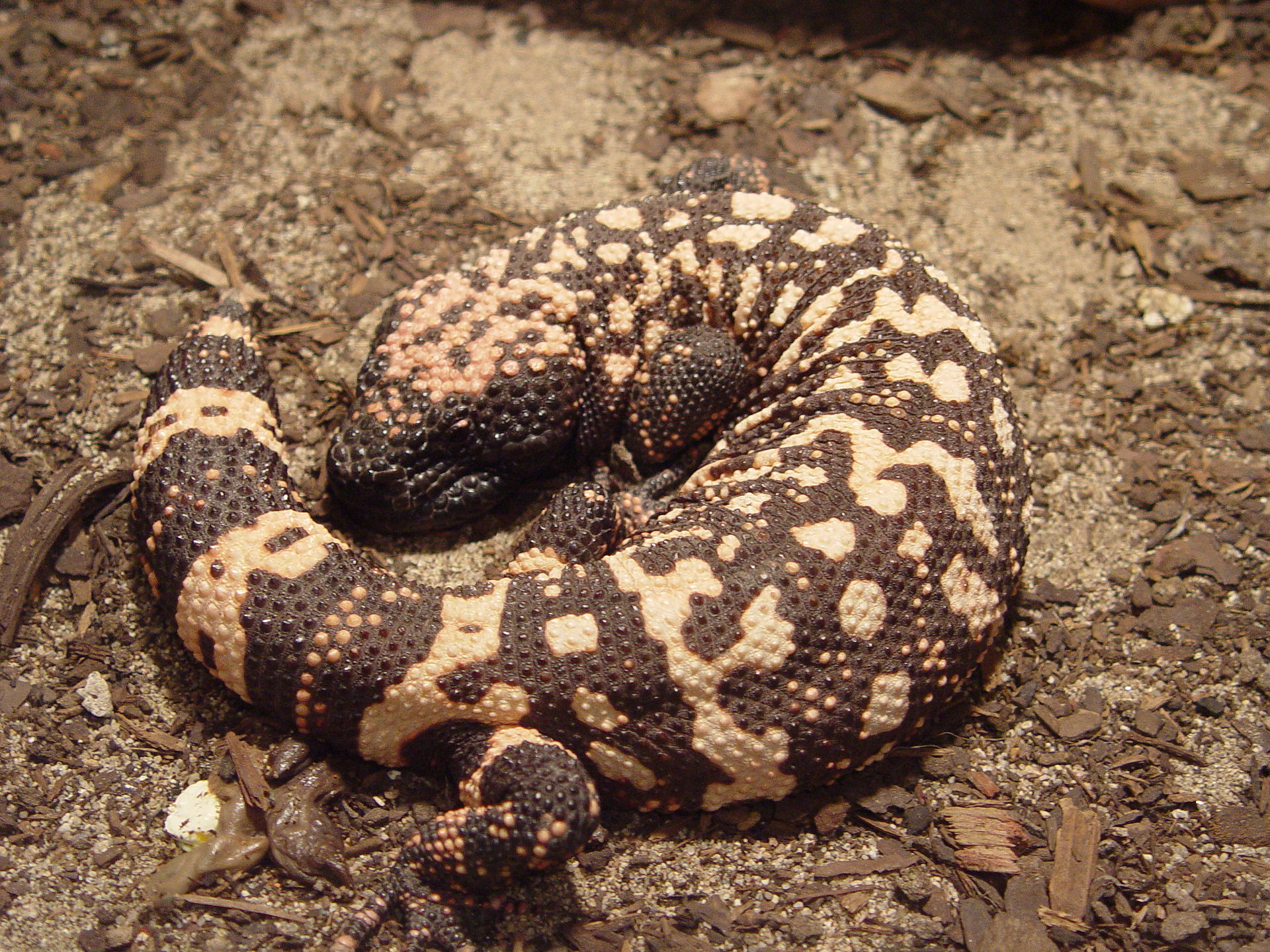
The Gila monster is one of only a small number of venomous lizards in the world and the largest lizard native to the United States, a stout, slow-moving desert reptile whose beaded skin and black-and-orange banding make it instantly recognizable. Restricted to the deserts of the southwestern United States and northwestern Mexico, it spends the overwhelming majority of its life sheltering underground, emerging for only a few weeks each year [Hammerson et al. 2007; Beck 1990]. This profile examines the animal's distinctive biology, the medical discoveries that emerged from its venom, the pressures it now faces, and the conservation measures protecting it.
Biology and Identification
The Gila monster is a heavy-bodied lizard reaching roughly 35–50 cm in total length and commonly weighing 350–700 g, making it the largest extant lizard native to the United States [Beck 1990]. Its skin is covered in bead-like osteoderms — bony scales — producing the pebbled texture for which the family Helodermatidae is known. The coloration is a striking pattern of pink, orange, or yellow markings on a dark ground, a contrast widely interpreted as aposematic warning coloration [Bogert & Martin del Campo 1956].
Unusually among lizards, the Gila monster is venomous. Venom is produced in modified glands in the lower jaw and delivered through grooved teeth as the animal chews, rather than injected through fangs [Bogert & Martin del Campo 1956]. Detailed proteomic analysis has catalogued the components of this venom, including kallikrein-like enzymes, phospholipase A2, and a suite of bioactive peptides [Sanggaard et al. 2015]. One such peptide, exendin-4, was isolated from the venom in 1992 and shown to share roughly half its amino acid sequence with the human hormone glucagon-like peptide-1 [Eng et al. 1992].
The species is a binge feeder with a notably low metabolic rate. It can consume a very large meal relative to its body mass and stores fat in its tail to sustain long fasts, feeding only a handful of times per year [Beck 1990]. Diet consists chiefly of the contents of nests — bird and reptile eggs and nestling birds and mammals — located largely by scent [Beck 1990]. Body temperature is held comparatively low for a desert lizard, and individuals raise their temperature after feeding to aid digestion [Gienger et al. 2013].
Habitat and Range
The Gila monster occupies arid and semi-arid habitats including desert scrub, thornscrub, and the lower margins of oak woodland, frequently in rocky foothills and along drainages where shelter sites are available [Hammerson et al. 2007]. Its range spans the southwestern United States — Arizona, parts of Nevada, Utah, New Mexico, and California — and extends south into the Mexican state of Sonora [Hammerson et al. 2007; Nowak 2006].
Telemetry studies show that the species spends the great majority of its life inactive in burrows and rock shelters, with surface activity concentrated into a short period in spring and early summer; recorded home ranges vary widely with environment, from a few hectares to well over a hundred [Beck 1990; Edelkind et al. 2025]. This reliance on underground refuges shapes both the animal's thermal ecology and its vulnerability to disturbance.
In accordance with NRWL sensitive-species policy, specific shelter-site locations, burrow coordinates, and seasonal movement details are not disclosed in this article.
Conservation Status
The Gila monster is listed as Near Threatened on the IUCN Red List [Hammerson et al. 2007]. The assessment, published in 2007 (taxon 9865; assessment 13022716), notes that the species is probably in significant decline — though at an estimated rate below the threshold for a threatened category — driven primarily by habitat loss across much of its range, and that its population trend is decreasing [Hammerson et al. 2007]. International trade is regulated under CITES Appendix II, which covers the genus Heloderma (with the Guatemalan species H. charlesbogerti listed on Appendix I) [CITES 2023].
The species also carries longstanding domestic protection. In 1952 Arizona made it illegal to collect or kill the Gila monster — the first venomous animal in the United States to receive such legal protection — and it remains protected by state law across its U.S. range [Brennan & Holycross 2006].
Threats
Habitat loss and fragmentation are the principal drivers of decline. Urban expansion, agriculture, and road construction across the desert Southwest remove and fragment the shelter-rich foothill habitats the species depends on, and the IUCN assessment identifies habitat loss as the main pressure on the population [Hammerson et al. 2007].
Climate change poses a longer-term threat. Modeling of future habitat suitability in the Mojave Desert projects that under high-emission scenarios suitable habitat could shrink substantially by the latter part of the century, with newly suitable areas often too distant to be reached by the lizard's limited natural dispersal — raising the risk of population isolation [Hromada et al. 2025].
Illegal collection for the pet trade continues despite legal protection, a concern reflected in the species' CITES Appendix II listing [CITES 2023]. The animal's slow life history and infrequent surface activity make local populations slow to recover from removals.
Direct killing persists where the species is feared, a problem compounded by enduring myths about its danger; deliberate persecution has historically been a source of mortality [Brennan & Holycross 2006].
What Is Being Done
Legal protection. The Gila monster is protected under state wildlife law throughout its U.S. range, building on Arizona's pioneering 1952 statute, and international commercial trade is regulated through its CITES Appendix II listing [Brennan & Holycross 2006; CITES 2023].
Long-term field research. Multi-population telemetry and ecological studies — including decades of work in Utah and recent range-wide syntheses of space-use data — provide the population and habitat information needed to guide management [Beck 1990; Edelkind et al. 2025]. Studies of the species' thermal biology and feeding ecology further clarify how it will respond to a warming, drying climate [Gienger et al. 2013; Hromada et al. 2025].
Biomedical recognition. The discovery of exendin-4 in Gila monster venom led to the development of the medication exenatide, approved in the United States in 2005 for type 2 diabetes and now part of a widely used class of GLP-1 receptor agonist drugs [Eng et al. 1992; Yap & Misuan 2019]. This history is frequently cited as a concrete example of why preserving genetic and biochemical diversity in wild species has tangible value.
Managed populations. Accredited zoos maintain and breed Gila monsters, supporting public education that counters the fear-driven persecution the species has long suffered [Brennan & Holycross 2006].
How Readers Can Help
Observe, do not handle. A Gila monster encountered in the wild should be watched from a distance and left undisturbed; the species is protected by law across its U.S. range, and collection or harassment is prohibited [Brennan & Holycross 2006].
Citizen science. Photograph and log wildlife sightings through platforms such as iNaturalist. Verified occurrence records contribute directly to range-mapping and conservation assessments.
Support desert habitat protection. Habitat loss is the species' primary threat, so backing the protection of intact desert and foothill landscapes — including connectivity between habitat patches — addresses the pressure that matters most [Hammerson et al. 2007; Hromada et al. 2025].
Share accurate information. Persistent myths about the Gila monster's danger drive needless killing. Sharing science-based information about the animal's biology and its protected status helps reduce persecution [Brennan & Holycross 2006].
References
[Beck 1990] Beck, D.D. (1990). Ecology and behavior of the Gila monster in southwestern Utah. Journal of Herpetology, 24(1), 54–68. https://www.jstor.org/stable/1564290
[Bogert & Martin del Campo 1956] Bogert, C.M. & Martín del Campo, R. (1956). The Gila Monster and Its Allies: The Relationships, Habits, and Behavior of the Lizards of the Family Helodermatidae. Bulletin of the American Museum of Natural History, 109, 1–238. https://digitallibrary.amnh.org/handle/2246/1148
[Brennan & Holycross 2006] Brennan, T.C. & Holycross, A.T. (2006). A Field Guide to Amphibians and Reptiles in Arizona. Arizona Game and Fish Department, Phoenix. https://www.azgfd.com
[CITES 2023] CITES. (2023). Appendices I, II and III. Convention on International Trade in Endangered Species of Wild Fauna and Flora. https://cites.org/eng/app/appendices.php
[Edelkind et al. 2025] Edelkind, M.M., Stalker, J.B., Beck, D.D., DeNardo, D.F., Emblidge, P.G., Gallardo, B., Gentry, H., Goode, M., Jennings, R.D., Jones, J.L., Kwiatkowski, M.A., Nowak, E.M., Repp, R., Schuett, G.W., Sullivan, B.K., Tracy, C.R. & Gienger, C.M. (2025). Environmental influences on space use of Gila monsters (Heloderma suspectum). Herpetologica, 81(3). https://doi.org/10.1655/Herpetologica-D-24-00053
[Eng et al. 1992] Eng, J., Kleinman, W.A., Singh, L., Singh, G. & Raufman, J.P. (1992). Isolation and characterization of exendin-4, an exendin-3 analogue, from Heloderma suspectum venom. Journal of Biological Chemistry, 267(11), 7402–7405. https://doi.org/10.1016/S0021-9258(18)42531-8
[Gienger et al. 2013] Gienger, C.M., Tracy, C.R. & Zimmerman, L.C. (2013). Thermal responses to feeding in a secretive and specialized predator (Gila monster, Heloderma suspectum). Journal of Thermal Biology, 38(3), 143–147. https://doi.org/10.1016/j.jtherbio.2012.12.004
[Hammerson et al. 2007] Hammerson, G.A., Frost, D.R. & Gadsden, H. (2007). Heloderma suspectum. The IUCN Red List of Threatened Species 2007: e.T9865A13022716. https://dx.doi.org/10.2305/IUCN.UK.2007.RLTS.T9865A13022716.en
[Hromada et al. 2025] Hromada, S.J., Jones, J.L., Stalker, J.B., Wood, D.A., Vandergast, A.G., Tracy, C.R., Gienger, C.M. & Nussear, K.E. (2025). Climate and dispersal ability limit future habitats for Gila monsters in the Mojave Desert. Ecology and Evolution, 15(3), e71008. https://doi.org/10.1002/ece3.71008
[Nowak 2006] Nowak, E.M. (2006). Gila monster (Heloderma suspectum). U.S. Geological Survey Fact Sheet 2006-3061. https://doi.org/10.3133/fs20063061
[Sanggaard et al. 2015] Sanggaard, K.W., Dyrlund, T.F., Thomsen, L.R., Nielsen, T.A., Brøndum, L., Wang, T., Thøgersen, I.B. & Enghild, J.J. (2015). Characterization of the gila monster (Heloderma suspectum suspectum) venom proteome. Journal of Proteomics, 117, 1–11. https://doi.org/10.1016/j.jprot.2015.01.004
[Yap & Misuan 2019] Yap, M.K.K. & Misuan, N. (2019). Exendin-4 from Heloderma suspectum venom: From discovery to its latest application as type II diabetes combatant. Basic & Clinical Pharmacology & Toxicology, 124(5), 513–527. https://doi.org/10.1111/bcpt.13169