
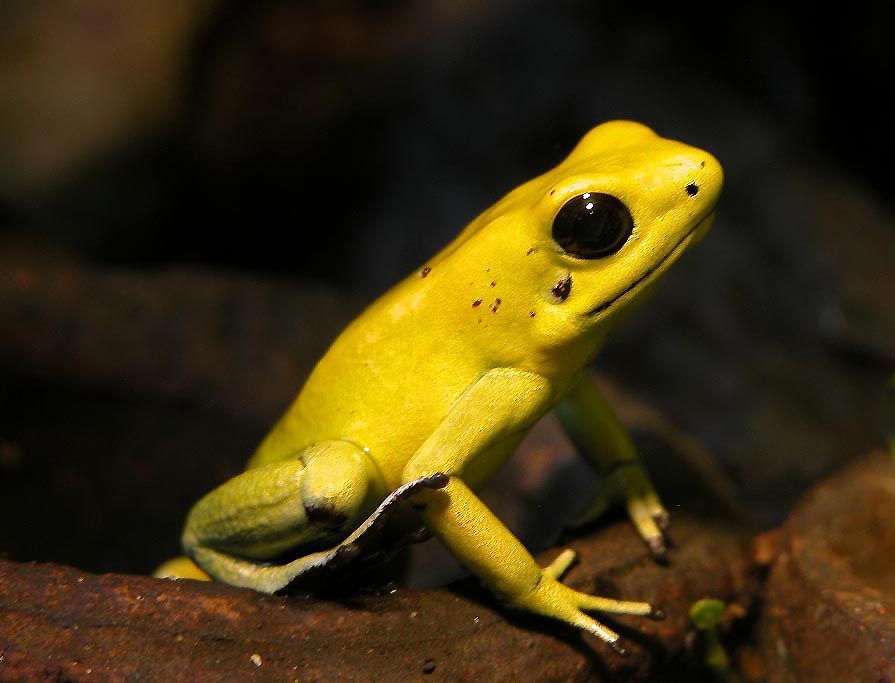
The golden poison frog is among the most toxic animals known to science and one of the most range-restricted vertebrates on Earth. Endemic to a small stretch of lowland rainforest on Colombia's Pacific coast, it carries enough batrachotoxin in its skin to make a single adult lethally dangerous, a chemistry that indigenous Emberá communities historically harnessed to arm blowgun darts [Myers et al. 1978]. This profile examines the frog's distinctive biology, the narrow habitat that defines its survival, and the conservation pressures bearing down on a species confined to fewer than a handful of known sites.
Biology and Identification
The golden poison frog is the largest of the poison-dart frogs (family Dendrobatidae), reaching roughly 5–6 cm in snout-vent length, with females typically larger than males [Myers et al. 1978]. Adults are uniformly bright in coloration — most populations are golden yellow, while others are metallic mint-green or orange — an example of aposematism, in which conspicuous color advertises chemical defense to potential predators.
That defense is extraordinary. The skin secretes batrachotoxin and homobatrachotoxin, steroidal alkaloids that bind voltage-gated sodium channels and hold them open, disrupting nerve and muscle function. Phyllobates terribilis produces these compounds in far greater quantity than any congener and is at least twenty-fold more toxic than other Phyllobates species [Myers et al. 1978; Daly et al. 1980]. The frog does not synthesize the toxin itself; like other dendrobatids it sequesters alkaloids from dietary arthropods, with melyrid beetles (genus Choresine) identified as a probable batrachotoxin source in the wild [Dumbacher et al. 2004]. Captive-raised frogs fed standard feeder insects lose their toxicity, and captive-bred offspring are effectively non-toxic [Dumbacher et al. 2004].
How the frog tolerates a toxin that targets its own sodium channels has been a long-running research question. Amino-acid substitutions in the muscle sodium channel were proposed as the mechanism, and a single engineered substitution can confer batrachotoxin resistance to a rat channel in the laboratory [Wang & Wang 2017]. However, comparative work across Phyllobates found that autoresistance does not track toxicity as cleanly as a simple target-mutation model predicts, indicating the picture is more complex than channel mutations alone [Márquez et al. 2019; Abderemane-Ali et al. 2021].
Reproduction involves terrestrial courtship and external fertilization; after hatching, larvae are transported to small water bodies to complete development, a parental-care strategy shared broadly among dendrobatid frogs [Myers et al. 1978].
Habitat and Range
The golden poison frog is endemic to the Pacific lowland rainforest of southwestern Colombia, historically documented along the Río Saija drainage in Cauca Department and, following later fieldwork, in southern Valle del Cauca Department, extending the known range northward [Márquez et al. 2012]. Records span from near sea level up to roughly 200 m elevation, in perpetually wet forest receiving very high annual rainfall [Márquez et al. 2012; IUCN SSC Amphibian Specialist Group 2017].
The species occupies an exceptionally small total area. The IUCN assessment reports an extent of occurrence on the order of about 1,500 km², with the frog known from only a few threat-defined locations [IUCN SSC Amphibian Specialist Group 2017]. Recent molecular phylogenetic work has further refined the boundaries of the species by describing two closely related sister species formerly confounded with toxic yellow Phyllobates, underscoring how narrowly P. terribilis itself is circumscribed [Amézquita et al. 2024].
In accordance with NRWL sensitive-species policy, specific breeding-site locations, aggregation coordinates, and seasonal movement details are not disclosed in this article.
Conservation Status
The golden poison frog is listed as Endangered on the IUCN Red List, assessed by the IUCN SSC Amphibian Specialist Group in 2017 under criterion B1ab(iii), reflecting an extent of occurrence below the threshold, severe habitat fragmentation across very few locations, and a continuing decline in habitat quality [IUCN SSC Amphibian Specialist Group 2017]. The population trend is reported as decreasing. The species is also included on CITES Appendix II, which regulates international commercial trade to ensure it is not detrimental to wild populations [CITES 2023].
Threats
Habitat loss and degradation are the dominant pressures. Within the frog's narrow Pacific-coast range, forest is being cleared and degraded by logging, conversion to agriculture, mining, and associated pollution, steadily reducing the small area of suitable habitat the species depends on [IUCN SSC Amphibian Specialist Group 2017].
Restricted range and few localities compound every other threat. Because the entire global distribution is small and the frog is known from only a handful of sites, a localized disturbance can affect a disproportionate share of the species [IUCN SSC Amphibian Specialist Group 2017].
Collection for the international pet trade has been documented as an additional pressure on a charismatic, highly sought species, the reason it is subject to CITES trade controls [Márquez et al. 2012; CITES 2023].
Amphibians worldwide also face the fungal disease chytridiomycosis; while the golden poison frog's confinement to a tiny range already places it at risk, the broader amphibian disease landscape is a recognized background concern for the group.
What Is Being Done
Protected habitat. A dedicated reserve, the Rana Terribilis Amphibian Reserve, was established by the Colombian NGO Fundación ProAves to safeguard habitat for this species, which previously had no formal protected area within its range [ProAves 2024].
Coordinated ex-situ breeding. The golden poison frog is widely and successfully bred in captivity, and the European Association of Zoos and Aquaria (EAZA) has moved to coordinate conservation breeding so that managed populations can support research and education without drawing on wild stock [Citizen Conservation 2024].
Taxonomic and field research. Continued survey and molecular work has extended the documented range and clarified species limits within toxic Phyllobates, information that directly improves the accuracy of conservation assessments and the targeting of protection efforts [Márquez et al. 2012; Amézquita et al. 2024].
How Readers Can Help
Support habitat protection. The single greatest lever for this species is keeping its remaining Pacific-coast rainforest intact. Supporting reputable organizations that protect Colombian Chocó rainforest contributes to the habitat the frog requires.
Choose captive-bred animals only. If keeping dendrobatid frogs as part of the hobby, source only legally captive-bred animals and never wild-collected specimens, consistent with CITES Appendix II controls [CITES 2023].
Support amphibian science. Verified observation records and museum-grade documentation contribute to range mapping and IUCN reassessment. Reporting wildlife sightings through recognized biodiversity platforms helps build the data assessments rely on.
Share accurate information. Communicating the real conservation situation — a uniquely toxic frog confined to a shrinking patch of rainforest — builds informed public support for protecting one of the world's most remarkable amphibians.
References
[Abderemane-Ali et al. 2021] Abderemane-Ali, F., Rossen, N.D., Kobiela, M.E., Craig, R.A., Garrison, C.E., Chen, Z., Colleran, C.M., O'Connell, L.A., Du Bois, J., Dumbacher, J.P. & Minor, D.L. (2021). Evidence that toxin resistance in poison birds and frogs is not rooted in sodium channel mutations and may rely on "toxin sponge" proteins. Journal of General Physiology, 153(9), e202112872. https://doi.org/10.1085/jgp.202112872
[Amézquita et al. 2024] Amézquita, A., Vargas-Salinas, F., Ramos, I., Palacios-Rodríguez, P., Salazar, E.N., Quiroz, M., Bolívar, W., Galindo-Uribe, D.M. & Mazariegos-H, L.A. (2024). Molecular phylogenetics uncovers two new species in the genus Phyllobates (Anura, Dendrobatidae): the terrible frog gets two new sisters. ZooKeys, 1212, 217–240. https://doi.org/10.3897/zookeys.1212.126733
[Citizen Conservation 2024] Citizen Conservation. (2024). Basic Information and Care Recommendations for Phyllobates terribilis (Breeding Guidelines, July 2024). https://citizen-conservation.org/wp-content/uploads/2024/10/CC-Breeding-Guidelines_Phyllobates-terribilis_07-2024.pdf
[CITES 2023] CITES. (2023). Appendices I, II and III. Convention on International Trade in Endangered Species of Wild Fauna and Flora. https://cites.org/eng/app/appendices.php
[Daly et al. 1980] Daly, J.W., Myers, C.W., Warnick, J.E. & Albuquerque, E.X. (1980). Levels of batrachotoxin and lack of sensitivity to its action in poison-dart frogs (Phyllobates). Science, 208(4450), 1383–1385. https://doi.org/10.1126/science.6246586
[Dumbacher et al. 2004] Dumbacher, J.P., Wako, A., Derrickson, S.R., Samuelson, A., Spande, T.F. & Daly, J.W. (2004). Melyrid beetles (Choresine): A putative source for the batrachotoxin alkaloids found in poison-dart frogs and toxic passerine birds. Proceedings of the National Academy of Sciences USA, 101(45), 15857–15860. https://doi.org/10.1073/pnas.0407197101
[IUCN SSC Amphibian Specialist Group 2017] IUCN SSC Amphibian Specialist Group. (2017). Phyllobates terribilis. The IUCN Red List of Threatened Species 2017: e.T55264A85887889. https://dx.doi.org/10.2305/IUCN.UK.2017-3.RLTS.T55264A85887889.en
[Márquez et al. 2012] Márquez, R., Corredor, G., Galvis, C., Góez, D. & Amézquita, A. (2012). Range extension of the critically endangered true poison-dart frog, Phyllobates terribilis (Anura: Dendrobatidae), in western Colombia. Acta Herpetologica, 7(2), 341–345. https://doi.org/10.13128/Acta_Herpetol-11387
[Márquez et al. 2019] Márquez, R., Ramírez-Castañeda, V. & Amézquita, A. (2019). Does batrachotoxin autoresistance coevolve with toxicity in Phyllobates poison-dart frogs? Evolution, 73(2), 390–400. https://doi.org/10.1111/evo.13672
[Myers et al. 1978] Myers, C.W., Daly, J.W. & Malkin, B. (1978). A dangerously toxic new frog (Phyllobates) used by Emberá Indians of western Colombia, with discussion of blowgun fabrication and dart poisoning. Bulletin of the American Museum of Natural History, 161(2), 307–366. https://digitallibrary.amnh.org/items/d82fffd4-13a8-4bc0-97df-40e96e7e6f14
[ProAves 2024] Fundación ProAves. (2024). Reserva Natural Ranita Terribilis (Rana Terribilis Amphibian Reserve). https://proaves.org/en/ranita-terribilis-proaves-reserve/
[Wang & Wang 2017] Wang, S.-Y. & Wang, G.K. (2017). Single rat muscle Na+ channel mutation confers batrachotoxin autoresistance found in poison-dart frog Phyllobates terribilis. Proceedings of the National Academy of Sciences USA, 114(39), 10491–10496. https://doi.org/10.1073/pnas.1707873114