
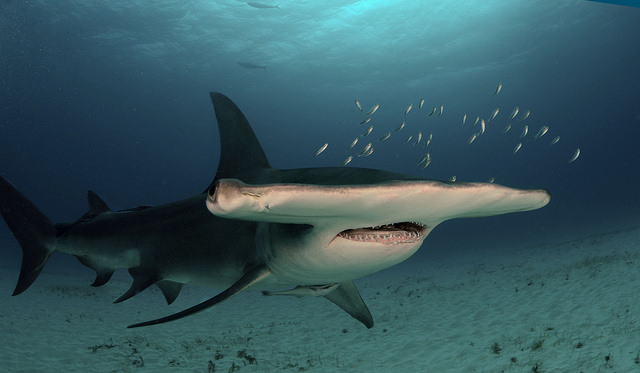
A Five-Metre Apex Predator Driven to Critical Endangerment by the Fin Trade
The great hammerhead is the largest of the nine hammerhead shark species. It is a wide-ranging tropical and warm-temperate apex predator with a global circumtropical distribution, reaching 5+ metres in length and historically common across coastal and offshore waters in every tropical ocean basin [Compagno 2001; Casper et al. 2019]. The IUCN listed Sphyrna mokarran as Critically Endangered in 2019, with population declines estimated at >80% over the past three generations across most of its range — attributed primarily to bycatch and targeted catch for the international shark-fin trade [Rigby et al. 2019].
The hammerhead's cephalofoil (the distinctive head structure) is densely packed with electroreceptors (ampullae of Lorenzini) that detect the bioelectric fields of buried prey. This makes the species extraordinarily effective at finding stingrays and other benthic prey — and also makes the fin (which is large, smooth-edged, and easily identifiable in trade) one of the most prized in the shark-fin market.
Biology and identification
Sphyrna mokarran is identified by:
- Very tall, slightly curved first dorsal fin — taller than in any other shark, used as the principal field identification character at distance
- Nearly straight leading edge of the cephalofoil with a central notch (vs. the more curved or scalloped heads of other Sphyrna species)
- Greatest total length recorded approximately 6.1 m, though most adults are 3.5–4.5 m
- Adults typically weigh 200–450 kg [Compagno 2001]
Reproductive biology is the binding constraint on recovery:
- Females first reproduce at approximately 8–9 years
- Generation time approximately 20 years
- Gestation 11 months; viviparous (live birth), litter sizes 6–55 pups
- Reproductive frequency typically every 2 years
This combination — late maturity, long generation time, biennial reproduction — gives the species one of the slowest population recovery potentials of any shark family, and explains why even a modest sustained reduction in adult survival produces the >80% three-generation decline documented by IUCN.
Habitat and range
Circumtropical: the species occurs in all warm-temperate and tropical oceans worldwide, typically 1–80 m depth over continental shelves but ranging into open-ocean and to depths exceeding 300 m [Compagno 2001]. Documented populations across:
- Western Atlantic: Florida, Bahamas, Caribbean, Gulf of Mexico, Brazil
- Eastern Atlantic: West Africa from Mauritania to Angola
- Indo-Pacific: Red Sea, East Africa, India, Southeast Asia, Australia, the central Pacific
- Eastern Pacific: Baja California to northern Peru, with the principal aggregation sites at Cocos, Galápagos, and Malpelo Islands [Casper et al. 2019]
Migratory connectivity across these regions is documented through both tagging and genetic studies. Significant aggregation sites support fisheries-research and ecotourism economies — particularly Bimini in the Bahamas, the central Bahamas, the Galápagos, and the Cocos Island archipelago.
Conservation status
The great hammerhead is listed as Critically Endangered on the IUCN Red List [Rigby et al. 2019]. It is on CITES Appendix II (since 2013, jointly with three other shark species including scalloped hammerhead) [CITES CoP16 2013]. The Appendix II listing requires that any international commercial trade be supported by a non-detriment finding from the exporting country's CITES Scientific Authority.
In November 2022 at CITES CoP19, all remaining members of the family Carcharhinidae plus six additional hammerhead-relevant species were listed on Appendix II, substantially expanding the international regulatory framework for shark-fin trade. The great hammerhead's Appendix II listing pre-dates this expansion but benefits from the broader regulatory environment it created [CITES CoP19 2022].
US federal protection: NMFS prohibits commercial retention of hammerheads in the federal Atlantic shark fishery; recreational catch limits apply. Several US states have additional protections.
Threats
Bycatch and targeted catch for the international shark-fin trade. Hammerhead fins are large, smooth-edged, and visually identifiable in the trade, which makes them among the most prized fin types in the dried-fin markets of Hong Kong SAR and mainland China. A 2006 study by Clarke and colleagues estimated that the global fin trade encompassed roughly 26–73 million sharks per year, of which hammerheads represented an estimated 1.3–2.7 million annually [Clarke et al. 2006]. Subsequent studies have confirmed continued high hammerhead representation in fin-market sampling [Cardeñosa et al. 2018].
Bycatch in longline and gillnet fisheries targeting tuna, swordfish, and other large pelagic species. Hammerheads are particularly stress-sensitive — they experience high physiological stress when hooked or netted, and post-release mortality (even from "released alive" captures) is elevated relative to other shark species. NOAA Fisheries' research has documented post-release mortality rates of 53–93% depending on capture method [Gallagher et al. 2014].
Coastal habitat degradation affecting juvenile nursery habitat — particularly mangrove and shallow-bay nurseries in the Western Atlantic and Indo-Pacific.
Climate change affecting prey distribution and aggregation-site oceanography. The species' association with seamount upwelling sites (Galápagos, Cocos, Malpelo) makes it potentially sensitive to El Niño-Southern Oscillation shifts.
What is being done
- CITES Appendix II (2013) + broader 2022 shark listings — the primary international regulatory framework. Every international shipment of hammerhead products requires an exporting-country non-detriment finding. Enforcement varies but the legal architecture exists.
- Hong Kong SAR fin-market sampling — TRAFFIC and academic partners conduct regular market sampling, providing the trade-monitoring data that informs CITES decision-making.
- The Shark Conservation Fund — multi-funder pooled fund supporting shark conservation organisations globally; principal funder of the regulatory and field work targeting hammerhead recovery.
- Bahamas shark sanctuary (2011) and similar national shark sanctuaries (Palau 2009; the Maldives 2010; Honduras 2011; the Marshall Islands 2011; many others since) — prohibit commercial shark fishing in national EEZs. The Bahamas in particular hosts internationally significant hammerhead populations.
- The IUCN SSC Shark Specialist Group — coordinates Red List assessments and global research priorities.
- NMFS and the Inter-American Tropical Tuna Commission (IATTC) — manage bycatch in US Atlantic and eastern Pacific tuna fisheries respectively.
- Bimini Biological Field Station ("Sharklab") in the Bahamas — long-term research site on great hammerhead biology and movement; principal source of the species' tagging data for the Western Atlantic.
How readers can help
- Do not eat shark. Almost all shark meat in retail or restaurants outside source jurisdictions is unverifiable as to species — DNA studies have repeatedly found CITES-listed species (including great hammerhead) mislabelled or unidentified in shark-meat commerce.
- Do not buy shark-fin soup or any shark-fin product. The species composition is essentially never identified at the consumer end; the trade is the principal driver of the species' decline.
- Choose certified sustainable seafood. Marine Stewardship Council certification, Seafood Watch and equivalent national programmes flag shark-bycatch-heavy fisheries; avoiding those reduces indirect pressure on hammerheads.
- Support shark-research and conservation NGOs. The Shark Conservation Fund, the Marine Conservation Institute, the Pew Shark Conservation programme, Bimini Sharklab, and Save Our Seas Foundation all support direct research and policy work.
- Engage on CITES Standing Committee processes. The Standing Committee periodically reviews compliance on shark Appendix II listings. Public engagement during CITES Conference of the Parties cycles influences whether trade suspensions are recommended against non-compliant parties.
- Support marine-protected-area expansion. Hammerheads' aggregation at specific seamount and island sites means that targeted MPA protection at known aggregation locations is high-leverage. Galápagos Marine Reserve and similar expansions benefit the species directly.
Last verified: 2026-05-23 Conservation status: Critically Endangered (IUCN Red List 2019 assessment); CITES Appendix II since 2013.
References
- Cardeñosa, D., Fields, A. T., Babcock, E. A., et al. (2018). CITES-listed sharks remain among the top species in the contemporary fin trade. Conservation Letters 11(4): e12457.
- Casper, B. M., Domingo, A., Gaibor, N., et al. (2019). Sphyrna mokarran — extended range and life-history data. In IUCN Red List supplementary material for Rigby et al. 2019 assessment.
- CITES (2013). Conference of the Parties 16 — inclusion of Sphyrna mokarran and three additional hammerhead species in Appendix II. Bangkok, Thailand, March 2013.
- CITES (2022). Conference of the Parties 19 — expanded Appendix II listings for Carcharhinidae and additional shark species. Panama City, November 2022.
- Clarke, S. C., McAllister, M. K., Milner-Gulland, E. J., et al. (2006). Global estimates of shark catches using trade records from commercial markets. Ecology Letters 9(10): 1115–1126.
- Compagno, L. J. V. (2001). Sharks of the World — Volume 2: Bullhead, mackerel and carpet sharks (Heterodontiformes, Lamniformes and Orectolobiformes). FAO Species Catalogue.
- Gallagher, A. J., Orbesen, E. S., Hammerschlag, N., & Serafy, J. E. (2014). Vulnerability of oceanic sharks as pelagic longline bycatch. Global Ecology and Conservation 1: 50–59.
- Rigby, C. L., Barreto, R., Carlson, J., et al. (2019). Sphyrna mokarran. IUCN Red List of Threatened Species. e.T39386A2920499.