Grévy's zebra is the largest of the wild equids and the most threatened of the three zebra species, restricted today to the arid rangelands of northern Kenya and a small remnant in Ethiopia [Rubenstein et al. 2016]. Its global population has fallen by roughly 80% since the late 1970s, and most of what remains lives outside formally protected areas, on land shared with pastoralist communities [Rubenstein et al. 2016; GZT 2024]. This profile examines the species' distinctive biology, the pressures behind its decline, and the community-led conservation that now underpins its survival.
Biology and Identification
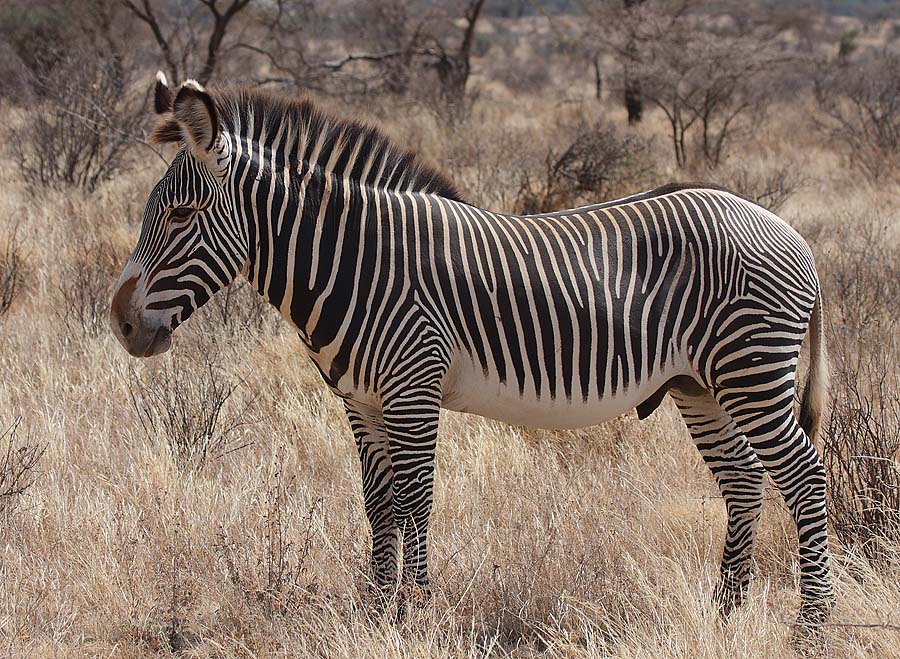
Grévy's zebra is readily distinguished from the plains and mountain zebras by its size and markings. Adults weigh around 350–450 kg, making it the heaviest wild equid, and they carry narrow, closely spaced black-and-white stripes that wrap the body but stop short of the white belly [SDZWA 2023]. Two further field marks are diagnostic: large, rounded, heavily furred ears, and a broad dark dorsal stripe bordered by white. As with all zebras, each individual's stripe pattern is unique, a feature researchers exploit for photographic identification [SDZWA 2023].
The species is well adapted to dry country, able to survive in arid, bush-covered grasslands and stony plains where it can go longer without water than cattle [SDZWA 2023]. Its social system differs from that of the plains zebra: rather than forming stable family harems, Grévy's zebra adults associate in fluid groups, with dominant males defending large territories around water and grazing resources.
Reproduction is slow. Females produce a single foal after a gestation of roughly 390 days — the longest of any equid — which weighs about 40 kg at birth [SDZWA 2023]. This low reproductive rate makes population recovery gradual and heightens the impact of adult and foal mortality.
Habitat and Range
Grévy's zebra occupies arid and semi-arid grassland and shrubland in southern Ethiopia and northern Kenya, the northernmost distribution of any zebra [SDZWA 2023; Rubenstein et al. 2016]. The species' range has contracted sharply over recent decades, and more than 99% of the area it now occupies lies outside formally protected reserves, on community and county rangelands shared with people and livestock [GZT 2024].
Because so little of the range is protected, the species depends heavily on the stewardship of pastoralist communities and on access to dry-season water and grazing — resources that are increasingly contested under drought and growing livestock numbers [GZT 2024; Rubenstein et al. 2016].
In accordance with NRWL sensitive-species policy, specific site locations, corridor routes, and seasonal movement details are not disclosed in this article.
Conservation Status
Grévy's zebra is listed as Endangered on the IUCN Red List, having undergone an estimated reduction of more than 50% over the preceding 18 years driven by exploitation and habitat change [Rubenstein et al. 2016]. The assessment (e.T7950A89624491) was last carried out in 2016 and reports a global population of roughly 2,000 mature individuals, with the largest single subpopulation numbering a few hundred animals [Rubenstein et al. 2016]. The species is included on CITES Appendix I, prohibiting commercial international trade, a listing in place since 1979 [CITES 2023].
The longer-term trajectory is stark: the global population is estimated to have fallen by around 80% since the late 1970s, from roughly 15,000 animals to about 3,000 today [GZT 2024]. There is no documented killing for skins since the CITES listing, indicating that international trade controls have been effective against that particular threat, but habitat loss, competition with livestock, and reduced water access remain the dominant pressures [GZT 2024; Rubenstein et al. 2016].
Threats
Habitat loss and degradation are leading pressures. Overgrazing by expanding livestock herds, conversion of rangeland, and the spread of bush and invasive plants reduce the grassland forage on which the species depends [Rubenstein et al. 2016; GZT 2024].
Competition for water and grazing intensifies during the long dry seasons. Grévy's zebra must share scarce water sources with people and livestock, and reduced access — sometimes exacerbated by fencing or exclusion around water points — can limit survival, particularly for lactating females and foals [GZT 2024]. Habitat-use studies in Kenya show that female Grévy's zebra with dependent foals select areas with greater grass abundance and proximity to water, so degradation that pushes forage and water apart disproportionately affects them [Sundaresan et al. 2008].
Low recruitment compounds these pressures. The species' long gestation and single-foal reproduction mean populations recover slowly, so elevated foal mortality during droughts can have outsized demographic effects [SDZWA 2023; Rubenstein et al. 2016].
Drought linked to climate variability reduces forage and water simultaneously across the arid range, driving die-offs and sharpening competition with pastoralist livestock [GZT 2024].
What Is Being Done
Community-led conservation. With more than 99% of the species' range outside protected areas, conservation centres on community engagement. A network of community and county conservancies has been established across the Kenyan range, making local people the primary stewards of the species [GZT 2024].
Citizen-science monitoring. The Grevy's Zebra Trust employs Grevy's Zebra Scouts — many of them women from local communities — who monitor the zebras and foster positive local attitudes. Their data provide an ongoing index of population demography and trend, functioning as long-term endangered-species monitoring [GZT 2024].
International trade controls. The CITES Appendix I listing, in force since 1979, has effectively eliminated documented killing for the international skin trade, removing one historic driver of decline [CITES 2023; GZT 2024].
Specialist assessment and national strategies. The IUCN SSC Equid Specialist Group maintains the species' Red List assessment and conservation guidance [ESG 2024], providing the technical basis for national action plans in Kenya and Ethiopia [Rubenstein et al. 2016]. Range-country conservation programs, supported by partners such as the African Wildlife Foundation, focus on securing rangelands and reducing livestock competition [AWF 2024].
How Readers Can Help
Citizen science. Photograph and log wildlife observations through platforms such as iNaturalist when traveling in range areas. Because each zebra's stripes are unique, clear images can contribute to individual-identification monitoring.
Policy engagement. Support conservation programs and policies that strengthen community conservancies and secure dry-season water and grazing for wildlife in arid rangelands.
Informed consumer choices. Never purchase zebra skins or products, consistent with CITES Appendix I protection, and choose tour operators that support community-based conservation.
Education outreach. Share accurate information about Grévy's zebra and the role of pastoralist communities in its survival, recognizing that coexistence on shared rangelands is central to the species' future [GZT 2024].
References
[CITES 2023] CITES. (2023). Appendices I, II and III. Convention on International Trade in Endangered Species of Wild Fauna and Flora. https://cites.org/eng/app/appendices.php
[AWF 2024] African Wildlife Foundation. (2024). Grevy's Zebra — species profile. https://www.awf.org/wildlife-conservation/grevys-zebra
[ESG 2024] IUCN SSC Equid Specialist Group. (2024). About the Equid Specialist Group. https://iucn.org/our-union/commissions/group/iucn-ssc-equid-specialist-group
[GZT 2024] Grevy's Zebra Trust. (2024). Conservation Status and Grevy's Zebra Scouts. https://www.grevyszebratrust.org/conservation-status/
[Rubenstein et al. 2016] Rubenstein, D., Low Mackey, B., Davidson, Z.D., Kebede, F. & King, S.R.B. (2016). Equus grevyi. The IUCN Red List of Threatened Species 2016: e.T7950A89624491. https://dx.doi.org/10.2305/IUCN.UK.2016-3.RLTS.T7950A89624491.en
[SDZWA 2023] San Diego Zoo Wildlife Alliance. (2023). Grevy's Zebra (Equus grevyi) Fact Sheet. https://ielc.libguides.com/sdzg/factsheets/grevyszebra
[Sundaresan et al. 2008] Sundaresan, S.R., Fischhoff, I.R., Hartung, H.M., Akilong, P. & Rubenstein, D.I. (2008). Habitat choice of Grevy's zebras (Equus grevyi) in Laikipia, Kenya. African Journal of Ecology, 46(3), 359–364. https://doi.org/10.1111/j.1365-2028.2007.00848.x