
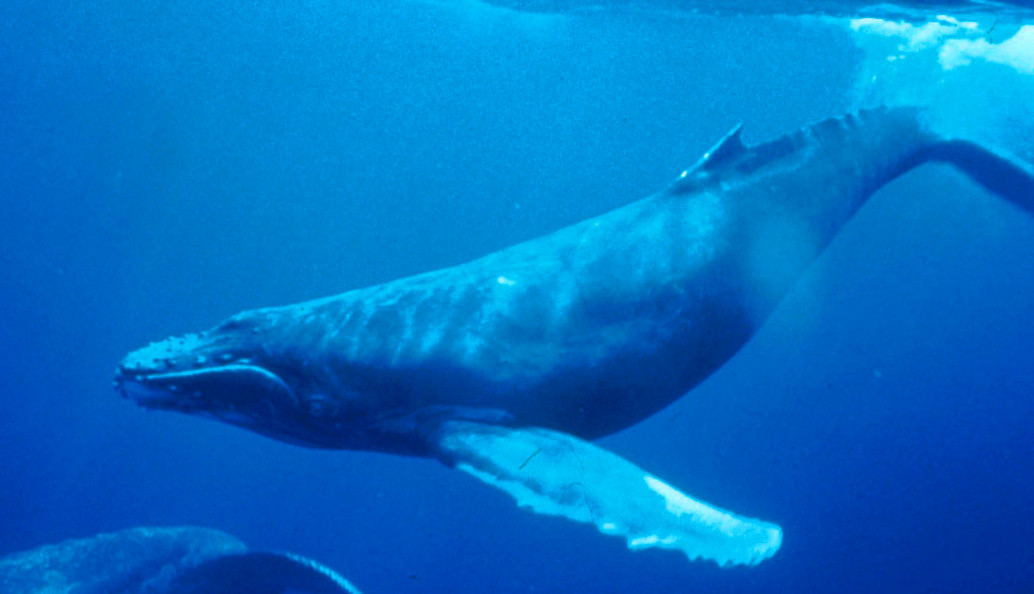
The humpback whale (Megaptera novaeangliae) is one of the great conservation stories of the modern era. Hunted to the edge of collapse during industrial whaling, the species has rebounded across most of its range and now numbers on the order of 135,000 individuals worldwide. Famous for its acrobatic breaching, its wing-like pectoral fins, and the long songs of breeding males, it is among the most studied and recognizable baleen whales. Its recovery is genuine but uneven: a few regional populations remain small and at real risk, and pressures from fishing gear, vessel traffic, and a changing ocean continue to shape its future [Cooke 2018] [NOAA Fisheries 2024].
Biology and Identification
The humpback is a rorqual (family Balaenopteridae) and the sole living species in the genus Megaptera — "big wing," for its extraordinarily long pectoral fins, which reach nearly a third of its body length. Adults typically measure 14 to 17 metres, with females slightly larger than males, and can weigh up to roughly 40 metric tons. The underside of the tail flukes carries a unique pattern of pigmentation and scarring that researchers use, like a fingerprint, to identify individuals across decades.
As a baleen whale, the humpback filters small prey — primarily krill and schooling fish — through plates of keratin baleen rather than teeth. It is notable for cooperative, tool-assisted foraging: tag and drone studies show that whales manufacture spiralling "bubble-nets" to concentrate prey, with solitary animals controlling net structure to increase food captured per lunge by roughly sevenfold [Szabo et al. 2024].
The species is best known, however, for its song. Payne and McVay first described the long, hierarchically organized vocal sequences produced by males, establishing these as true repeated "songs" [Payne and McVay 1971]. Song is not fixed: populations periodically undergo "song revolutions" in which a new song type sweeps across an entire ocean basin — a striking example of cultural transmission in a non-human animal [Garland et al. 2011].
Habitat and Range
Humpback whales occur in all major ocean basins, from tropical breeding grounds to high-latitude feeding grounds near the poles. Most populations are strongly migratory, undertaking some of the longest movements of any mammal: animals wintering off Central America and feeding off the Antarctic Peninsula have been documented travelling on the order of 8,300 kilometres each way [Rasmussen et al. 2007]. They feed in cold, productive waters in summer and move to warmer waters to breed in winter.
Not every population follows this pattern. The humpback whales of the Arabian Sea are genetically distinct and isolated, and are believed to be the only humpback population that does not undertake a long seasonal migration, instead remaining year-round in the northern Indian Ocean [Pomilla et al. 2014].
In accordance with NRWL sensitive-species policy, specific site locations, corridor routes, and seasonal movement details are not disclosed in this article.
Conservation Status
Globally, the humpback whale is assessed by the IUCN Red List as Least Concern (assessed 2018, assessment ID e.T13006A50362794), with an estimated 84,000 mature individuals and an increasing population trend [Cooke 2018]. This reflects a substantial recovery from the depletion caused by twentieth-century commercial whaling — an uplisting from the more concerning categories the species held in earlier decades.
That global picture, however, masks regional variation. The Arabian Sea subpopulation is assessed separately by the IUCN as Endangered; mark-recapture and genetic studies place it at roughly 80 to 100 animals, one of the smallest whale populations in the world [Pomilla et al. 2014]. United States waters are managed at finer resolution: under the Endangered Species Act, NOAA Fisheries in 2016 divided the species into 14 Distinct Population Segments, of which four are listed as endangered and one (Mexico) as threatened, while the remaining nine had recovered enough to no longer warrant listing [NOAA Fisheries 2024].
The species is also listed on CITES Appendix I, which prohibits commercial international trade, and is protected under the International Whaling Commission's moratorium on commercial whaling [NOAA Fisheries 2024].
Threats
The greatest historical threat — commercial whaling — has been largely curtailed. Modelling shows the scale of both decline and rebound: the western South Atlantic population fell from roughly 27,000 animals to about 450 by the mid-1950s before recovering to an estimated 93 percent of its pre-whaling size [Zerbini et al. 2019].
Today, entanglement in fishing gear is among the most serious threats to large whales. Bycatch analyses show that most cetacean entanglement occurs in net fisheries, and entangling gear can drown a whale or cause prolonged injury [Read et al. 2006]. Vessel strikes are a second major source of injury and death where shipping lanes overlap feeding or migratory waters. Underwater noise from shipping and coastal development can mask communication and disturb behaviour; these threats are especially acute for the small, non-migratory Arabian Sea population [Pomilla et al. 2014]. Climate-driven shifts in krill and forage fish add further uncertainty for populations that depend on cold, productive waters [NOAA Fisheries 2024].
What Is Being Done
The foundation of humpback recovery has been the international protections that ended large-scale hunting — the CITES Appendix I listing and the IWC moratorium — which removed the pressure driving the species toward collapse. Regional frameworks build on this: the 2016 Distinct Population Segment structure lets U.S. managers focus protections on the populations that still need them while recognising others' recovery [NOAA Fisheries 2024].
Beyond legal protection, conservation now centres on reducing the threats whales face in the water. NOAA and partner organisations run large-whale entanglement response programs, work with fisheries to modify risky gear, and support vessel-speed reductions in high-risk areas. Long-term photo-identification of flukes, satellite tagging, and acoustic monitoring continue to refine our understanding of population size, movement, and song culture — the evidence base targeted protection depends on [Garland et al. 2011] [Zerbini et al. 2019]. For the Arabian Sea population, dedicated research has been essential just to establish how few animals remain [Pomilla et al. 2014].
How Readers Can Help
The humpback whale shows that science-based protection can reverse even severe decline, though recovery is not complete or universal. Readers who want to support that work can:
- Support reputable marine conservation and research organisations that fund whale monitoring, entanglement response, and population assessment.
- Choose responsibly sourced seafood and support fisheries that adopt whale-safe gear, since entanglement remains a leading threat [Read et al. 2006].
- Watch whales responsibly, keeping to regulated distances and choosing operators that follow approved guidelines.
- Report entangled, injured, or stranded whales promptly to the relevant authority rather than intervening.
- Support reductions in ocean noise and vessel-strike risk, such as slower shipping speeds in sensitive waters.
Informed, measured engagement sustains the monitoring and management that has carried this species back toward health.
References
[Cooke 2018] Cooke, J.G. Megaptera novaeangliae. The IUCN Red List of Threatened Species, 2018, e.T13006A50362794. https://doi.org/10.2305/IUCN.UK.2018-2.RLTS.T13006A50362794.en
[Garland et al. 2011] Garland, E.C., Goldizen, A.W., Rekdahl, M.L., Constantine, R., Garrigue, C., Hauser, N.D., Poole, M.M., Robbins, J., & Noad, M.J. Dynamic horizontal cultural transmission of humpback whale song at the ocean basin scale. Current Biology, 21(8), 687–691. https://doi.org/10.1016/j.cub.2011.03.019
[NOAA Fisheries 2024] NOAA Fisheries. Humpback Whale (Megaptera novaeangliae) — Species Directory. National Oceanic and Atmospheric Administration, U.S. Department of Commerce. https://www.fisheries.noaa.gov/species/humpback-whale
[Payne and McVay 1971] Payne, R.S., & McVay, S. Songs of humpback whales. Science, 173(3997), 585–597. https://doi.org/10.1126/science.173.3997.585
[Pomilla et al. 2014] Pomilla, C., Amaral, A.R., Collins, T., Minton, G., Findlay, K., Leslie, M.S., Ponnampalam, L., Baldwin, R., & Rosenbaum, H. The world's most isolated and distinct whale population? Humpback whales of the Arabian Sea. PLOS ONE, 9(12), e114162. https://doi.org/10.1371/journal.pone.0114162
[Rasmussen et al. 2007] Rasmussen, K., Palacios, D.M., Calambokidis, J., Saborío, M.T., Dalla Rosa, L., Secchi, E.R., Steiger, G.H., Allen, J.M., & Stone, G.S. Southern Hemisphere humpback whales wintering off Central America: insights from water temperature into the longest mammalian migration. Biology Letters, 3(3), 302–305. https://doi.org/10.1098/rsbl.2007.0067
[Read et al. 2006] Read, A.J., Drinker, P., & Northridge, S. Bycatch of marine mammals in U.S. and global fisheries. Conservation Biology, 20(1), 163–169. https://doi.org/10.1111/j.1523-1739.2006.00338.x
[Szabo et al. 2024] Szabo, A., Bejder, L., Warick, H., van Aswegen, M., Friedlaender, A.S., Goldbogen, J., Kendall-Bar, J.M., Leunissen, E.M., Angot, M., & Gough, W.T. Solitary humpback whales manufacture bubble-nets as tools to increase prey intake. Royal Society Open Science, 11(8), 240328. https://doi.org/10.1098/rsos.240328
[Zerbini et al. 2019] Zerbini, A.N., Adams, G., Best, J., Clapham, P.J., Jackson, J.A., & Punt, A.E. Assessing the recovery of an Antarctic predator from historical exploitation. Royal Society Open Science, 6(10), 190368. https://doi.org/10.1098/rsos.190368