
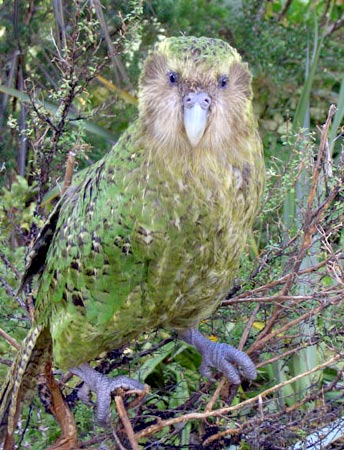
A Flightless Nocturnal Parrot Pulled Back from Functional Extinction
The kākāpō is the world's only flightless parrot, the heaviest parrot species on record, and a nocturnal ground-dweller that evolved in the absence of mammalian predators on the islands of New Zealand [BirdLife International 2020]. By the mid-1990s the total wild population was 51 known individuals; in 2023 the population reached 252 birds after an exceptional 2022 breeding season produced a record cohort of fledglings [Department of Conservation 2023]. Every kākāpō alive today is individually named, fitted with a smart transmitter, monitored continuously by the New Zealand Department of Conservation's Kākāpō Recovery Programme, and confined to a small set of predator-free offshore islands. The species remains Critically Endangered.
Biology and Identification
Strigops habroptilus is a large, owl-faced parrot. Adults weigh 1.5 to 4 kg, with males significantly larger than females [Higgins 1999]. Plumage is moss-green mottled with brown and yellow — cryptic against forest-floor leaf litter — and the face is framed by stiff bristle-like feathers that resemble an owl's facial disc. The species' English name "owl parrot" reflects this resemblance, as does its scientific genus Strigops (from the Greek for "owl-faced").
Kākāpō are nocturnal, primarily folivorous and frugivorous, and exceptionally long-lived — confirmed wild lifespans exceed 60 years and the species may live 90+ years in captivity [Powlesland et al. 2006]. Breeding is irregular: females nest only in "mast" years when native rimu, beech, or other forest trees produce heavy seed and fruit crops. In non-mast years no breeding occurs at all [Cockrem 2006]. Males display at communal arenas ("leks") by inflating thoracic air sacs and producing a low-frequency booming call audible for several kilometres on still nights — the only parrot known to use a lek mating system [Merton et al. 1984].
The combination of flightlessness, ground-nesting, slow reproduction, and lek-based breeding made kākāpō exceptionally vulnerable when mammalian predators were introduced to New Zealand by humans.
Habitat and Range
Before human arrival, kākāpō were common throughout the North Island, South Island, and Stewart Island/Rakiura of New Zealand, occupying a wide range of forest and shrubland habitats from coast to alpine zone [Higgins 1999]. They survived 700+ years of Māori settlement only because Polynesian rats (kiore) and dogs were less effective predators of large adult parrots than the species' true demographic threat — the post-1840 introduction of European-origin mustelids (stoats, ferrets, weasels) and ship rats (Rattus rattus) [Williams 1956; Powlesland et al. 2006].
By 1976 the species was believed extinct on the mainland. Surviving populations were discovered in Fiordland (1977) and on Stewart Island/Rakiura (1977), where roughly 200 birds were found before introduced cats reduced that population to fewer than 65 individuals by 1982 [Powlesland et al. 2006]. Between 1980 and 1997 all surviving kākāpō were translocated to predator-free offshore islands — initially Maud, Little Barrier, and Codfish/Whenua Hou — where the population remains today, with new releases on additional islands as predator eradication permits [Department of Conservation 2023].
Conservation Status
The kākāpō is listed as Critically Endangered on the IUCN Red List [BirdLife International 2020] and Nationally Critical under the New Zealand Threat Classification System [Robertson et al. 2021]. It is on CITES Appendix I, prohibiting international commercial trade. Every individual kākāpō is named, microchipped, and fitted with a battery-powered smart transmitter that reports the bird's location and breeding behaviour continuously to the recovery team [Department of Conservation 2023].
The 2022 breeding season was the species' most productive on record: 55 chicks fledged across the recovery programme, bringing the total to 252 birds at the start of 2023 [Department of Conservation 2023]. Breeding occurred again in 2024 at smaller scale. Per IUCN's assessment criteria the species remains Critically Endangered because the entire global population is confined to a few small islands and is dependent on continuous intensive management.
Threats
Introduced mammalian predators drove the species to functional extinction on the New Zealand mainland and remain the principal extinction risk. Stoats and ship rats are particularly lethal to nesting females (which incubate alone at night and forage between nest visits) and to chicks. The species' entire current safe range — a handful of offshore islands — exists only because those islands have been cleared of all introduced mammalian predators [Powlesland et al. 2006].
Low reproductive output is intrinsic to the species. Mast events occur every 2–4 years, females produce small clutches (one to four eggs), and many eggs are infertile because of an unusually small founding population's reduced genetic diversity [Cockrem 2006; White et al. 2015]. The 2019 breeding season, the largest pre-2022 cohort, was followed by an outbreak of aspergillosis (a fungal respiratory infection) that killed 9 birds and required intensive veterinary intervention [Department of Conservation 2020].
Genetic bottleneck. The known kākāpō pedigree traces almost the entire current population to a small number of Stewart Island/Rakiura founders. Reduced genetic diversity is associated with low fertility, low hatching success, and elevated disease susceptibility. The recovery programme has used artificial insemination, founder pedigree management, and whole-genome sequencing of every living kākāpō to inform pairing decisions and outbreeding strategy [Dussex et al. 2021].
Disease. Aspergillosis (2019) and exotic pathogen risk from translocations are ongoing concerns. Every bird is health-screened before translocation and post-release.
What Is Being Done
The Kākāpō Recovery Programme is operated by the New Zealand Department of Conservation (DOC) in partnership with Ngāi Tahu (the principal South Island iwi) and supported by major conservation funders. Programme elements include:
- Predator-free island sanctuaries — Whenua Hou/Codfish, Anchor, Pearl, and others are managed as kākāpō habitat with rigorous biosecurity to prevent reintroduction of mammals [Department of Conservation 2023]
- Individual-bird intensive management — every kākāpō wears a battery-powered smart transmitter; nests are monitored 24/7 during the breeding season; eggs are incubated artificially when nests are at risk; chicks are hand-reared if needed [Eason et al. 2006]
- Supplementary feeding at strategic sites during mast years to extend the duration of high reproductive condition in females
- Artificial insemination and pedigree management to maximise effective population size and reduce inbreeding [White et al. 2015]
- Kākāpō125 genome project — every living kākāpō has had its genome sequenced; pairing decisions are informed by predicted offspring genetic diversity [Dussex et al. 2021]
- Aspergillosis response — improved respiratory monitoring, antifungal prophylaxis for high-risk birds, and laboratory development of vaccines [Department of Conservation 2020]
The species' presence on its historical mainland range is, for now, impossible without large-scale predator eradication. The Predator Free 2050 national initiative — a commitment by the New Zealand government to eliminate stoats, ship rats, and possums from the country by 2050 — is the long-horizon strategy that would eventually allow kākāpō re-establishment on the mainland [Department of Conservation 2020].
How Readers Can Help
- Donate to Kākāpō Recovery. The Department of Conservation accepts targeted donations to the Kākāpō Recovery Programme via Forest & Bird's "Adopt a Kākāpō" programme. Funds support transmitters, vet care, nest monitoring, and field staff.
- Support Predator Free 2050. Organisations such as Predator Free NZ Trust and Predator Free 2050 Ltd coordinate community-led predator control across mainland New Zealand. Donations and (for residents) volunteer time on local trap lines are the most direct contribution.
- Visit responsibly. Kākāpō are not currently accessible to the general public — viewing is restricted to protect biosecurity. Zealandia ecosanctuary in Wellington occasionally hosts kākāpō for short stays and is open to visitors; revenue supports broader sanctuary conservation work.
- Choose ethical New Zealand wildlife tourism. Tourism operators certified under Qualmark Sustainable Tourism Business Certification meet biosecurity and conservation-impact standards.
- Engage on national conservation policy. New Zealand's conservation funding is repeatedly contested at central-government level. Public support for DOC's biosecurity, threatened-species, and predator-control budgets directly affects kākāpō programme stability.
Last verified: 2026-05-23 Conservation status as of writing: Critically Endangered (IUCN Red List 2020 assessment); Nationally Critical (NZ Threat Classification System).
References
- BirdLife International (2020). Strigops habroptila. IUCN Red List of Threatened Species. e.T22685245A172250603. https://www.iucnredlist.org/species/22685245/172250603
- Cockrem, J. F. (2006). The timing of breeding in the kakapo (Strigops habroptilus). Notornis 53(1): 153–159.
- Department of Conservation (2020). Kākāpō Recovery Plan 2020–2025. New Zealand Department of Conservation.
- Department of Conservation (2023). Kākāpō Recovery Programme — 2022/23 Breeding Season Summary. https://www.doc.govt.nz/our-work/kakapo-recovery/
- Dussex, N., van der Valk, T., Morales, H. E., et al. (2021). Population genomics of the critically endangered kākāpō. Cell Genomics 1(1): 100002.
- Eason, D. K., Elliott, G. P., Merton, D. V., et al. (2006). Breeding biology of kakapo (Strigops habroptilus) on offshore island sanctuaries, 1990–2002. Notornis 53(1): 27–36.
- Higgins, P. J. (Ed.) (1999). Handbook of Australian, New Zealand & Antarctic Birds. Volume 4: Parrots to Dollarbird. Oxford University Press.
- Merton, D. V., Morris, R. B., & Atkinson, I. A. E. (1984). Lek behaviour in a parrot: the kakapo Strigops habroptilus of New Zealand. Ibis 126: 277–283.
- Powlesland, R. G., Merton, D. V., & Cockrem, J. F. (2006). A parrot apart: the natural history of the kakapo (Strigops habroptilus), and the context of its conservation management. Notornis 53(1): 3–26.
- Robertson, H. A., Baird, K. A., Elliott, G. P., et al. (2021). Conservation status of birds in Aotearoa New Zealand, 2021. New Zealand Threat Classification Series 36. Department of Conservation.
- White, K. L., Eason, D. K., Jamieson, I. G., & Robertson, B. C. (2015). Evidence of inbreeding depression in the critically endangered parrot, the kakapo. Animal Conservation 18(4): 341–347.
- Williams, G. R. (1956). The kakapo (Strigops habroptilus Gray) — a review and re-appraisal of a near-extinct species. Notornis 7(2): 29–56.