
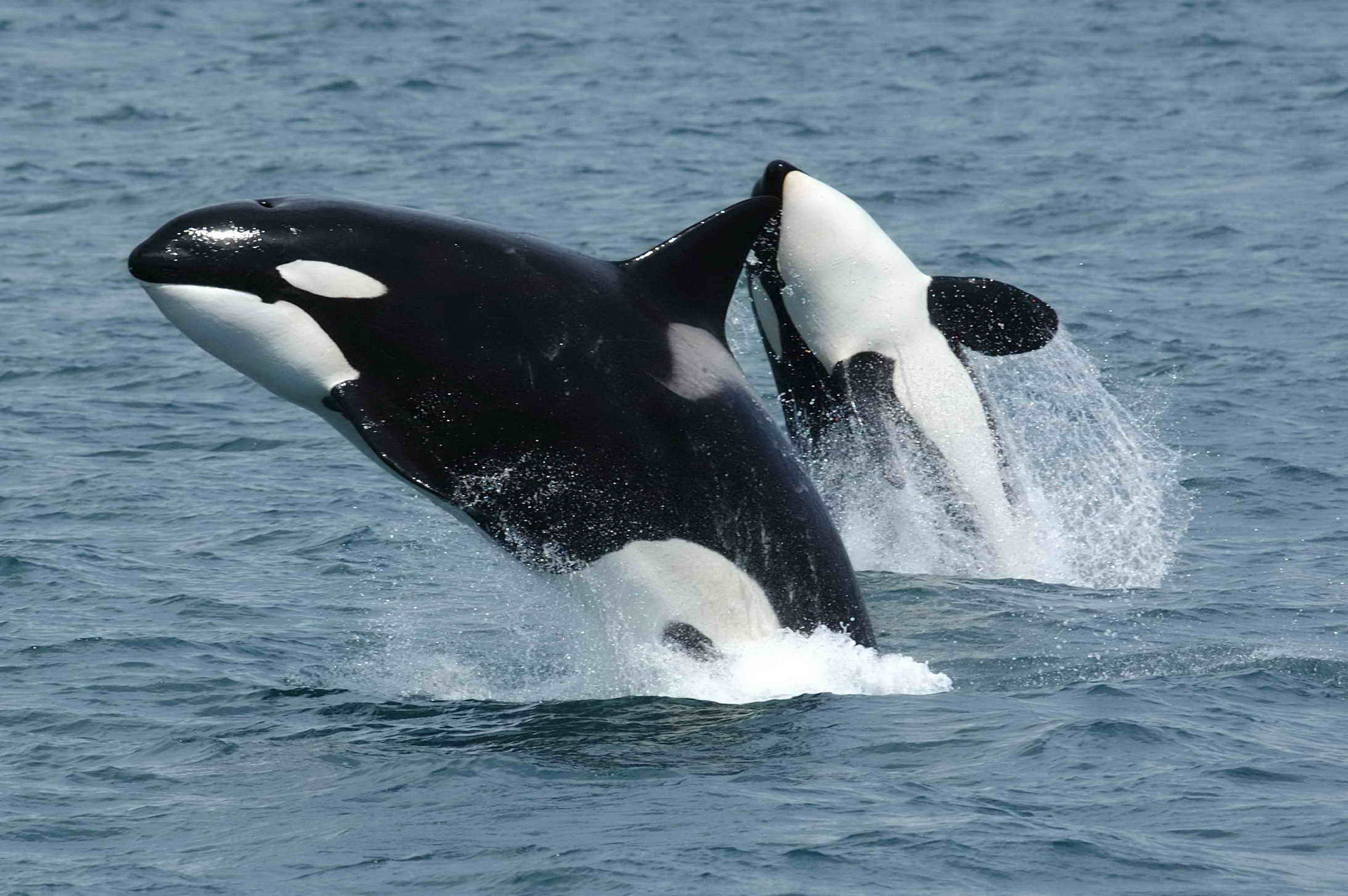
The killer whale, or orca, is the largest member of the dolphin family and one of the most widely distributed mammals on Earth, occupying every ocean from the tropics to the polar ice edges. A cognitively complex, socially structured apex predator, the orca exists as a mosaic of distinct ecotypes with specialized diets and cultures, and the unresolved taxonomy of these forms shapes how the species is assessed globally [Reeves et al. 2017; NOAA 2024c]. This profile examines orca biology, the threats facing particular populations, and the conservation measures now in place.
Biology and Identification
Killer whales are unmistakable: glossy black above and white below, with a white eye patch, a grey saddle behind the dorsal fin, and a tall dorsal fin that in mature males can reach exceptional height. Adults grow up to about 9.8 m (32 ft) and 11 tonnes, making the orca the largest of the oceanic dolphins [NOAA 2024c]. Lifespans are long, particularly for females, which may live to at least 90 years, while males average roughly 30 years and can exceed 60 [NOAA 2024c].
Orcas live in stable matrilineal societies. Pods are groups of maternally related individuals, typically from a few to 20 or more closely related animals, and these family units transmit hunting techniques and vocal dialects across generations — a form of culture [NOAA 2024c]. Diet is highly specialized by ecotype: in the North Pacific, resident orcas feed primarily on fish such as salmon, transient (Bigg's) orcas hunt marine mammals, and offshore orcas take fish including sharks [NOAA 2024c]. These ecological and cultural differences are central to the ongoing question of how many subspecies or species the orca represents.
Habitat and Range
The killer whale is the most widely distributed of all cetaceans, found in all oceans and most seas, from equatorial waters to the edges of the Arctic and Antarctic pack ice [Reeves et al. 2017; NOAA 2024c]. Orcas are most abundant in cold, productive waters such as those of the North Pacific, the North Atlantic, and around Antarctica, but the species is genuinely cosmopolitan. Different populations occupy distinct ranges and habitats consistent with their dietary specializations.
In accordance with NRWL sensitive-species policy, specific site locations, feeding grounds, and seasonal movement details are not disclosed in this article.
Conservation Status
The killer whale is listed as Data Deficient on the IUCN Red List (assessment e.T15421A50368125, 2017), because unresolved taxonomy means that several distinct forms may warrant recognition as separate subspecies or species, making a single global assessment of "the killer whale" scientifically problematic [Reeves et al. 2017]. The species is included on CITES Appendix II, regulating international trade through permits [CITES 2023], and certain populations are listed on Appendix II of the Convention on Migratory Species [CMS 2024]. In United States waters all killer whales are protected under the Marine Mammal Protection Act [NOAA 2024c].
The global Data Deficient listing should not be read as an absence of concern: it reflects taxonomic uncertainty, not population health, and several regional populations are in serious trouble. The Southern Resident population of the eastern North Pacific is listed as endangered under the U.S. Endangered Species Act; after peaking at 98 individuals in 1995, it had declined to 74 whales by July 2025 [NOAA 2024c]. In Canada, a 2023 assessment by the Committee on the Status of Endangered Wildlife in Canada (COSEWIC) evaluated five killer whale populations separately, reflecting their distinct demographics and pressures [COSEWIC 2023]. Other regional populations and subpopulations, assessed separately, also show elevated concern.
Threats
Prey depletion is a primary threat to fish-eating populations. The Southern Residents depend heavily on Chinook salmon, many runs of which are themselves threatened or endangered, and reduced prey availability is linked to poor body condition and reproductive failure [NOAA 2024c].
Contaminants. As long-lived apex predators, killer whales accumulate uniquely high concentrations of persistent organic pollutants, which can impair immune and reproductive function and are transferred from mothers to calves [NOAA 2024c].
Vessel noise and disturbance. Increased vessel traffic and underwater noise interfere with the echolocation and communication orcas use to find prey; Southern Residents have been documented calling more loudly amid vessel noise, expending additional energy [NOAA 2024c].
Historical capture and direct interactions. A history of live capture for display and, in some regions, direct killing reduced certain populations, and entanglement and other human interactions remain localized concerns [Reeves et al. 2017; NOAA 2024c].
What Is Being Done
Endangered Species Act recovery. The Southern Resident population is the focus of a U.S. recovery program addressing prey availability, contaminants, and vessel disturbance, with designated critical habitat and ongoing monitoring [NOAA 2024c].
Marine Mammal Protection Act. All killer whales in U.S. waters are protected under the Marine Mammal Protection Act, which prohibits take and supports stock assessment [NOAA 2024c].
International trade regulation. The CITES Appendix II listing requires permits and non-detriment findings for international trade, providing oversight of any commercial movement [CITES 2023].
Taxonomic and population science. Research clarifying orca ecotypes and their genetic relationships — including a 2024 proposal to recognize the eastern North Pacific resident and Bigg's forms as distinct taxa — is steadily resolving the taxonomy that currently constrains the global assessment, enabling more meaningful, population-specific evaluation [Morin et al. 2024]. Long-term photo-identification and demographic monitoring track individual populations such as the Southern Residents over time [NOAA 2024c].
How Readers Can Help
Citizen science. Report orca sightings to recognized regional monitoring and stranding networks. Verified observations support population tracking and assessment.
Support salmon recovery. Back habitat restoration and fisheries-management measures that rebuild wild salmon runs, which underpin the survival of fish-eating orca populations [NOAA 2024c].
Reduce pollutants. Support policies that limit persistent organic pollutants and reduce contaminant runoff into coastal waters, lowering the toxic burden carried by apex predators [NOAA 2024c].
Practice responsible viewing. Observe whale-watching regulations and recommended distances, and support vessel-noise reduction measures in areas used by sensitive orca populations [NOAA 2024c].
References
[CITES 2023] CITES. (2023). Appendices I, II and III. Convention on International Trade in Endangered Species of Wild Fauna and Flora. Orcinus orca listed on Appendix II. https://cites.org/eng/app/appendices.php
[CMS 2024] Convention on the Conservation of Migratory Species of Wild Animals. Orcinus orca — species page (eastern North Atlantic and eastern North Pacific populations on Appendix II). https://www.cms.int/species/orcinus-orca
[COSEWIC 2023] Committee on the Status of Endangered Wildlife in Canada. (2023). COSEWIC assessment and status report on the Killer Whale (Orcinus orca) in Canada. https://www.canada.ca/en/environment-climate-change/services/species-risk-public-registry/cosewic-assessments-status-reports/killer-whale-2023.html
[Morin et al. 2024] Morin, P.A., McCarthy, M.L., Fung, C.W., Durban, J.W., Parsons, K.M., Perrin, W.F., Taylor, B.L., Jefferson, T.A., Archer, F.I. (2024). Revised taxonomy of eastern North Pacific killer whales (Orcinus orca): Bigg's and resident ecotypes deserve species status. Royal Society Open Science, 11(3), 231368. https://doi.org/10.1098/rsos.231368
[NOAA 2024c] NOAA Fisheries. (2024). Killer Whale (Orcinus orca) — Species Directory, including Southern Resident killer whale population information. National Oceanic and Atmospheric Administration. https://www.fisheries.noaa.gov/species/killer-whale
[Reeves et al. 2017] Reeves, R., Pitman, R.L. & Ford, J.K.B. (2017). Orcinus orca. The IUCN Red List of Threatened Species 2017: e.T15421A50368125. https://dx.doi.org/10.2305/IUCN.UK.2017-3.RLTS.T15421A50368125.en