
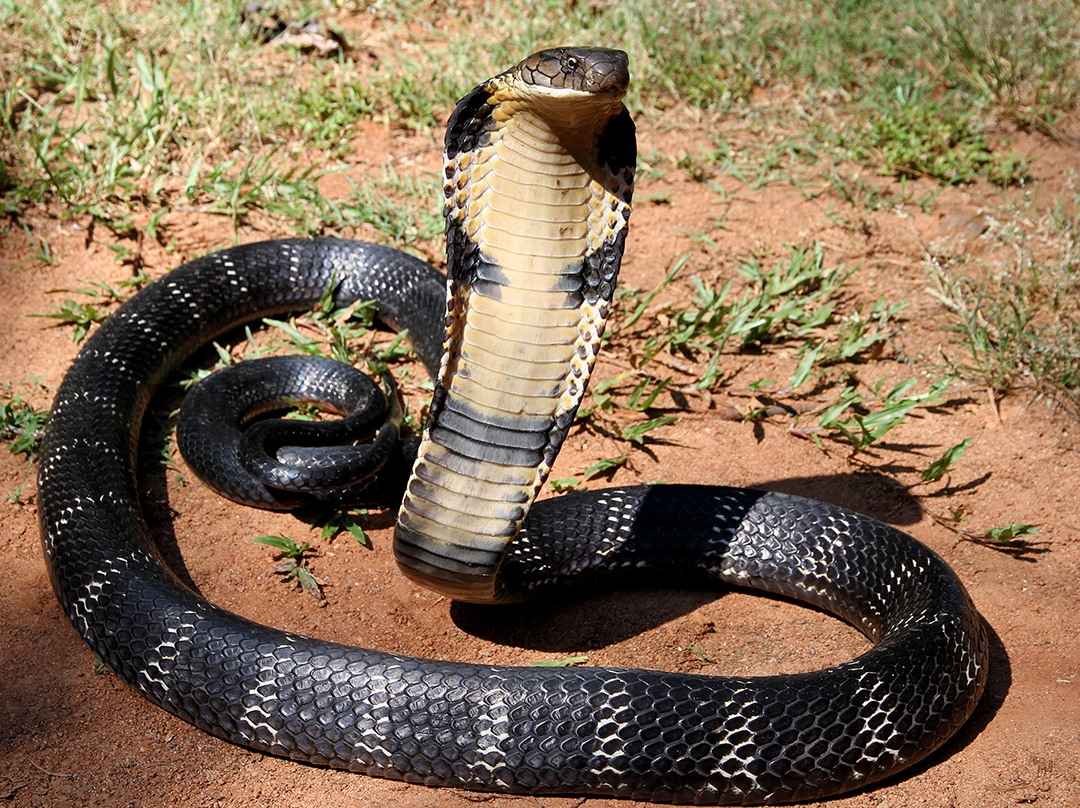
The king cobra (Ophiophagus hannah) is the longest venomous snake on Earth, exceeding five meters in exceptional individuals. A specialized snake-eater, an unusually devoted nest-builder, and the source of one of the most studied neurotoxic venoms in science, it occupies forests across South and Southeast Asia. It is also a species under pressure — susceptible to forest clearance, road mortality, and persecution — and, since 2024, the subject of a major taxonomic revision. This spotlight reviews its biology, range, conservation status, and the work underway to secure its future.
Biology and Identification
The king cobra is an elapid distinguished from "true" cobras (genus Naja) by its size, narrower hood, and the large occipital scales on the back of its head. Adults typically measure 3.18 to 4 m (10.4 to 13.1 ft), with the longest reliably reported individual approaching 5.85 m (19.2 ft); field measurements from Kerala, India, reached about 3.75 m and 10 kg in males and 2.75 m and 5 kg in females [Wikipedia 2025]. Coloration ranges from olive and tan to near-black, often with faint pale crossbands.
The genus name Ophiophagus means "snake-eater," and the diet reflects it: the species preys predominantly on other snakes, including the Indian cobra and banded krait, plus monitor lizards and occasionally other reptiles [Amat & Escoriza 2022]. Its venom is dominated by three-finger toxins. One, haditoxin, was characterized as a novel homodimeric three-finger neurotoxin that blocks both muscle and neuronal nicotinic acetylcholine receptors, with highest affinity for the neuronal α7 subtype [Roy et al. 2010]. Clinical envenoming is primarily neurotoxic, producing ptosis and, in severe cases, respiratory paralysis [Renault et al. 2024].
The king cobra is also the only snake known to build a nest: the female scrapes leaf litter into a mound, deposits her clutch inside, and guards it through incubation. Field studies in northeast India and Bhutan have recorded clutches up to 37 eggs, with incubation lasting roughly two to three months [Koirala & Tshering 2021; Hrima et al. 2014]. This maternal investment is rare among snakes and makes nest sites a focal point for research and conservation.
Habitat and Range
The king cobra occupies a broad but patchy range across South and Southeast Asia, from eastern Pakistan and northern India through the Andaman Islands, mainland Southeast Asia, the Greater Sunda Islands, and the Philippines [Das et al. 2024]. It favors dense, humid forest — evergreen and moist deciduous formations, mangroves, and bamboo thickets — and also occurs in agricultural mosaics near forest edges. Distribution modeling indicates the range is strongly limited by humid climatic conditions, with precipitation a primary constraint [Amat & Escoriza 2022]. In Nepal, modeling identified roughly 23,703 km² of suitable habitat — about 16% of the country — of which more than 60% lies outside protected areas [Baral et al. 2025]. Elevational records in eastern Bhutan span from about 650 m to over 2,000 m [Koirala & Tshering 2021].
In accordance with NRWL sensitive-species policy, specific site locations, corridor routes, and seasonal movement details are not disclosed in this article.
Conservation Status
The king cobra is assessed as Vulnerable on the IUCN Red List of Threatened Species [IUCN 2012]. The current global assessment was published in 2012 (based on a 2010 evaluation) under assessment ID e.T177540A1491874, with a population trend recorded as decreasing [IUCN 2012]. The listing reflected an inferred population decline driven by habitat loss, exploitation, and persecution, with locally severe declines documented in parts of the range [IUCN 2012; Amat & Escoriza 2022]. Internationally, the species is listed on Appendix II of the Convention on International Trade in Endangered Species (CITES), regulating cross-border commercial trade [IUCN 2012].
A significant caveat applies. In 2024, a taxonomic revision split the long-recognized single species into four: the northern king cobra (O. hannah, in the strict sense), the Sunda king cobra (O. bungarus), the Western Ghats king cobra (O. kaalinga), and the Luzon king cobra (O. salvatana) [Das et al. 2024]. The IUCN assessment predates this revision and still covers the species as historically defined; the category and decline figures cited here apply to the pre-split, broadly defined king cobra and will require reassessment for each newly recognized species.
Threats
Habitat loss and fragmentation. Conversion of humid forest to agriculture, plantations, and settlement is the dominant threat, shrinking and isolating the moist habitat the species depends on [IUCN 2012; Baral et al. 2025]. Because much suitable habitat lies outside protected areas, populations are exposed to ongoing land-use change [Baral et al. 2025].
Direct human-caused mortality. Persecution and road mortality are substantial. In Nepal, researchers documented 94 king cobra deaths across 29 districts between 2000 and 2024, concentrated in eastern lowland and mid-hill regions where human activity overlaps with suitable habitat [Baral et al. 2025].
Exploitation and trade. The species is collected for skins, meat, the pet trade, and traditional medicine, pressures that contributed to its Vulnerable listing [IUCN 2012].
Human–wildlife conflict. As a large, conspicuous predator, the king cobra is frequently killed on encounter. Snakebite is a serious regional public-health burden — India alone recorded an estimated 1.2 million snakebite deaths from 2000 to 2019 — and although king cobra bites are comparatively rare, fear of venomous snakes drives retaliatory killing [Suraweera et al. 2020]. A Malaysian case series of 32 confirmed king cobra bites (2015–2020) found about 69% occurred while people were attempting to catch or handle the snake [Renault et al. 2024].
What Is Being Done
International trade regulation. CITES Appendix II listing requires permits for international commercial trade, providing a legal framework to monitor and limit exploitation [IUCN 2012].
Habitat and corridor planning. Research in Nepal explicitly maps suitable habitat and mortality hotspots to guide conservation outside formal protected areas, emphasizing habitat connectivity and community-based management as essential to persistence [Baral et al. 2025].
Nest protection and field monitoring. Because nests are discrete and tended by the female, they offer a practical conservation unit. Field studies in Bhutan and northeast India document nesting ecology and, in some regions, protect or relocate at-risk clutches to improve hatching success [Koirala & Tshering 2021; Hrima et al. 2014].
Taxonomic clarity for targeted conservation. The 2024 four-species revision, grounded in molecular phylogenetics and morphological analysis of 148 specimens, lets planners assess and manage each lineage separately rather than as one wide-ranging complex [Das et al. 2024].
Venom and antivenom research. Characterization of venom components such as haditoxin supports antivenom development and informs clinical management of envenoming [Roy et al. 2010; Renault et al. 2024].
How Readers Can Help
- Support habitat-focused conservation. Because most suitable king cobra habitat lies outside protected areas, groups working on forest connectivity and community-based management address the primary threat directly [Baral et al. 2025].
- Back CITES enforcement. The species' Appendix II status depends on funded monitoring and enforcement to curb trade-driven exploitation [IUCN 2012].
- Report suspected wildlife trade. Sales of snake skins, parts, or live king cobras can be reported to TRAFFIC, the global wildlife trade monitoring network.
- Contribute to citizen science. Verified observations logged on platforms such as iNaturalist add to the distribution data used in habitat models and reassessments.
- Share accurate information. Replacing fear-driven myths with credible science reduces retaliatory killing — the single largest source of documented direct mortality in studied populations [Baral et al. 2025].
References
[IUCN 2012] Stuart, B., Wogan, G., Grismer, L., Auliya, M., Inger, R.F., Lilley, R., Chan-Ard, T., Thy, N., Nguyen, T.Q., Srinivasulu, C., & Jelić, D. (2012). Ophiophagus hannah. The IUCN Red List of Threatened Species 2012: e.T177540A1491874. https://doi.org/10.2305/IUCN.UK.2012-1.RLTS.T177540A1491874.en
[Das et al. 2024] Das, I., Gowri Shankar, P., Swamy, P., Williams, R.C., Lalremsanga, H.T., Prashanth, P., Sahoo, G., Vijayakumar, S.P., Höglund, J., Shanker, K., Dutta, S.K., Ganesh, S.R., & Wüster, W. (2024). Taxonomic revision of the king cobra Ophiophagus hannah (Cantor, 1836) species complex (Reptilia: Serpentes: Elapidae), with the description of two new species. European Journal of Taxonomy, 961, 1–51. https://doi.org/10.5852/ejt.2024.961.2681
[Amat & Escoriza 2022] Amat, F., & Escoriza, D. (2022). Biogeographic inferences on the evolutionary history of the king cobra (Ophiophagus hannah, Cantor 1836) species complex. Zoological Studies, 61, e28. https://doi.org/10.6620/ZS.2022.61-28
[Roy et al. 2010] Roy, A., Zhou, X., Chong, M.Z., D'hoedt, D., Foo, C.S., Rajagopalan, N., Nirthanan, S., Bertrand, D., Sivaraman, J., & Kini, R.M. (2010). Structural and functional characterization of a novel homodimeric three-finger neurotoxin from the venom of Ophiophagus hannah (king cobra). Journal of Biological Chemistry, 285(11), 8302–8315. https://doi.org/10.1074/jbc.M109.074161
[Renault et al. 2024] Renault, A., Lim, C.S., Tan, K.Y., Tan, N.H., et al. (2024). Frequency, geographical distribution, clinical characteristics, antivenom utilisation and outcomes of king cobra (Ophiophagus hannah) bites in Malaysia. PLOS Neglected Tropical Diseases, 18(7), e0012359. https://doi.org/10.1371/journal.pntd.0012359
[Baral et al. 2025] Baral, R., Adhikari, B., Sapkota, A., et al. (2025). Understanding suitable habitats and anthropogenic mortality risks for king cobras in Nepal. Ecology and Evolution, 15(9), e72030. https://doi.org/10.1002/ece3.72030
[Koirala & Tshering 2021] Koirala, B.K., & Tshering, D. (2021). Distribution, habitat use, and nesting behavior of the King Cobra (Ophiophagus hannah) in the Trashigang Forest Division, Eastern Bhutan. Reptiles & Amphibians, 28(3), 397–403. https://doi.org/10.17161/randa.v28i3.15786
[Hrima et al. 2014] Hrima, V.L., Sailo, V.L.H., Fanai, Z., Lalronunga, S., Lalrinchhana, C., Zothansiama, & Lalremsanga, H.T. (2014). Nesting ecology of the King Cobra, Ophiophagus hannah (Reptilia: Squamata: Elapidae) in Aizawl District, Mizoram, India. Issues and Trends of Wildlife Conservation in Northeast India, 268–274. https://www.researchgate.net/publication/263008786
[Suraweera et al. 2020] Suraweera, W., Warrell, D., Whitaker, R., Menon, G., Rodrigues, R., Fu, S.H., Begum, R., Sati, P., Piyasena, K., Bhatia, M., Brown, P., & Jha, P. (2020). Trends in snakebite deaths in India from 2000 to 2019 in a nationally representative mortality study. eLife, 9, e54076. https://doi.org/10.7554/eLife.54076
[Wikipedia 2025] Wikipedia contributors. (2025). King cobra. Wikipedia, The Free Encyclopedia. [Tertiary source cited for general size and morphological figures only; primary measurements derive from Whitaker & Captain field studies.] https://en.wikipedia.org/wiki/King_cobra