
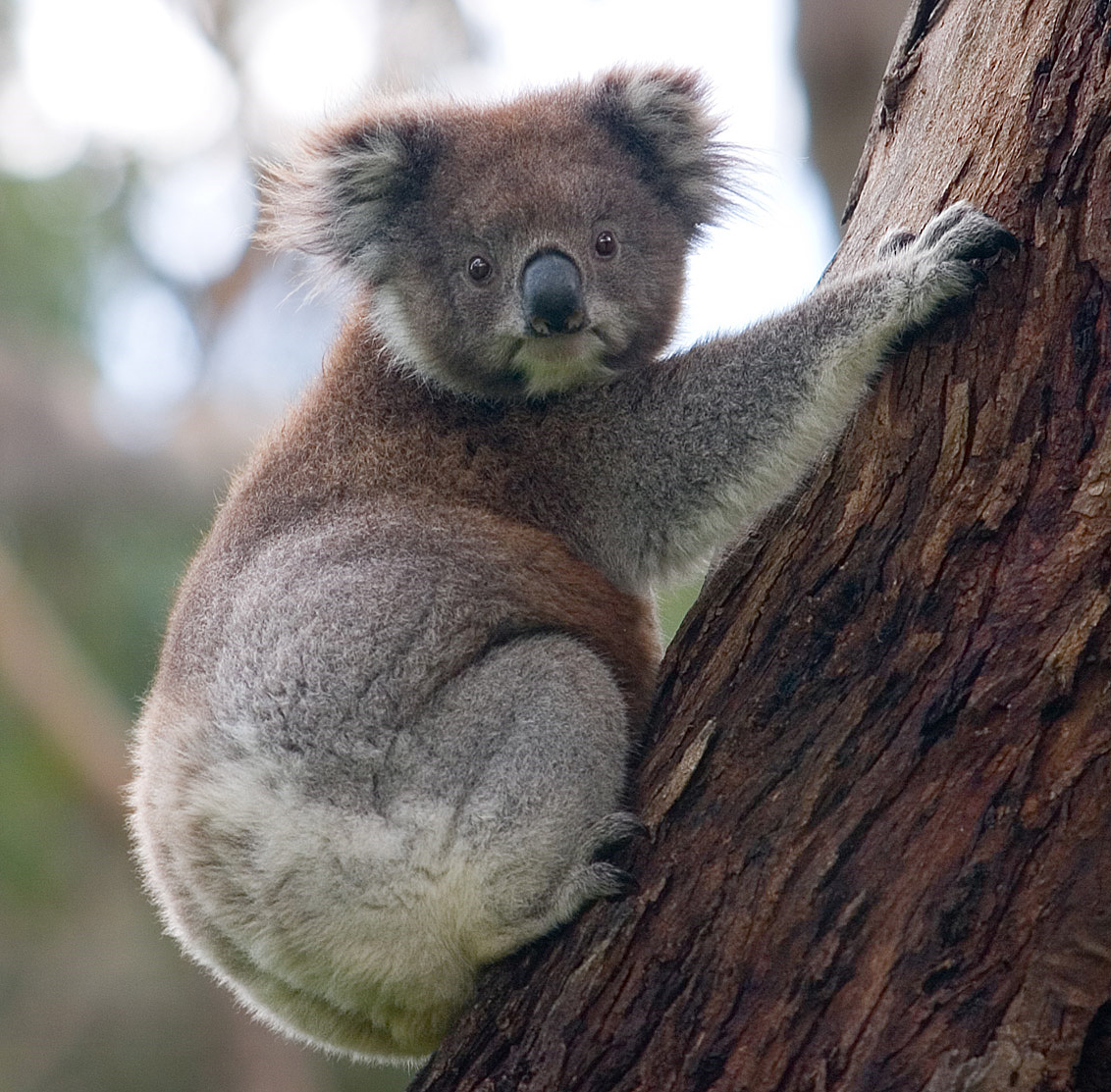
The koala is a tree-dwelling marsupial native to eastern and southeastern Australia, instantly recognizable by its stout, tailless body, large round ears, and spoon-shaped nose. Despite often being called a "bear," it is a marsupial more closely related to wombats, and it has evolved a highly specialized diet of eucalyptus leaves. Once widespread across Australia's eastern forests, koala populations have contracted sharply over recent decades, making the species a focus of national and international conservation concern [IUCN 2020].
Biology and Identification
Koalas have a head-and-body length of roughly 60–85 cm and weigh between about 4 and 15 kg, with animals from cooler southern regions such as Victoria being considerably larger and heavier than those from Queensland; males are also substantially larger than females [Britannica 2024]. Their dense fur, large clawed feet, and opposable digits are adaptations for life in the canopy.
The koala is a dietary specialist, feeding almost exclusively on the leaves of eucalyptus trees, supplemented occasionally by related species. Eucalyptus foliage is low in nutrition, high in fiber, and contains toxic compounds, so koalas rely on a greatly enlarged caecum and symbiotic gut bacteria to break down these substances; an adult can consume on the order of a kilogram of leaves per day [Britannica 2024]. This low-energy diet drives their famously sedentary lifestyle, with individuals sleeping for many hours each day to conserve energy.
Koalas are largely solitary, with the strongest social bond being between a mother and her dependent young. As marsupials, they give birth to tiny, underdeveloped young known as joeys, which crawl into the mother's pouch and remain there for roughly six to seven months before gradually transitioning to a leaf diet and independence [Britannica 2024]. In the wild, koalas typically live to around 15 years of age [Britannica 2024].
Habitat and Range
Koalas inhabit eucalyptus-dominated woodlands and open forests across the eastern and southeastern Australian states of Queensland, New South Wales, Victoria, and South Australia, including the Australian Capital Territory [IUCN 2020]. The species is endemic to Australia and is not found naturally anywhere else in the world. Suitable habitat depends on the presence of preferred food-tree species, soil and moisture conditions that support them, and connectivity between forest patches that allows animals to move and disperse safely [SDZWA 2021]. Across much of its range, this habitat has become increasingly fragmented by land clearing for agriculture, urban expansion, and infrastructure [DCCEEW 2022].
Conservation Status
The koala is listed as Vulnerable on the IUCN Red List, assessed in 2014 and published in the 2020 update [IUCN 2020]. The assessment applied criteria reflecting an observed and projected population reduction of roughly 30% over three generations (about 18–24 years), driven by habitat loss, degradation, fragmentation, and disease across the species' range [IUCN 2020; SDZWA 2021]. Aggregated state-based estimates place the total population on the order of several hundred thousand individuals—around 300,000 mature animals—and the overall population trend is decreasing [SDZWA 2021].
National listing reflects an even greater level of concern in the northern part of the range. On 12 February 2022, the Australian Government uplisted the koala populations of Queensland, New South Wales, and the Australian Capital Territory to Endangered under Australia's national environmental law, the Environment Protection and Biodiversity Conservation Act 1999 (EPBC Act), a change from their previous Vulnerable status that had been in place since 2012 [DCCEEW 2022; WWF Australia 2022]. This uplisting followed evidence of steep regional declines compounded by the catastrophic 2019–2020 bushfire season [WWF Australia 2022].
Threats
The primary documented threats to koalas are habitat loss, degradation, and fragmentation from land clearing for agriculture, urban development, and infrastructure, which reduce food and shelter and isolate populations [DCCEEW 2022]. Disease is a major and well-documented pressure: chlamydial infection is widespread in many populations and can cause blindness, reproductive-tract disease, infertility, and death, undermining recovery even where habitat persists [Polkinghorne et al. 2013].
Bushfires are an increasing threat, with the 2019–2020 "Black Summer" fires burning large areas of koala habitat across New South Wales, Queensland, and the ACT and killing or displacing many animals [WWF Australia 2022]. Additional sources of mortality include vehicle strikes on roads that cross or fragment habitat and attacks by domestic and wild dogs, both of which add chronic pressure in urbanizing landscapes [DCCEEW 2022; AKF 2024]. Climate change intensifies several of these threats by increasing the frequency and severity of heatwaves, drought, and fire [WWF Australia 2022].
What Is Being Done
In response to the 2022 listing, the Australian Government published a National Recovery Plan for the koala covering Queensland, New South Wales, and the ACT, establishing a multi-year framework aimed at halting decline and improving the extent, quality, and connectivity of occupied habitat [DCCEEW 2022]. Recovery actions emphasize protecting and restoring habitat, reducing land clearing, and managing threats such as disease, vehicle strike, and fire.
Non-government organizations contribute substantial conservation and research effort. WWF-Australia advocates for stronger habitat protection and has set a goal of helping recover east-coast koala numbers, calling for faster action to protect critical habitat from development and land clearing [WWF Australia 2022]. The Australian Koala Foundation maintains habitat and population mapping tools and campaigns for dedicated legislative protection of koala habitat [AKF 2024]. The International Fund for Animal Welfare (IFAW) supports koala rescue, rehabilitation, and habitat-protection initiatives along Australia's east coast [IFAW 2023]. Veterinary and university research groups continue to study chlamydial disease and vaccine development to reduce its impact on wild populations [Polkinghorne et al. 2013].
How You Can Help
Members of the public can support koala recovery in factual, constructive ways. Supporting established, effective organizations that protect and restore eucalyptus habitat and fund disease research—such as WWF-Australia, the Australian Koala Foundation, and IFAW—directs resources toward documented conservation work [WWF Australia 2022; AKF 2024; IFAW 2023]. Reporting koala sightings to citizen-science platforms and state wildlife databases helps scientists map populations and prioritize habitat protection [AKF 2024].
Residents within the koala's range can plant locally appropriate native food trees, keep dogs contained, and drive carefully in known koala areas to reduce road mortality [DCCEEW 2022]. Informed advocacy for habitat protection and stronger land-clearing controls supports the goals set out in the National Recovery Plan [DCCEEW 2022].
References
[AKF 2024] Australian Koala Foundation. (2024). The Koala — Endangered or Not? Australian Koala Foundation. https://savethekoala.com/about-koalas/the-koala-endangered-or-not/
[Britannica 2024] Encyclopaedia Britannica. (2024). Koala | Appearance, Diet, Habitat, & Facts. Encyclopaedia Britannica. https://www.britannica.com/animal/koala
[DCCEEW 2022] Department of Climate Change, Energy, the Environment and Water. (2022). Koala listing under national environmental law. Australian Government. https://www.dcceew.gov.au/environment/biodiversity/threatened/species/koalas/listing-under-national-environmental-law
[IFAW 2023] International Fund for Animal Welfare. (2023). Koalas: Habitat, Conservation Status, & Threats. IFAW. https://www.ifaw.org/animals/koalas
[IUCN 2020] Woinarski, J. & Burbidge, A.A. (2020). Phascolarctos cinereus. The IUCN Red List of Threatened Species 2020: e.T16892A166496779. https://www.iucnredlist.org/species/16892/166496779
[Polkinghorne et al. 2013] Polkinghorne, A., Hanger, J., & Timms, P. (2013). Recent advances in understanding the biology, epidemiology and control of chlamydial infections in koalas. Veterinary Microbiology, 165(3–4), 214–223. https://doi.org/10.1016/j.vetmic.2013.02.026
[SDZWA 2021] San Diego Zoo Wildlife Alliance. (2021). Koala (Phascolarctos cinereus) Fact Sheet: Population & Conservation Status. San Diego Zoo Wildlife Alliance Library. https://ielc.libguides.com/sdzg/factsheets/koala/population
[WWF Australia 2022] WWF-Australia. (2022). Koala endangered listing is a grim but important decision. WWF-Australia. https://wwf.org.au/news/2022/koala-endangered-listing-is-a-grim-but-important-decision/