
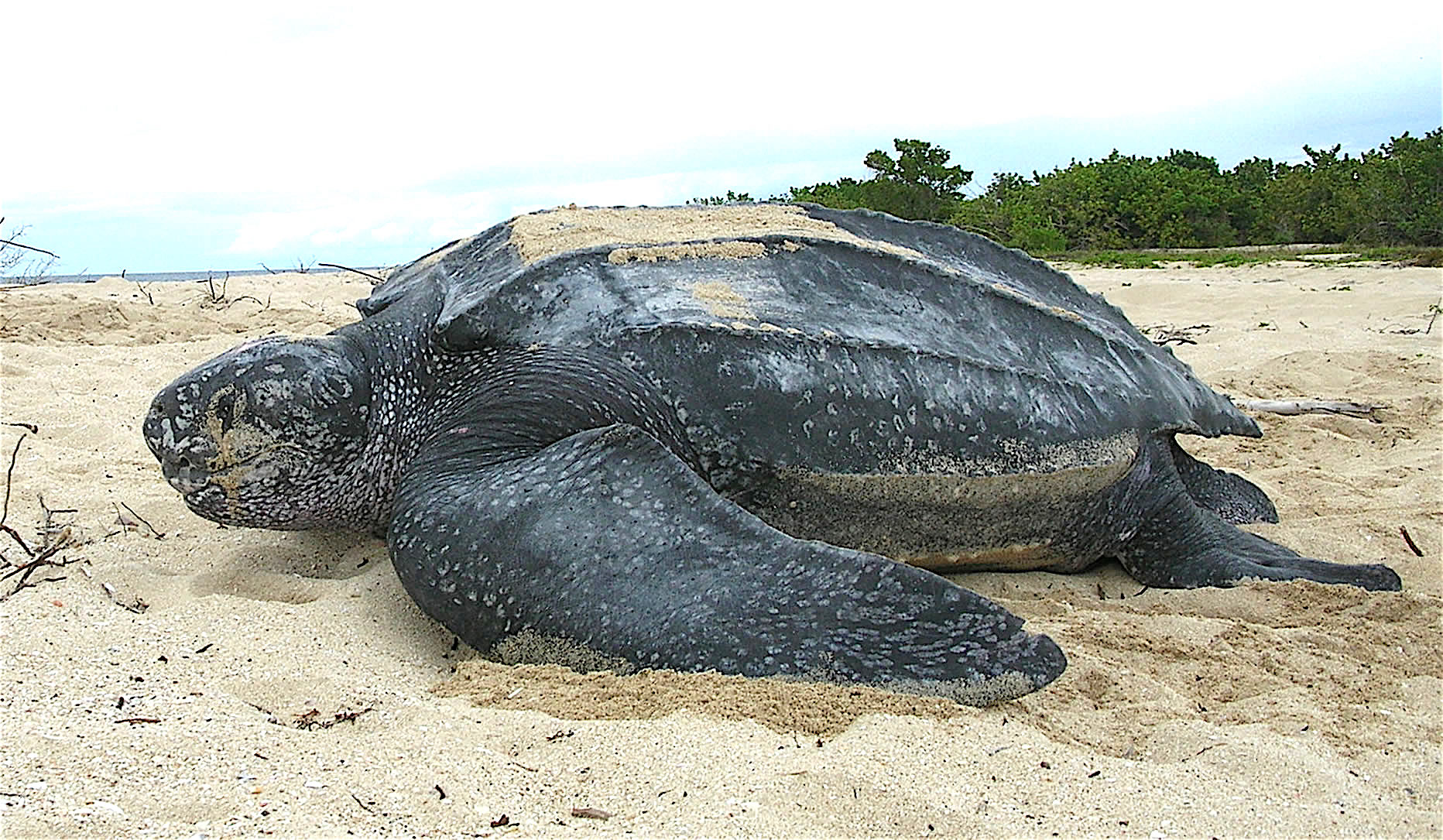
The leatherback sea turtle is the largest living turtle and one of the most widely distributed reptiles on Earth, ranging across the Atlantic, Pacific, and Indian Oceans. Unlike all other sea turtles, it lacks a hard bony shell, instead carrying a flexible, ridged carapace covered in leathery, oil-saturated skin. Its physiology allows it to dive deeper and tolerate colder water than any other sea turtle, following blooms of its gelatinous prey across entire ocean basins.
Biology and Identification
Adult leatherbacks typically measure about 5 to 6 feet (roughly 1.5 to 1.8 meters) in length and weigh between 750 and 1,000 pounds, making them the largest turtle in the world [NOAA 2024]. In place of a hard shell, seven longitudinal ridges run along a teardrop-shaped carapace of tough, rubbery skin reinforced by a mosaic of small bones [NOAA 2024]. They feed almost exclusively on soft-bodied prey such as jellyfish and salps, which they grip using pointed, tooth-like cusps on the jaws and backward-pointing spines lining the throat that prevent gelatinous food from slipping back out [NOAA 2024]. Among the deepest-diving of all reptiles, leatherbacks regularly descend to depths greater than 1,000 meters in pursuit of zooplankton prey [SWOT]. They are highly migratory, with some individuals swimming more than 10,000 miles a year between nesting and foraging grounds [NOAA 2024]. Their lifespan is not precisely known but is estimated at 45 to 50 years or more [NOAA 2024].
Habitat and Range
Leatherbacks occur in the Atlantic, Pacific, and Indian Oceans, ranging from tropical nesting beaches to cold temperate and even sub-polar foraging waters far from land [NOAA 2024]. Females nest on tropical and subtropical sandy beaches, while adults forage across open ocean and coastal waters wherever their gelatinous prey concentrates [SWOT]. For assessment and management, the global population is divided into seven subpopulations that differ widely in size, geographic range, and trend, spanning the Northwest and Southeast Atlantic, the East and West Pacific, the Southwest and Northeast Indian Ocean, and Southwest Atlantic regions [IUCN 2013].
Conservation Status
The leatherback sea turtle is listed as Vulnerable on the IUCN Red List at the global species level, assessed in 2013 under criterion A2bd [IUCN 2013]. The 2013 global reassessment moved the species from its previous Critically Endangered listing largely because new datasets revealed some previously undocumented increasing trends, particularly in the Northwest Atlantic; the IUCN nonetheless cautioned that the continued severe declines of Pacific subpopulations require urgent intervention [IUCN 2013; Mongabay 2013]. At the subpopulation level the picture is far more dire: the East Pacific subpopulation has declined by more than 97% over three generations and the West Pacific subpopulation by more than 80%, and both are assessed as Critically Endangered [Mongabay 2013; NOAA 2024]. In the United States, the leatherback is listed as endangered under the U.S. Endangered Species Act, a status in place since 1970, and the species is included on Appendix I of CITES, which prohibits international commercial trade [NOAA 2024; CITES]. Globally, NOAA reports that populations have declined roughly 40% over the past three generations [NOAA 2024].
Threats
The greatest threat to leatherbacks worldwide is incidental capture, or bycatch, in fishing gear such as longlines, gillnets, and trawls, which drowns or injures turtles that cannot reach the surface to breathe [NOAA 2024; IUCN 2013]. Direct harvest of adults and the collection of eggs from nesting beaches for human consumption have driven steep declines in many regions [IUCN 2013]. Additional documented pressures include coastal development and habitat loss at nesting beaches, vessel strikes, ingestion of and entanglement in marine debris, and climate change, which alters sand temperatures that determine hatchling sex ratios and threatens low-lying nesting beaches [NOAA 2024].
What Is Being Done
NOAA Fisheries leads U.S. recovery efforts under the Endangered Species Act, including designating critical habitat, operating sea turtle stranding and salvage networks, and prioritizing Pacific leatherbacks through its Species in the Spotlight initiative [NOAA 2024]. A central bycatch-reduction tool is the Turtle Excluder Device (TED), a grid fitted inside trawl nets that lets captured turtles escape; current TED designs have been determined to be about 97% effective at excluding turtles from shrimp trawls [NOAA TED]. On nesting beaches, long-running community and NGO programs protect females and eggs: at the Pacuare Reserve on Costa Rica's Caribbean coast, teams have conducted nightly patrols and operated hatcheries since 1989, and long-term monitoring there has documented a relatively stable nesting trend attributed to reduced poaching [Pacuare Reserve; Rivas et al. 2015]. Scientific assessment efforts coordinated through the IUCN Marine Turtle Specialist Group continue to track subpopulation trends and guide priorities [IUCN 2013].
How You Can Help
The public can support leatherback recovery in honest, practical ways. Backing established, science-based organizations such as NOAA Fisheries' sea turtle program and reputable nesting-beach conservation groups helps fund patrols, hatcheries, and monitoring [NOAA 2024; Pacuare Reserve]. Reporting stranded, injured, or nesting turtles to local stranding networks and wildlife authorities provides data that directly informs management [NOAA 2024]. Reducing single-use plastics that resemble jellyfish prey, supporting fisheries that use turtle-safe gear such as TEDs, and following informed advocacy for bycatch-reduction policy all contribute to lowering the threats documented in the scientific literature [NOAA 2024].
References
[IUCN 2013] Wallace, B.P., Tiwari, M. & Girondot, M. (2013). Dermochelys coriacea (Leatherback Turtle). The IUCN Red List of Threatened Species 2013: e.T6494A43526147. https://www.iucnredlist.org/species/6494/43526147
[NOAA 2024] NOAA Fisheries. (2024). Leatherback Turtle (Dermochelys coriacea) — Species Profile. National Oceanic and Atmospheric Administration. https://www.fisheries.noaa.gov/species/leatherback-turtle
[NOAA TED] NOAA Fisheries. Turtle Excluder Devices. National Oceanic and Atmospheric Administration. https://www.fisheries.noaa.gov/southeast/bycatch/turtle-excluder-devices
[Mongabay 2013] Hance, J. (2013). Leatherback sea turtle no longer Critically Endangered. Mongabay News. https://news.mongabay.com/2013/11/leatherback-sea-turtle-no-longer-critically-endangered/
[Pacuare Reserve] Pacuare Reserve. Sea Turtle Conservation Program, Caribbean Costa Rica. https://www.pacuarereserve.org/
[Rivas et al. 2015] Rivas, M.L., Fernández, C. & Marco, A. (2015). Nesting ecology and population trend of leatherback turtles Dermochelys coriacea at Pacuare Nature Reserve, Costa Rica. Oryx, 50(2), 274–282. https://doi.org/10.1017/S0030605314000775
[SWOT] State of the World's Sea Turtles (SWOT). Leatherback Turtle Species Profile. https://www.seaturtlestatus.org/leatherback-turtle
[CITES] Convention on International Trade in Endangered Species of Wild Fauna and Flora (CITES). Appendix I listing of Dermochelys coriacea. https://cites.org/eng/app/appendices.php