
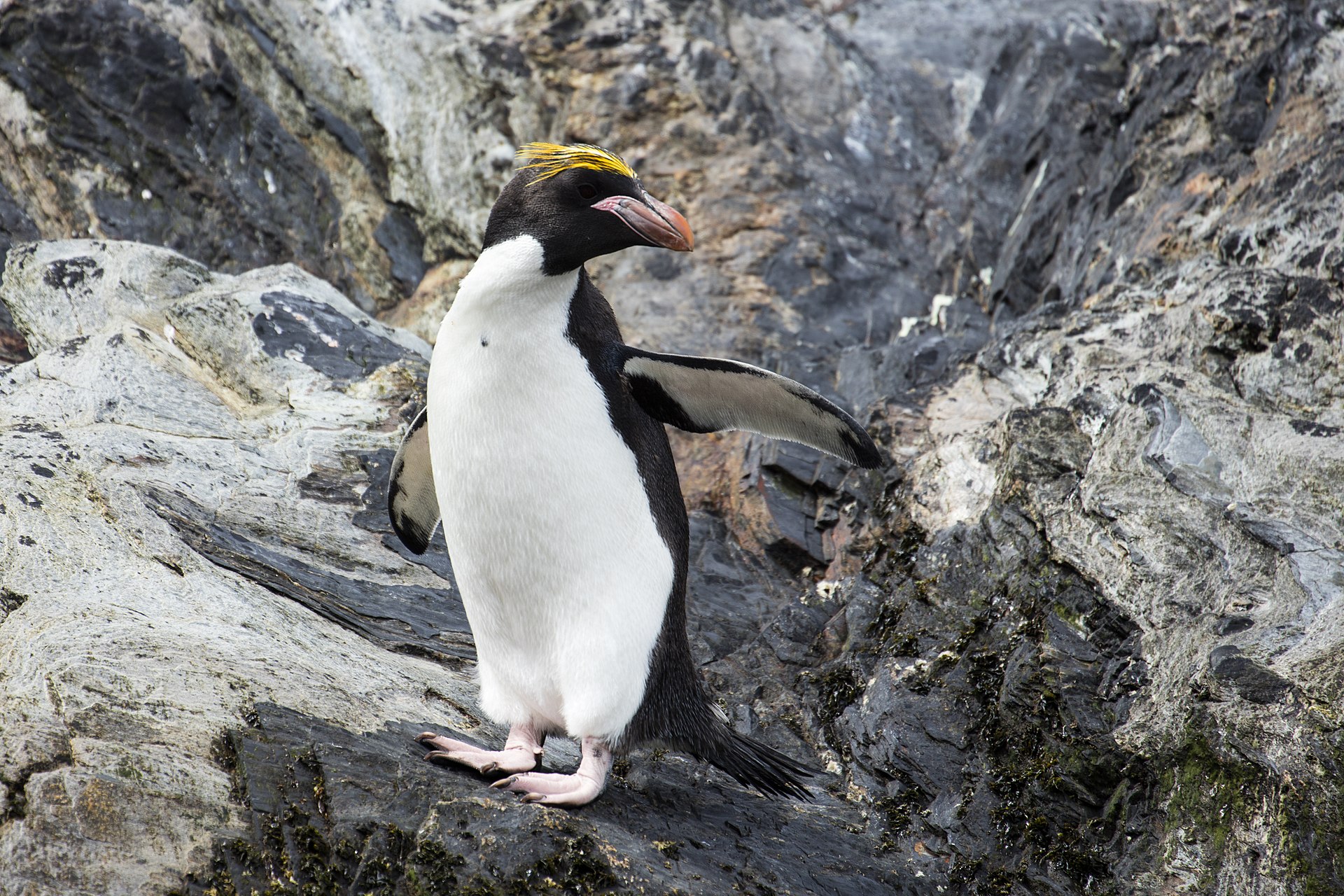
The macaroni penguin is the world's most abundant penguin and the single largest avian consumer of marine prey on Earth, eating an estimated 9.2 million tonnes of Antarctic krill, fish and squid every year [Brooke 2004; Trathan et al. 2015]. Yet despite numbering many millions of breeding pairs, the species is in steep decline and is listed as Vulnerable (VU) on the IUCN Red List [BirdLife International 2020]. Instantly recognisable by the flamboyant orange-yellow crest that arcs back from a bare patch above each eye, this crested penguin breeds on remote sub-Antarctic islands ringing the Southern Ocean. Long-term monitoring has documented losses of roughly 50% at major colonies such as South Georgia since the 1970s, making the macaroni penguin a sentinel of change in one of the planet's most productive yet rapidly warming marine ecosystems [Crawford et al. 2009].
Biology and Identification
Eudyptes chrysolophus (Brandt, 1837) is one of seven species in the crested-penguin genus Eudyptes, family Spheniscidae [Brandt 1837; Brooke 2004]. Adults stand about 70 cm tall and average roughly 5.5 kg, with body mass cycling seasonally between about 3.2 kg after the fasting moult and 6.4 kg before breeding [Williams 1995]. The sexes are similar, though males are larger with heavier bills. The diagnostic feature is a crest of golden-orange plumes that meet on the forehead and sweep back over the crown — the trait that inspired the common name, after the ornately dressed "macaroni" dandies of eighteenth-century England [Williams 1995].
The diet is dominated overwhelmingly by Antarctic krill (Euphausia superba and related euphausiids), supplemented by small fish and cephalopods, the balance shifting with local prey availability [Deagle et al. 2007]. Foraging birds dive repeatedly to pursue swarming krill, and the species' enormous aggregate consumption places it at the centre of Southern Ocean food webs [Brooke 2004].
Macaroni penguins are colonial and monogamous, with pairs returning to the same nest site each austral spring [Williams 1995]. They display obligate brood reduction: the female lays two eggs, but the first (smaller) egg is almost always lost, and typically only the chick from the larger second egg is reared [Williams 1995]. Breeding adults are highly synchronous, departing colonies after the chick-rearing and moult periods to spend the austral winter dispersed across the open ocean [Ratcliffe & Trathan 2012].
Habitat and Range
The macaroni penguin has a circumpolar sub-Antarctic and peri-Antarctic distribution, breeding on scattered islands across the South Atlantic and southern Indian Oceans and very locally on the northern Antarctic Peninsula [BirdLife International 2020]. Major breeding sites include South Georgia and the South Sandwich Islands, the Falkland Islands, the South Orkney and South Shetland Islands, Bouvet Island, the Prince Edward Islands (including Marion Island), the Crozet Islands, the Kerguelen Islands, and Heard and McDonald Islands; small numbers also breed in southern Chile [BirdLife International 2020; Crawford et al. 2009].
Colonies are typically established on rocky slopes, headlands and tussock-covered ground above the shoreline, where adults nest in dense aggregations that can number in the hundreds of thousands of pairs at the largest sites [Williams 1995]. Outside the breeding season the species is fully pelagic, ranging widely over Antarctic and sub-Antarctic waters and exploiting frontal zones where krill concentrate [Ratcliffe & Trathan 2012].
Distribution has contracted at the margins over recent decades. The species disappeared as a breeder from Isla Recalada in southern Chile, and several monitored colonies have shrunk substantially [BirdLife International 2020]. At South Georgia — historically one of the global strongholds — counts fell by roughly half between the mid-1970s and the mid-1990s, while at Marion Island in the Prince Edward group the breeding population declined by about 38% over three generations [Crawford et al. 2009; BirdLife International 2020].
Conservation Status
The macaroni penguin is listed as Vulnerable (VU) on the IUCN Red List of Threatened Species, assessed in 2020 under criteria reflecting a rapid population reduction over three generations (approximately 37 years) [BirdLife International 2020]. The total breeding population is estimated at around 6.3 million pairs, equating to a very large but decreasing number of mature individuals, and the global population trend is classified as decreasing [BirdLife International 2020]. Despite this abundance, the sustained rate of decline at monitored colonies is the basis for the Vulnerable listing rather than the absolute population size [BirdLife International 2020].
As a penguin species, Eudyptes chrysolophus is afforded protection under the Convention on International Trade in Endangered Species (CITES), under which it is treated as a CITES Appendix II taxon, regulating international trade in the species and its parts [CITES 2023]. Regional assessments echo the global picture: at the Prince Edward Islands, South Africa's national authorities record a continuing decline, with Marion Island falling from an estimated 433,723 pairs in 1994/95 to 313,217 pairs in 2021/22 [BirdLife South Africa 2025]. Because breeding is concentrated at a relatively small number of island groups, the species' fate is closely tied to conditions in the Southern Ocean and to the management of the krill-based ecosystems on which it depends [Trathan et al. 2015].
Threats
Macaroni penguins face a suite of interacting pressures, most of them operating at sea [Trathan et al. 2015; BirdLife International 2020]:
- Climate-driven changes in prey: Warming surface waters and shifting sea-ice dynamics alter the abundance and distribution of Antarctic krill, the dietary mainstay; reduced prey availability lowers breeding success and adult survival [Trathan et al. 2015; Deagle et al. 2007].
- Competition with commercial krill fisheries: Industrial harvesting of Euphausia superba in the Southern Ocean can reduce the prey accessible to foraging penguins, particularly when fishing overlaps with colonies during the breeding season [Trathan et al. 2015].
- Marine pollution and oil spills: Hydrocarbon contamination and other marine pollutants degrade plumage waterproofing and can cause direct mortality among seabirds that spend most of the year at sea [Trathan et al. 2015].
- Introduced predators and disturbance at colonies: On some islands, non-native mammals and human disturbance affect eggs, chicks and nesting adults [BirdLife International 2020].
- Natural predation pressure: Eggs and chicks are taken by skuas and giant petrels, while at sea adults are vulnerable to fur seals and other marine predators — a baseline pressure that compounds anthropogenic stressors [Horswill et al. 2014].
The cumulative effect of these mechanisms, acting on a species with naturally low reproductive output owing to brood reduction, drives the sustained declines documented across the breeding range [BirdLife International 2020].
What Is Being Done
A substantial part of the macaroni penguin's range lies within frameworks designed to protect Southern Ocean ecosystems. The Commission for the Conservation of Antarctic Marine Living Resources (CCAMLR) regulates the Antarctic krill fishery using precautionary catch limits intended to leave sufficient prey for dependent predators such as penguins, and has established marine protected areas in the region [CCAMLR 2023]. The wider Antarctic Treaty System provides environmental protection for breeding sites south of 60°S [Trathan et al. 2015].
Several key breeding islands hold formal protected status. South Georgia and the South Sandwich Islands are managed as a marine protected area, and South Africa's Prince Edward Islands — including Marion Island — are a designated Special Nature Reserve with a surrounding marine protected area, where long-term seabird monitoring underpins management decisions [BirdLife South Africa 2025]. International coordination is provided through the Agreement on the Conservation of Albatrosses and Petrels community and allied seabird-research networks, while CITES Appendix II provides a check on international trade [CITES 2023].
Long-term demographic studies at sites such as South Georgia, led by the British Antarctic Survey and partners, track survival, breeding success and foraging behaviour to identify the drivers of decline and inform ecosystem-based fisheries management [Horswill et al. 2014; Ratcliffe & Trathan 2012]. These monitoring programmes feed directly into IUCN reassessments and CCAMLR's management of the krill fishery [BirdLife International 2020].
How Readers Can Help
Because the macaroni penguin breeds only on remote islands, the most useful public contributions are informational and policy-oriented rather than hands-on. Birdwatchers and travellers can submit penguin observations to citizen-science platforms such as eBird, which aggregate distribution data used by researchers and conservation bodies [Sullivan et al. 2009]. Following and supporting the science-based catch limits set by CCAMLR for the Antarctic krill fishery helps keep prey available to penguins and other krill-dependent predators [CCAMLR 2023].
Consumers can favour seafood certified against credible sustainability standards and stay informed about how krill-derived products (such as some omega-3 supplements and aquaculture feeds) are sourced [Trathan et al. 2015]. More broadly, supporting measures that reduce greenhouse-gas emissions addresses the climate-driven shifts in krill that sit at the root of the species' decline [Trathan et al. 2015]. Reading and sharing peer-reviewed assessments — beginning with the IUCN Red List account — is a simple way to ground conversations about Southern Ocean wildlife in accurate, current information [BirdLife International 2020].
References
[BirdLife International 2020] BirdLife International (2020). Eudyptes chrysolophus. The IUCN Red List of Threatened Species 2020: e.T22697793. BirdLife Datazone species factsheet. https://datazone.birdlife.org/species/factsheet/macaroni-penguin-eudyptes-chrysolophus
[BirdLife South Africa 2025] BirdLife South Africa (2025). Macaroni Penguin Eudyptes chrysolophus — Regional Red List account, Prince Edward Islands. https://www.birdlife.org.za/red-list/macaroni-penguin/
[Brandt 1837] Brandt, J.F. (1837). Original description of Eudyptes chrysolophus. World Register of Marine Species (WoRMS) taxon record. https://www.marinespecies.org/aphia.php?p=taxdetails&id=212658
[Brooke 2004] Brooke, M. de L. (2004). The food consumption of the world's seabirds. Proceedings of the Royal Society of London B: Biological Sciences, 271(Suppl. 4), S246–S248. https://doi.org/10.1098/rsbl.2003.0153
[CCAMLR 2023] Commission for the Conservation of Antarctic Marine Living Resources (2023). Conservation of Antarctic krill and ecosystem-based fisheries management. https://www.ccamlr.org/
[CITES 2023] Convention on International Trade in Endangered Species of Wild Fauna and Flora (2023). Appendices I, II and III. https://cites.org/eng/app/appendices.php
[Crawford et al. 2009] Crawford, R.J.M., Whittington, P.A., Upfold, L., Ryan, P.G., Petersen, S.L., Dyer, B.M. & Cooper, J. (2009). Recent trends in numbers of four species of penguins at the Prince Edward Islands. African Journal of Marine Science, 31(3), 419–426. https://www.tandfonline.com/doi/abs/10.2989/00577610909350081
[Deagle et al. 2007] Deagle, B.E., Gales, N.J., Evans, K., Jarman, S.N., Robinson, S., Trebilco, R. & Hindell, M.A. (2007). Studying seabird diet through genetic analysis of faeces: a case study on macaroni penguins (Eudyptes chrysolophus). PLoS ONE, 2(9), e831. https://doi.org/10.1371/journal.pone.0000831
[Horswill et al. 2014] Horswill, C., Matthiopoulos, J., Green, J.A., Meredith, M.P., Forcada, J., Peat, H., Preston, M., Trathan, P.N. & Ratcliffe, N. (2014). Survival in macaroni penguins and the relative importance of different drivers: individual traits, predation pressure and environmental variability. Journal of Animal Ecology, 83(5), 1057–1067. https://doi.org/10.1111/1365-2656.12229
[Ratcliffe & Trathan 2012] Ratcliffe, N. & Trathan, P. (2012). A review of the diet and at-sea distribution of penguins breeding within the CAMLR Convention Area. CCAMLR Science, 19, 75–114. https://www.ccamlr.org/en/system/files/science_journal_papers/04ratcliffe-trathan.pdf
[Sullivan et al. 2009] Sullivan, B.L., Wood, C.L., Iliff, M.J., Bonney, R.E., Fink, D. & Kelling, S. (2009). eBird: a citizen-based bird observation network in the biological sciences. Biological Conservation, 142(10), 2282–2292. https://doi.org/10.1016/j.biocon.2009.05.006
[Trathan et al. 2015] Trathan, P.N., García-Borboroglu, P., Boersma, D., Bost, C.-A., Crawford, R.J.M., Crossin, G.T., Cuthbert, R.J., Dann, P., Davis, L.S., De La Puente, S., Ellenberg, U., Lynch, H.J., Mattern, T., Pütz, K., Seddon, P.J., Trivelpiece, W. & Wienecke, B. (2015). Pollution, habitat loss, fishing, and climate change as critical threats to penguins. Conservation Biology, 29(1), 31–41. https://doi.org/10.1111/cobi.12349
[Williams 1995] Williams, T.D. (1995). The Penguins: Spheniscidae. Bird Families of the World. Oxford University Press, Oxford. https://global.oup.com/academic/product/the-penguins-9780198540762