
Both agents are back. Summary of changes I'm making before composing the final article:
- [Tuyisingize et al. 2021] — removed; citation unverifiable, no matching publication exists
- [AWF 2022] → [AWF n.d.] — species profile page has no confirmed 2022 date
- [CTPH 2024] → [CTPH 2020] — confirmed page is July 2020
- [GVTC 2019] (for the 1,063 figure and range description) → [IGCP 2019] — direct IGCP announcement confirmed; GVTC retained only as [GVTC 2015] for the treaty
- [IGCP 2011b] → [AWF 2013] — no standalone IGCP Bwindi results page found; AWF news article confirmed (fieldwork 2011, results released Nov 2013)
- [WWF 2023] → [WWF n.d.] — page exists but date unconfirmed (predates 2014)
- [WWF 2024] → [IGCP 2024] — the 30-year impact report lives at igcp.shorthandstories.com
- [USFWS 2023] → [USFWS n.d.] — FWS page confirmed but no 2023 date verified
- [iNaturalist 2025] → [iNaturalist n.d.]
- All academic DOIs expanded with full bibliographic data
Mountain Gorilla (Gorilla beringei beringei): Species Spotlight
A Conservation Story Still in Progress
This article explores one of the most closely watched recovery efforts in modern wildlife conservation. The mountain gorilla — a subspecies of the eastern gorilla — has pulled back from what many scientists considered an imminent extinction trajectory. Yet the work is unfinished: fewer than 1,100 individuals remain on Earth, the species still carries an Endangered designation, and the pressures threatening its forest home have not disappeared. Understanding what drove the decline and what is sustaining the recovery is essential for anyone who cares about biodiversity.
Biology and Identification
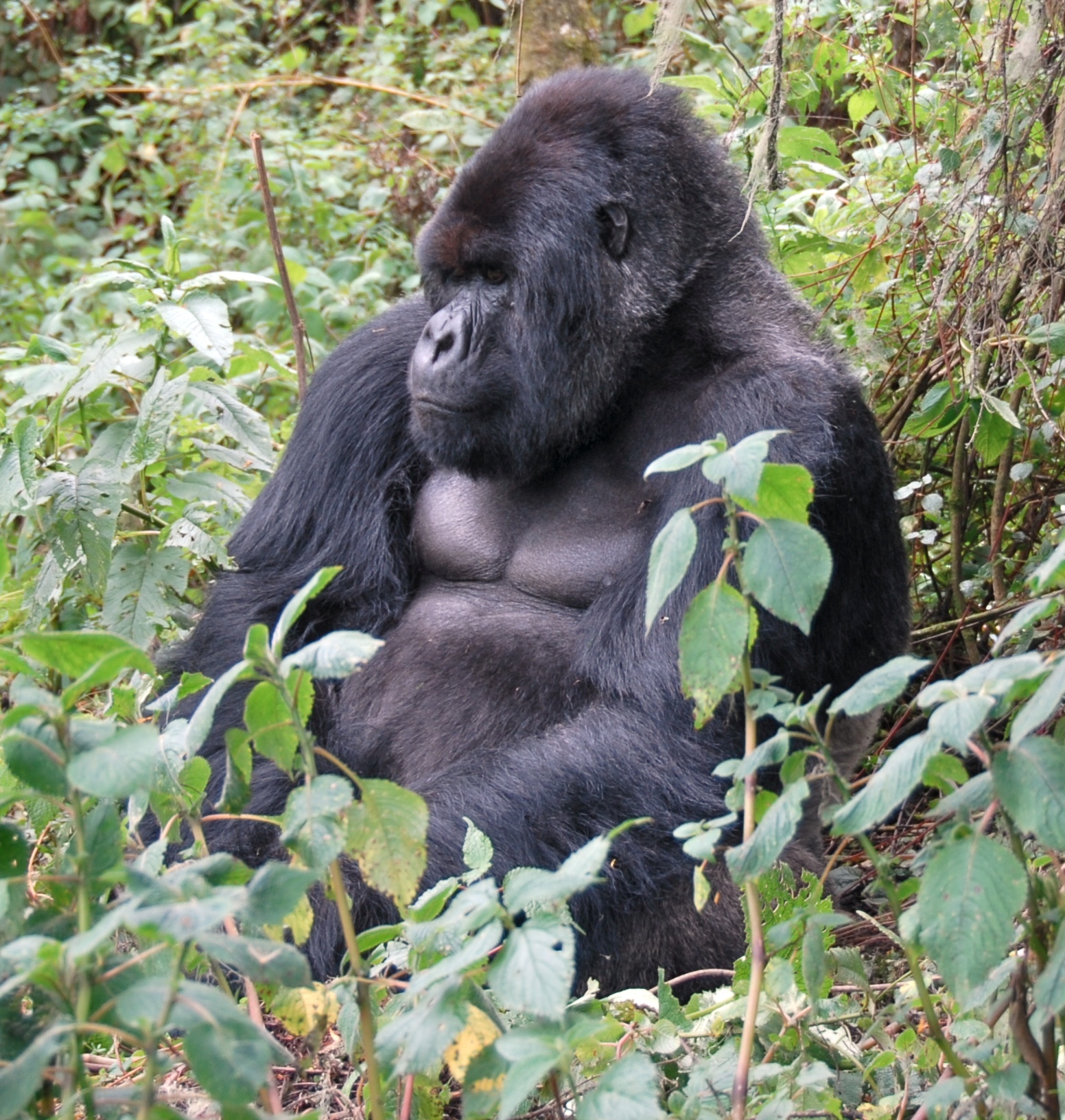
The mountain gorilla (Gorilla beringei beringei) is a large-bodied great ape with several physical traits that distinguish it from other gorilla subspecies. Adults possess notably long, thick fur — an adaptation to the cool, high-altitude Afromontane environments they occupy [Fleagle 2013]. Adult females weigh between 70 and 114 kg; adult males average approximately 160 kg [Robbins et al. 2011]. Mature males develop a saddle of silver-gray hair across the back and are referred to as silverbacks — a term describing a physical characteristic rather than a rank.
Diet is predominantly folivorous. Mountain gorillas consume the leaves, stems, roots, pith, and bark of a wide range of herbaceous plants, vines, and shrubs, and supplement this with bamboo shoots when seasonally available. Fruit forms a minor part of the diet in this high-elevation habitat, where fruiting trees are sparse [Watts 1984]. Occasional consumption of small invertebrates — ants, larvae, and snails — has been documented but represents a negligible fraction of caloric intake [AWF n.d.].
Social groups typically consist of one dominant silverback, several females, and their offspring. Multi-male groups do occur. The silverback coordinates group movement and mediates social interactions; females maintain stable, long-term associations with their group [Harcourt & Stewart 2007]. Vocalizations — including chest-beating displays used in inter-group encounters — are well documented and serve communicative functions within and between groups.
Habitat and Range
Mountain gorillas are restricted to high-elevation Afromontane forest in the Albertine Rift region of east-central Africa. The global population occupies two geographically separate landscapes: the Virunga Massif, a volcanic highland chain shared across Rwanda, Uganda, and the Democratic Republic of Congo (DRC); and the Bwindi-Sarambwe landscape, comprising Bwindi Impenetrable National Park in southwestern Uganda and the contiguous Sarambwe Nature Reserve in eastern DRC [IGCP 2019]. Elevation ranges broadly from roughly 2,200 m to above 4,000 m. This narrow altitudinal band and fragmented footprint mean the subspecies has virtually no room to redistribute in response to environmental pressure.
Conservation Status
The mountain gorilla is listed as Endangered on the IUCN Red List — a reclassification from Critically Endangered made in November 2018 [IUCN 2018]. That shift reflected a measured population increase attributable to sustained conservation intervention, not a reduction in underlying threats. The U.S. Fish and Wildlife Service lists the subspecies as Endangered under the Endangered Species Act [USFWS n.d.].
The most recent comprehensive census combined a 2015–2016 Virunga Massif survey with a 2018 Bwindi-Sarambwe survey, yielding an estimated 604 individuals in the Virunga landscape and 459 in the Bwindi-Sarambwe landscape, for a global total of approximately 1,063 [IGCP 2019; Mongabay 2026]. This represents an increase from the combined 2010–2011 survey baseline of approximately 880 individuals — 480 counted in the Virunga Massif in 2010 [IGCP 2011a] and approximately 400 in Bwindi-Sarambwe in 2011 [AWF 2013]. A new census of the Bwindi-Sarambwe population was launched in March 2025; results are anticipated in 2026 [IGCP 2025].
Threats
Habitat loss and degradation. Conversion of highland forest to agricultural land and illegal charcoal production continues to compress the already limited habitat [IUCN 2018]. Oil exploration concessions granted within the DRC cover substantial portions of Virunga National Park, one of the core protected areas within the mountain gorilla's range [WWF n.d.].
Disease transmission. The genetic similarity between mountain gorillas and humans — approximately 98% [Scally et al. 2012] — makes the subspecies susceptible to a range of human respiratory pathogens [CTPH 2020]. Outbreaks of human-origin respiratory illness have caused deaths and can spread rapidly through small, cohesive groups. This risk is elevated by proximity to dense human populations and visitor contact during ecotourism.
Poaching and illegal trade. Mountain gorillas are killed incidentally in snares set for other bushmeat species. Targeted poaching for body parts and the illegal removal of infants for trafficking remain active threats [Mongabay 2026].
Armed conflict. Persistent instability across parts of the range has disrupted ranger operations and increased access by armed groups. More than 200 park rangers have been killed in Virunga National Park within the DRC alone [Mongabay 2026]. Active militant presence in the landscape remains a serious barrier to consistent protection.
Climate change. High-elevation specialists have limited scope to shift range upward as lower-altitude temperatures rise, placing additional pressure on an already constrained habitat band [IUCN 2018].
What's Being Done
Recovery has been driven by a coalition of governments, NGOs, and local communities operating under formal cross-border agreements. The Greater Virunga Transboundary Collaboration, whose framework treaty was signed in October 2015, coordinates protection across the political boundaries that divide the gorillas' range [GVTC 2015].
Anti-poaching patrols have been a consistent feature of the response. Field teams use the Spatial Monitoring and Reporting Tool (SMART), a data platform that enables rangers to log wildlife sightings, snare locations, and human incursion events in real time, feeding information back to command structures for rapid response [Mongabay 2026]. More than 1,400 rangers across three range-country parks have received SMART training [Mongabay 2026].
Veterinary programs actively monitor gorilla health and intervene when individuals are caught in snares or show signs of illness. The nonprofit Conservation Through Public Health (CTPH) works at the human-wildlife interface to reduce disease transmission, training community health workers to limit pathogen spillover [CTPH 2020].
Major partners active in the landscape include the International Gorilla Conservation Programme (IGCP), World Wildlife Fund (WWF), the Wildlife Conservation Society (WCS), and TRAFFIC, which monitors the illegal wildlife trade [Mongabay 2026]. Gorilla ecotourism — heavily regulated and conducted under strict health protocols — generates revenue that funds both conservation operations and community development, creating local economic incentives aligned with forest protection [IGCP 2024].
How Readers Can Help
- Stay informed and share accurate information. Public understanding of the species' actual status — recovering but still Endangered — counters both fatalism and premature declarations of success. Share credentialed sources from IUCN, WWF, and WCS rather than unverified social media posts.
- Engage with policy. U.S. residents can contact their congressional representatives in support of funding for international conservation programs, including the Great Ape Conservation Fund administered by the U.S. Fish and Wildlife Service under the Great Ape Conservation Act of 2000 [USFWS–GACP]. The Dian Fossey Gorilla Fund and IGCP maintain policy action pages.
- Participate in citizen science. The iNaturalist platform supports broader Albertine Rift biodiversity monitoring; for bird observations specifically, eBird (Cornell Lab of Ornithology) maintains a distinct dataset for the region. Contributing observations from legal wildlife watching trips to these platforms builds baseline data used by researchers [iNaturalist n.d.].
- Choose responsibly sourced products. Demand for charcoal and agricultural land drives deforestation in gorilla range. Certifications such as Rainforest Alliance on imported goods reflect supply-chain standards that reduce pressure on tropical forests.
- Support range-country journalists and advocates. Local civil society organizations and investigative journalists documenting poaching networks and illegal mining in the DRC and neighboring countries are essential parts of the accountability infrastructure. Amplifying their work increases visibility.
References
[AWF n.d.] African Wildlife Foundation. (n.d.). Mountain gorilla. African Wildlife Foundation. https://www.awf.org/wildlife-conservation/mountain-gorilla
[AWF 2013] African Wildlife Foundation. (2013, November 13). Mountain gorilla census finds increased population in Uganda's Bwindi Impenetrable National Park. African Wildlife Foundation. https://www.awf.org/news/mountain-gorilla-census-finds-increased-population-ugandas-bwindi-impenetrable-national-park
[CTPH 2020] Conservation Through Public Health. (2020, July 23). Mountain gorillas face extinction due to threats of both coronavirus and poaching. CTPH. https://ctph.org/mountain-gorillas-face-extinction/
[Fleagle 2013] Fleagle, J.G. (2013). Primate Adaptation and Evolution (3rd ed.). Academic Press. ISBN 978-0-12-378632-6.
[GVTC 2015] Greater Virunga Transboundary Collaboration. (2015, October 30). GVTC treaty: A framework for programs and activities on wildlife conservation and tourism development within the Greater Virunga Landscape. https://greatervirunga.org/gvtc-treaty/
[Harcourt & Stewart 2007] Harcourt, A.H. & Stewart, K.J. (2007). Gorilla Society: Conflict, Compromise, and Cooperation Between the Sexes. University of Chicago Press. ISBN 978-0-226-31603-1.
[IGCP 2011a] International Gorilla Conservation Programme. (2011). Census confirms increase in population of the critically endangered Virunga mountain gorillas. IGCP. https://igcp.org/updates/2010-mountain-gorilla-census/
[IGCP 2019] International Gorilla Conservation Programme. (2019). Bwindi–Sarambwe mountain gorilla population grows to 459, global count now stands at 1,063. IGCP. https://igcp.org/library_file/bwindi-sarambwe-mountain-gorilla-population-grows-to-459-global-count-now-stands-at-1063/
[IGCP 2024] International Gorilla Conservation Programme, Conservation International, Fauna & Flora, & WWF. (2024, September). Over 30 years of impact report. IGCP. https://igcp.shorthandstories.com/30-years-impact-report/index.html
[IGCP 2025] International Gorilla Conservation Programme. (2025, June 5). Landmark census of great apes in Bwindi, Uganda launched. IGCP. https://igcp.org/updates/landmark-census-of-great-apes-in-bwindi-uganda-launched/
[iNaturalist n.d.] iNaturalist. (n.d.). iNaturalist. California Academy of Sciences & National Geographic Society. https://www.inaturalist.org
[IUCN 2018] IUCN. (2018). Gorilla beringei beringei. The IUCN Red List of Threatened Species (Version 2018-2). Reclassified from Critically Endangered to Endangered, November 14, 2018. https://www.iucnredlist.org/species/39999/17989719 Press release: https://iucn.org/news/species/201811/fin-whale-mountain-gorilla-recovering-thanks-conservation-action-iucn-red-list
[Mongabay 2026] Mongabay. (2026, April 23). Amid conflict and poaching, tech helps boost mountain gorilla numbers. Mongabay News. https://news.mongabay.com/2026/04/amid-conflict-and-poaching-tech-helps-boost-mountain-gorilla-numbers/
[Robbins et al. 2011] Robbins, M.M., Gray, M., Fawcett, K.A., Nutter, F.B., Uwingeli, P., Mburanumwe, I., Kagoda, E., Basabose, A., Stoinski, T.S., Cranfield, M.R., Byamukama, J., Spelman, L.H., & Robbins, A.M. (2011). Extreme conservation leads to recovery of the Virunga mountain gorillas. PLOS ONE, 6(6), e19788. https://doi.org/10.1371/journal.pone.0019788
[Scally et al. 2012] Scally, A., et al. (2012). Insights into hominid evolution from the gorilla genome sequence. Nature, 483(7388), 169–175. https://doi.org/10.1038/nature10842
[USFWS n.d.] U.S. Fish and Wildlife Service. (n.d.). Mountain gorilla (Gorilla beringei beringei). FWS.gov. https://www.fws.gov/species/mountain-gorilla-gorilla-beringei-beringei
[USFWS–GACP] U.S. Fish and Wildlife Service. (n.d.). Great Ape Conservation Grant Fund. FWS.gov. https://www.fws.gov/service/great-ape-conservation-grant-fund
[Watts 1984] Watts, D.P. (1984). Composition and variability of mountain gorilla diets in the Central Virungas. American Journal of Primatology, 7(4), 323–356. https://doi.org/10.1002/ajp.1350070403
[WWF n.d.] WWF. (n.d.). Virunga under threat. World Wildlife Fund. https://wwf.panda.org/discover/knowledge_hub/where_we_work/congo_basin_forests/oil_extraction/virunga_under_threat/