
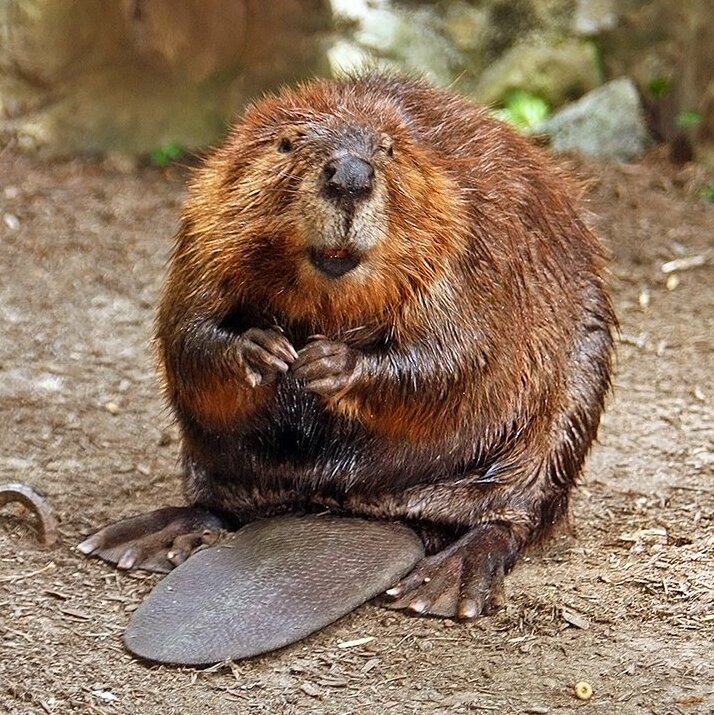
The North American beaver is the largest rodent on its continent and one of the most influential non-human engineers of temperate landscapes. By felling trees and building dams, a single colony can convert a free-flowing stream into a mosaic of ponds, wetlands, and wet meadows that store water, raise local water tables, and support a disproportionate share of regional biodiversity [Naiman et al. 1988; Wright et al. 2002]. This combination of ecological reach and behavioral persistence makes the beaver a textbook keystone species and ecosystem engineer. This profile examines beaver biology, the near-total collapse and recovery of the species under the fur trade, the paradox of its destructive introduced population in South America, and the restoration movement now harnessing beaver activity to build climate-resilient watersheds. It concerns Castor canadensis specifically, not the related Eurasian beaver Castor fiber.
Biology and Identification
The North American beaver is a large, semi-aquatic rodent, typically weighing 11–32 kg as an adult, with a stocky body, dense waterproof underfur, webbed hind feet, and a distinctive broad, scaled, paddle-shaped tail used for swimming, thermoregulation, and slapping the water as an alarm signal. Continuously growing, iron-reinforced incisors allow the animal to fell trees and shrubs for food and construction material.
Beavers are strict herbivores, feeding on the cambium of woody plants such as willow, aspen, and cottonwood, as well as aquatic vegetation and herbaceous growth. They are largely nocturnal and crepuscular and remain active through winter, drawing on submerged caches of branches stored near the lodge. Colonies are family units, generally a monogamous adult pair with offspring of multiple years; young typically disperse to establish their own territories.
The defining trait of the species is its construction behavior. Beavers build dams from branches, mud, and stones to impound water, raising pond depth to protect lodge entrances and create safe foraging access. They also excavate canals that extend their reach into surrounding wetlands; these channels can serve as movement corridors for other animals, including pond-breeding amphibians [Anderson et al. 2015]. It is this dam- and canal-building, rather than any single physiological feature, that gives the beaver its outsized ecological footprint.
Habitat and Range
The North American beaver occupies freshwater habitats across nearly the entire North American continent, from the boreal forests of Canada and Alaska south through the United States to northern Mexico. It is a habitat generalist, occurring along streams, rivers, lakes, ponds, and marshes wherever woody vegetation and year-round water are available [Cassola 2016].
Beyond its native range, the species was deliberately introduced to the Tierra del Fuego archipelago of southern Argentina and Chile in 1946 and to Finland in the early twentieth century. The South American population, free of natural predators and competitors, has spread widely and is now treated as a damaging invasive species across Patagonia [Anderson et al. 2006; Pietrek & González-Roglich 2016].
In accordance with NRWL sensitive-species policy, specific site locations, corridor routes, and seasonal movement details are not disclosed in this article.
Conservation Status
The North American beaver is listed as Least Concern on the IUCN Red List, with a population trend assessed as stable [Cassola 2016]. The species is widespread, abundant, occurs in many protected areas, and is not currently of global conservation concern.
This status, however, masks a dramatic history. Before sustained European colonization, beavers numbered in the tens of millions across the continent. Demand for beaver felt, used chiefly in hats, drove a fur trade that depleted the animal across most of its range, and by the late nineteenth and early twentieth centuries the species had been extirpated from large portions of its former distribution. Twentieth-century trapping regulations, legal protection, and active reintroduction and translocation programs allowed populations to recover broadly, and the continental population today again numbers in the millions [Naiman et al. 1988]. The species' present security is therefore a conservation recovery story rather than evidence that it was never at risk.
The introduced South American population represents the inverse situation: an abundant, expanding population that is itself a conservation problem for native sub-Antarctic ecosystems [Anderson et al. 2006].
Threats
Within its native range, the beaver no longer faces a continental threat to its survival, but localized pressures persist. Trapping continues for fur and for population management, and conflict-driven removal is common where dam-building floods roads, culverts, agricultural land, and timber. Because beavers reliably rebuild dams that are breached, lethal removal is often used as a first response to flooding complaints. Habitat loss from stream channelization, wetland drainage, and development reduces the availability of the slow, vegetated waterways the species depends on.
A distinct category of harm is the damage beavers themselves cause as an invasive species in southern Patagonia. Native Nothofagus (southern beech) forests did not evolve with large dam-building rodents and, unlike North American riparian trees, do not readily resprout after being felled. Beaver damming and foraging have driven landscape-scale conversion of riparian forest to open meadow and altered stream channels, sediment dynamics, water-table depth, and nutrient cycling across Tierra del Fuego [Anderson et al. 2006; Pietrek & González-Roglich 2016]. Some impacts are mixed rather than uniformly negative — for example, acoustic surveys have found higher patch-level bird diversity at beaver-modified sites — but the net effect on native sub-Antarctic forest is widely regarded as severe [Francomano et al. 2021]. The same engineering that makes the beaver beneficial in its native range makes it destructive where it does not belong.
What Is Being Done
Beaver-based and process-based restoration. A growing field of low-tech, process-based stream restoration deliberately harnesses beaver activity to repair degraded watersheds. Practitioners install beaver dam analogues — porous, hand-built structures of posts, branches, and mud that mimic real dams — to slow water, reconnect streams to their floodplains, trap sediment, and create habitat, often as a precursor to natural recolonization by beavers [Pollock et al. 2014]. Field experiments have shown that natural and simulated beaver dams can raise water tables, expand wetland area, and benefit native fishes.
Climate resilience. Beaver-built wetlands slow and store water, recharge groundwater, and keep riparian zones moist, buffering watersheds against both drought and wildfire. Remote-sensing analyses across the western United States have found that beaver-dammed riparian corridors stay markedly greener during wildfire than comparable undammed corridors, acting as fire-resistant refugia [Fairfax & Whittle 2020]. Beaver ponds and meadows also influence carbon and nitrogen cycling, storing organic carbon in sediments and altering riparian water chemistry [Wohl 2013; Hill & Duval 2009]. These properties have led researchers to frame beaver restoration as a scalable, low-cost component of freshwater climate adaptation [Jordan & Fairfax 2022].
Coexistence tools. Where dam-building conflicts with infrastructure, non-lethal flow devices — pond levelers and culvert-protection fences, sometimes called "beaver deceivers" — allow water to pass while keeping beavers in place, resolving flooding without removal. Reviews of these devices document substantial reductions in flooding complaints and favorable cost-benefit outcomes relative to repeated trapping [Taylor & Singleton 2014].
Invasive control. In Tierra del Fuego, binational Argentine-Chilean efforts have sought to map the invasion and, in pilot areas, eradicate or control beavers to allow native Nothofagus riparian forest to recover [Pietrek & González-Roglich 2016].
How Readers Can Help
Citizen science. Photograph and log beaver sightings and signs of beaver activity through platforms such as iNaturalist. Verified records help researchers track range, recovery, and, in introduced regions, the spread of invasive populations.
Support coexistence. Where beavers cause flooding, support and encourage the use of non-lethal flow devices and professional installation programs as an alternative to repeated removal [Taylor & Singleton 2014].
Policy engagement. Support wetland-protection measures and stream-restoration programs, including low-tech process-based restoration and beaver reintroduction where ecologically appropriate.
Education outreach. Share accurate, science-based information about the beaver's role as an ecosystem engineer — and about why the same species is a serious problem outside its native range. Understanding that context is essential to supporting restoration in North America while backing invasive control in Patagonia.
References
[Anderson et al. 2006] Anderson, C.B., Griffith, C.R., Rosemond, A.D., Rozzi, R. & Dollenz, O. (2006). The effects of invasive North American beavers on riparian plant communities in Cape Horn, Chile: Do exotic beavers engineer differently in sub-Antarctic ecosystems? Biological Conservation, 128(4), 467–474. https://doi.org/10.1016/j.biocon.2005.10.011
[Anderson et al. 2015] Anderson, N.L., Paszkowski, C.A. & Hood, G.A. (2015). Linking aquatic and terrestrial environments: can beaver canals serve as movement corridors for pond-breeding amphibians? Animal Conservation, 18(3), 287–294. https://doi.org/10.1111/acv.12170
[Cassola 2016] Cassola, F. (2016). Castor canadensis. The IUCN Red List of Threatened Species 2016: e.T4003A22187946. https://dx.doi.org/10.2305/IUCN.UK.2016-3.RLTS.T4003A22187946.en
[Fairfax & Whittle 2020] Fairfax, E. & Whittle, A. (2020). Smokey the Beaver: beaver-dammed riparian corridors stay green during wildfire throughout the western United States. Ecological Applications, 30(8), e02225. https://doi.org/10.1002/eap.2225
[Francomano et al. 2021] Francomano, D., Gottesman, B.L. & Pijanowski, B.C. (2021). Acoustic monitoring shows invasive beavers Castor canadensis increase patch-level avian diversity in Tierra del Fuego. Journal of Applied Ecology, 58(10), 2105–2116. https://doi.org/10.1111/1365-2664.13999
[Hill & Duval 2009] Hill, A.R. & Duval, T.P. (2009). Beaver dams along an agricultural stream in southern Ontario, Canada: their impact on riparian zone hydrology and nitrogen chemistry. Hydrological Processes, 23(9), 1324–1336. https://doi.org/10.1002/hyp.7249
[Jordan & Fairfax 2022] Jordan, C.E. & Fairfax, E. (2022). Beaver: the North American freshwater climate action plan. WIREs Water, 9(4), e1592. https://doi.org/10.1002/wat2.1592
[Naiman et al. 1988] Naiman, R.J., Johnston, C.A. & Kelley, J.C. (1988). Alteration of North American streams by beaver. BioScience, 38(11), 753–762. https://doi.org/10.2307/1310784
[Pietrek & González-Roglich 2016] Pietrek, A.G. & González-Roglich, M. (2016). Post-establishment changes in habitat selection by an invasive species: beavers in Patagonia — landscape-level impact and habitat factors associated with invasive beaver distribution in Tierra del Fuego. Biological Invasions, 18(11), 3225–3235. https://doi.org/10.1007/s10530-016-1110-9
[Pollock et al. 2014] Pollock, M.M., Beechie, T.J., Wheaton, J.M., Jordan, C.E., Bouwes, N., Weber, N. & Volk, C. (2014). Using beaver dams to restore incised stream ecosystems. BioScience, 64(4), 279–290. https://doi.org/10.1093/biosci/biu036
[Taylor & Singleton 2014] Taylor, B.D. & Singleton, R.D. (2014). The evolution of flow devices used to reduce flooding by beavers: a review. Wildlife Society Bulletin, 38(1), 127–133. https://doi.org/10.1002/wsb.363
[Wohl 2013] Wohl, E. (2013). Landscape-scale carbon storage associated with beaver dams. Geophysical Research Letters, 40(14), 3631–3636. https://doi.org/10.1002/grl.50710
[Wright et al. 2002] Wright, J.P., Jones, C.G. & Flecker, A.S. (2002). An ecosystem engineer, the beaver, increases species richness at the landscape scale. Oecologia, 132(1), 96–101. https://doi.org/10.1007/s00442-002-0929-1