
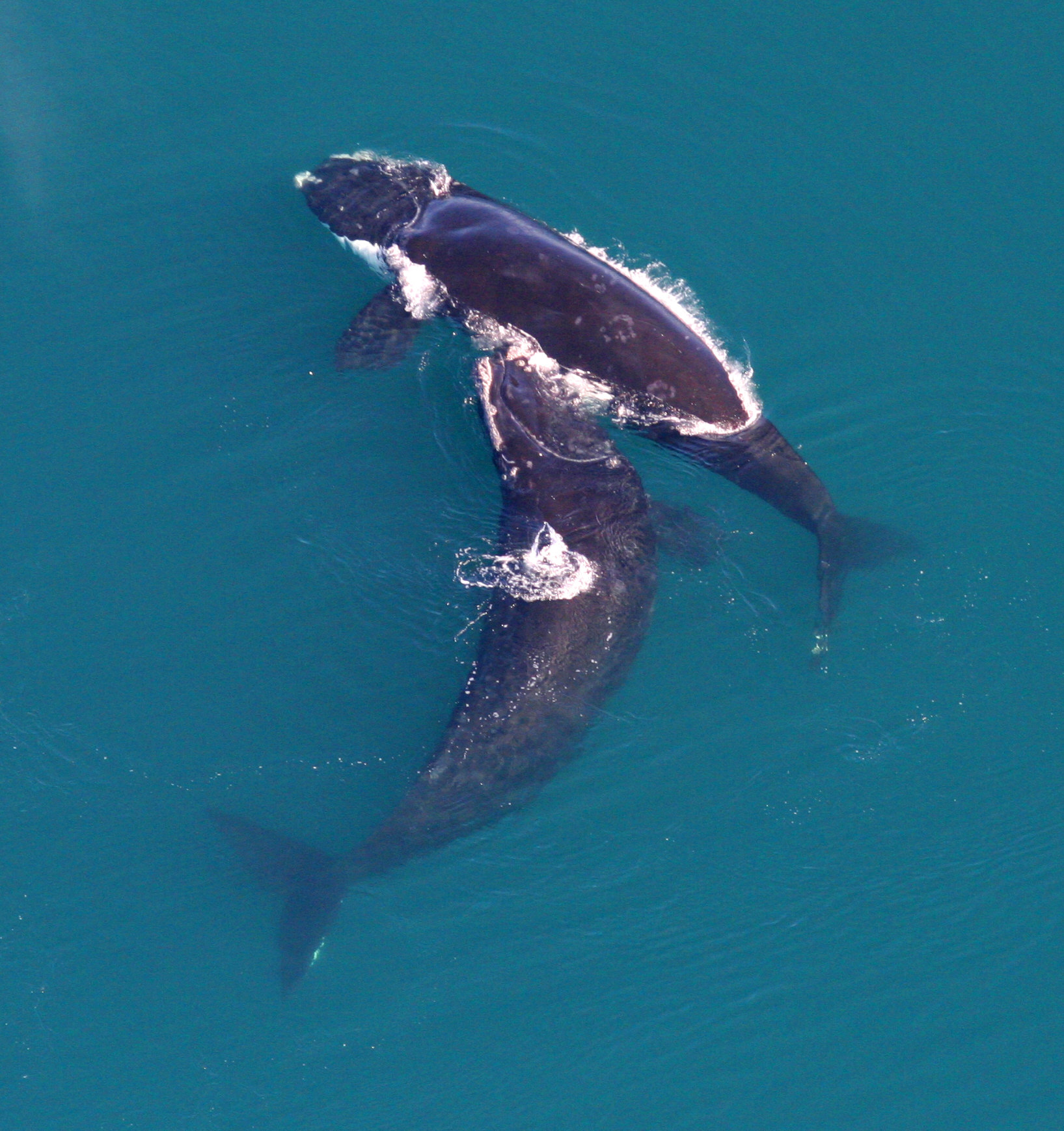
Roughly 370 Remaining — Killed by Boats and Rope
The North Atlantic right whale is among the most endangered large whales on Earth. The species was hunted to near-extinction during the commercial whaling era (it was the "right" whale to hunt — slow, coastal, and it floated when killed) and never recovered. The latest estimate from the North Atlantic Right Whale Consortium puts the population at approximately 370 individuals, including fewer than 70 reproductively active females [NARW Consortium 2024]. The IUCN reassessed the species as Critically Endangered in 2020, citing an ongoing population decline driven almost entirely by two human causes: vessel strikes and entanglement in fixed fishing gear [Cooke 2020].
Unlike many endangered species whose primary threat is habitat loss or a wildlife trade, the right whale's decline is driven by two mechanical, well-understood, and in-principle-preventable causes — which makes the continued decline a case study in the gap between knowing the cause and implementing the fix.
Biology and identification
Eubalaena glacialis adults reach 13–16 m in length and 40,000–70,000 kg [Kraus & Rolland 2007]. The species is identified by:
- No dorsal fin (distinguishing it from most other large whales at the surface)
- Callosities — roughened patches of thickened skin on the head, colonised by pale cyamid crustaceans ("whale lice"), forming individually-unique patterns used by researchers to identify every living right whale by sight
- Broad, deeply-notched flukes and a broad back
- V-shaped blow visible at the surface
Right whales are baleen filter-feeders, consuming primarily copepods (Calanus finmarchicus) and other zooplankton by skimming through dense patches with their mouth open. Feeding-ground location is tightly coupled to copepod distribution, which is shifting northward (into the Gulf of St. Lawrence and Canadian waters) as ocean temperatures change — a shift that has moved whales into areas with less protective regulation than their historical U.S. feeding grounds [Record et al. 2019].
Reproduction is slow: females first calve at approximately 10 years and produce a single calf at intervals that have lengthened from approximately 3 years historically to 6–10 years recently — the lengthening itself a documented stress signal [Kraus et al. 2016].
Habitat and range
The species occupies the western North Atlantic continental shelf, migrating between:
- Winter calving grounds off the southeastern United States (coastal Georgia and Florida) — November to March
- Spring/summer feeding grounds historically in the Gulf of Maine, Cape Cod Bay, and the Bay of Fundy; increasingly in the Gulf of St. Lawrence (Canada) as copepod distribution shifts northward [Record et al. 2019]
The northward feeding-ground shift since approximately 2010 is a central management challenge: the whales moved into Canadian waters and shipping lanes faster than protective regulations adapted, contributing to a documented "Unusual Mortality Event" declared by NOAA in 2017 that has continued [NOAA Fisheries UME 2017–ongoing].
A small eastern North Atlantic population (European/North African waters) is considered functionally extinct.
Conservation status
The North Atlantic right whale is listed as Critically Endangered on the IUCN Red List [Cooke 2020], Endangered under the U.S. Endangered Species Act, depleted under the U.S. Marine Mammal Protection Act, and Endangered under Canada's Species at Risk Act. It is on CITES Appendix I.
NOAA Fisheries declared an Unusual Mortality Event (UME) for the species beginning in 2017; as of recent reporting the UME documented dozens of dead, seriously injured, or sublethally-affected whales — a significant fraction of the total population — with vessel strike and entanglement as the attributed causes in necropsied cases [NOAA Fisheries 2024].
Threats
Vessel strikes — collisions with ships are a leading cause of right whale mortality. The species feeds and travels near the surface in coastal waters that overlap with major shipping lanes along the U.S. and Canadian Atlantic seaboard. NOAA implemented mandatory vessel speed restrictions (10 knots) in designated Seasonal Management Areas in 2008; a 2022 proposed rule sought to expand the speed-restriction zones and apply them to smaller vessels, but as of recent reporting the expanded rule faced significant delay and industry opposition [NOAA Fisheries proposed vessel-speed rule 2022].
Entanglement in fixed fishing gear — vertical lines connecting surface buoys to seafloor lobster and crab traps are the other leading cause. Whales swimming through these lines become entangled; the rope wraps around flukes, flippers, or the mouth, causing drowning, chronic injury, starvation (when the rope impairs feeding), or death over months. An estimated 85%+ of living right whales show scarring from at least one entanglement event [Knowlton et al. 2012]. "Ropeless" or "on-demand" fishing gear (traps with no persistent vertical line, retrieved by acoustic release) is the principal technological solution, in pilot deployment but not yet at scale.
Climate-driven prey shift — the northward movement of Calanus copepods has moved whales into less-regulated Canadian waters and altered the predictability of their distribution, complicating the static-zone regulatory approach.
Reduced reproductive rate — the lengthening calving interval (from ~3 to 6–10 years) is itself a population-level stress signal attributed to the cumulative sublethal effects of entanglement and nutritional stress [Kraus et al. 2016].
What is being done
- North Atlantic Right Whale Consortium — the multi-institutional research and data-sharing body that maintains the photo-identification catalog of every living right whale and produces the annual population estimate [NARW Consortium 2024].
- NOAA Fisheries — manages the U.S. regulatory framework: Seasonal Management Areas with vessel speed limits, the Atlantic Large Whale Take Reduction Plan (gear regulations), and the ongoing UME investigation.
- Canadian Department of Fisheries and Oceans (DFO) — implemented dynamic vessel-speed and fishery-closure measures in the Gulf of St. Lawrence after the 2017 mortality spike, which contributed to reduced Canadian-waters mortality in subsequent years.
- Ropeless gear development — the Ropeless Consortium, NOAA, and gear manufacturers are developing and piloting on-demand trap-retrieval systems that eliminate the persistent vertical line.
- New England Aquarium, Woods Hole, and university research programs — conduct the aerial and vessel surveys, necropsies, and entanglement-response work.
- Oceana, Defenders of Wildlife, Conservation Law Foundation — pursue litigation and advocacy to strengthen and accelerate the vessel-speed and gear regulations.
How readers can help
- Support the New England Aquarium's right whale research, Oceana, and the Conservation Law Foundation. These organizations sustain the monitoring and the legal/policy pressure to accelerate regulation.
- Support ropeless-gear deployment. The transition from persistent-vertical-line traps to on-demand gear is the single highest-leverage technological fix for entanglement. Organizations funding gear development and fishery-transition subsidies are a direct channel.
- Engage on the NOAA vessel-speed rule. The proposed expansion of vessel-speed restrictions has been delayed; public comment and policy engagement during rulemaking windows is the principal civic action.
- Choose responsibly-sourced seafood. Lobster and crab from fisheries adopting ropeless gear or operating outside right whale habitat reduce entanglement pressure. Seafood Watch and Marine Stewardship Council ratings flag right-whale-bycatch concerns.
- For boaters in the U.S./Canadian Atlantic seaboard: observe Seasonal Management Area speed limits (10 knots), maintain a 500-yard federal approach distance from right whales (a legal requirement in U.S. waters), and report sightings to NOAA's right whale sighting hotline.
Last verified: 2026-05-24 Conservation status: Critically Endangered (IUCN Red List 2020 assessment); ~370 individuals; ESA Endangered; ongoing NOAA Unusual Mortality Event since 2017.
References
- Cooke, J. G. (2020). Eubalaena glacialis. IUCN Red List of Threatened Species. e.T41712A178589687.
- Knowlton, A. R., Hamilton, P. K., Marx, M. K., Pettis, H. M., & Kraus, S. D. (2012). Monitoring North Atlantic right whale entanglement rates: a 30-year retrospective. Marine Ecology Progress Series 466: 293–302.
- Kraus, S. D., & Rolland, R. M. (Eds.) (2007). The Urban Whale: North Atlantic Right Whales at the Crossroads. Harvard University Press.
- Kraus, S. D., Kenney, R. D., Mayo, C. A., et al. (2016). Recent scientific publications cast doubt on North Atlantic right whale future. Frontiers in Marine Science 3: 137.
- North Atlantic Right Whale Consortium (2024). Annual Report Card and population estimate. https://www.narwc.org/
- NOAA Fisheries (2024). North Atlantic Right Whale Unusual Mortality Event. https://www.fisheries.noaa.gov/
- Record, N. R., Runge, J. A., Pendleton, D. E., et al. (2019). Rapid climate-driven circulation changes threaten conservation of endangered North Atlantic right whales. Oceanography 32(2): 162–169.