
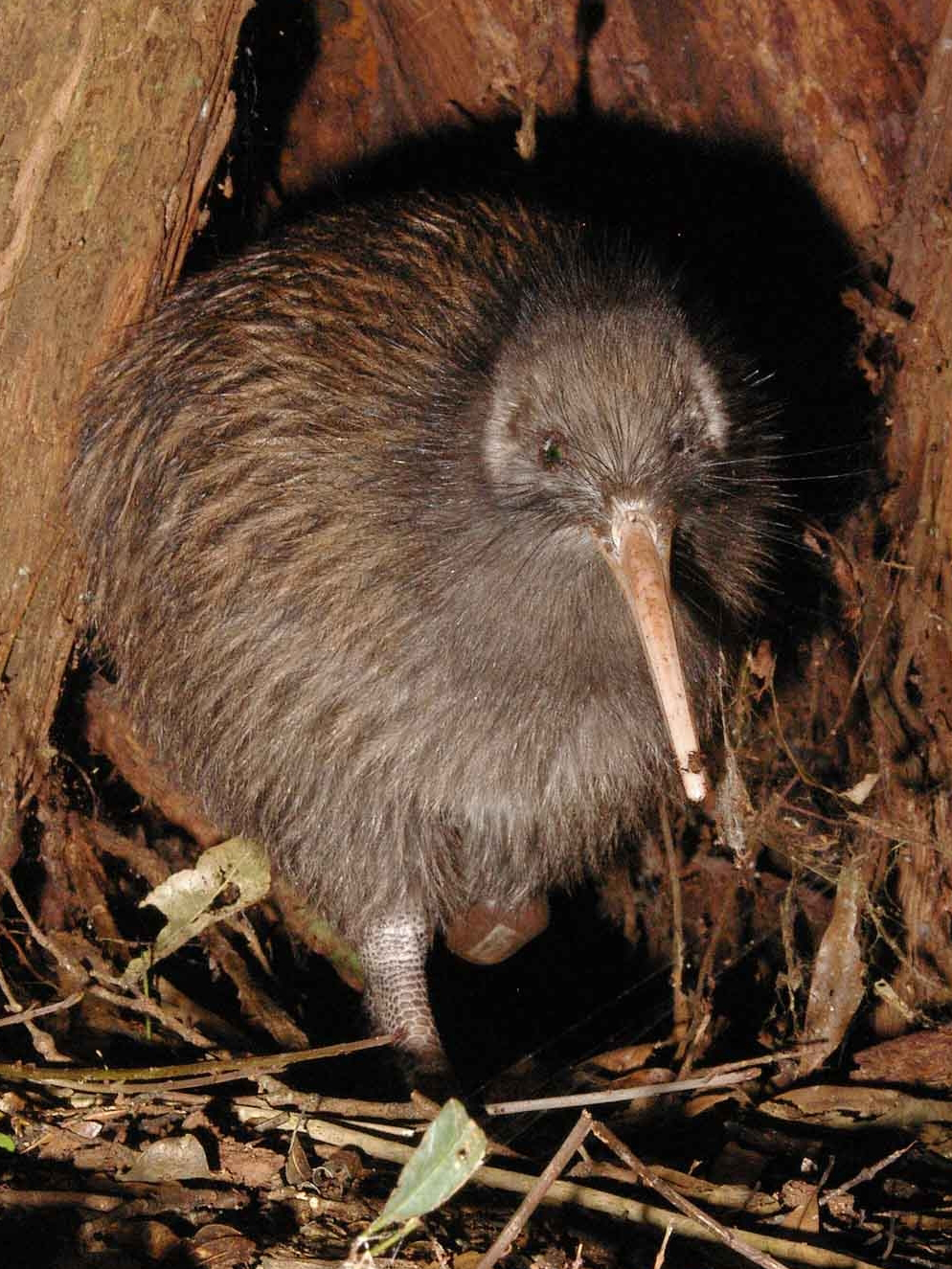
The North Island brown kiwi is a flightless, nocturnal ratite found only in the North Island of New Zealand, and one of the most recognizable national symbols of any country — a living taonga whose name New Zealanders apply to themselves. Once abundant across the island's forests, it has been pushed into isolated and fragmented populations by introduced mammalian predators, and unmanaged mainland populations continue to decline at roughly two percent per year [BirdLife International 2017; DOC 2024]. Yet the species is also one of conservation's clearest demonstrations that intensive intervention can reverse a downward trend. This profile examines the kiwi's biology, the pressures threatening it, and the national programs working to secure its future.
Biology and Identification
The North Island brown kiwi is a stocky, ground-dwelling bird with shaggy, hair-like brown plumage streaked with reddish and black, vestigial wings hidden beneath the feathers, and no functional tail. Females are larger than males, standing about 40 cm tall and weighing around 2.6 kg, against roughly 2 kg for males [Wikipedia 2024]. As a ratite — the lineage that includes the ostrich, emu, and the extinct moa — the kiwi lacks the keeled sternum required for flight and has instead evolved for a terrestrial, probing existence.
Several features set the kiwi apart from nearly all other birds. It is strongly nocturnal, with greatly reduced eyes and one of the smallest visual fields recorded in any bird; it relies instead on a highly developed sense of smell, with nostrils set uniquely at the tip of its long, slightly down-curved bill, and on a sensory bill-tip organ packed with mechanoreceptors used to detect invertebrate prey beneath the soil [Wikipedia 2024]. Its diet consists largely of earthworms, insect larvae, and other soil and leaf-litter invertebrates.
The kiwi is renowned for laying one of the largest eggs relative to body size of any bird. A single egg can measure roughly 12.5 × 7.8 cm and weigh about 430 g — a substantial fraction of the female's body mass [Wikipedia 2024]. Females typically lay one to two eggs per clutch, after which the male undertakes the long incubation, losing a significant proportion of his body weight during the months he tends the nest [Save the Kiwi 2024]. Pairs are generally monogamous and long-lived, and wild kiwi can live for decades.
Habitat and Range
The North Island brown kiwi is endemic to the North Island of New Zealand and some adjacent offshore and predator-free islands, occurring in scattered and fragmented populations rather than as a continuous range [BirdLife International 2017]. It occupies a wide variety of habitats, including native podocarp and broadleaf forest, scrub, regenerating bush, rough farmland, and exotic plantation forest, provided that ground cover and soil conditions support its invertebrate prey. Four broad regional populations are recognized — Northland, Coromandel, Eastern, and Western — each managed as a distinct unit [Save the Kiwi 2024].
Historically the species ranged across most of the island, but human settlement, large-scale forest clearance, and the arrival of introduced mammals contracted and fragmented its distribution, leaving many populations isolated from one another [BirdLife International 2017].
In accordance with NRWL sensitive-species policy, specific site locations, corridor routes, and seasonal movement details are not disclosed in this article.
Conservation Status
The North Island brown kiwi is listed as Vulnerable on the IUCN Red List, assessed by BirdLife International in 2017 [BirdLife International 2017]. The total population was estimated at roughly 24,550 birds in 2015, distributed across the four regional populations — approximately 8,200 in Northland, 7,500 in the Western population, 7,150 in the Eastern population, and 1,700 in Coromandel, the rarest [Save the Kiwi 2024]. With intensive management now applied across much of the range, the species is projected to increase by more than ten percent over three generations, which underpins its current Red List category despite continuing localized losses [BirdLife International 2017].
This recovery is conditional. The Department of Conservation reports that kiwi populations nationally decline at an average of about two percent per year where no predator control is carried out, whereas managed populations grow at rates that vary by site and method [DOC 2024; Save the Kiwi 2024]. Within New Zealand's own threat classification system, brown kiwi are recognized as at-risk taxa requiring active recovery, and they are a priority focus of the national Kiwi Recovery Plan [Holzapfel et al. 2008].
Threats
Introduced mammalian predators are the dominant driver of kiwi decline. Stoats (Mustela erminea) are the single greatest threat to kiwi chicks: in unmanaged populations, stoats accounted for the majority of identified chick deaths, and only a small fraction of wild-hatched chicks survive to independence without intervention [Robertson et al. 2011; McLennan et al. 1996]. Across mainland sites, the great majority of chicks die before reaching the body size — around 800 g to 1 kg — at which they become large enough to defend themselves against stoats [McLennan et al. 1996].
Dogs and ferrets are the leading killers of adult kiwi. Because adult kiwi are flightless, ground-nesting, and have only a faint defensive response, a single roaming dog can kill many birds in a short period; in one detailed study domestic dogs were responsible for half of attributed adult deaths and ferrets for a further fifth [Robertson et al. 2011]. Cats take chicks and juveniles, adding to early-life mortality.
Habitat loss and fragmentation from historic forest clearance reduced and divided the kiwi's range, isolating populations and limiting natural recolonization. Vehicle strike on roads that cross kiwi habitat is an additional, localized source of adult mortality.
What Is Being Done
Operation Nest Egg. Established in the 1990s as a partnership between the Department of Conservation, Save the Kiwi, kiwi-rearing facilities, community groups, and mana whenua, Operation Nest Egg removes eggs or young chicks from the wild, hatches and rears them in predator-free captivity, and returns them once they reach a stoat-proof weight. An Operation Nest Egg bird has roughly a 65 percent chance of surviving to adulthood, compared with about 10 percent for chicks left to hatch and grow in unmanaged wild conditions [DOC 2024; Robertson & de Monchy 2012].
Predator control and sanctuaries. Landscape-scale trapping and poisoning programs across dedicated kiwi sanctuaries have lifted chick survival dramatically — at managed sites, survival to six months reached levels many times higher than at comparable unmanaged sites [Robertson & de Monchy 2012]. Research has also shown that stoats can become "trap-shy" under continuous trapping, and that periodic pulses of complementary tools such as aerial 1080 can restore high chick survival where trapping alone has begun to fail [Robertson et al. 2016; DOC 2018].
Predator Free 2050. The kiwi is a flagship beneficiary of New Zealand's national goal of eradicating stoats, rats, and possums by 2050, a coordinated effort linking government, iwi, community trapping groups, and research institutions [Predator Free 2050 2024].
Community and recovery planning. Hundreds of community kiwi groups carry out local trapping and monitoring, while Save the Kiwi coordinates funding and advocacy and the national Kiwi Recovery Plan sets shared targets across all kiwi taxa [Holzapfel et al. 2008; Save the Kiwi 2024].
How Readers Can Help
Responsible dog ownership. In kiwi country, keeping dogs leashed, confined at night, and trained through kiwi-aversion programs directly reduces the leading cause of adult kiwi death [Robertson et al. 2011].
Support predator control. Community trapping groups and sanctuary programs depend on volunteers and donations; contributing to or joining local predator-control efforts is among the most effective individual actions for kiwi.
Citizen science. Log wildlife observations through platforms such as iNaturalist. Verified records support range mapping and monitoring that inform conservation assessments.
Policy engagement. Support funding for the Department of Conservation and the Predator Free 2050 initiative, and for habitat protection in regions where kiwi persist [Predator Free 2050 2024].
Education outreach. Share accurate, science-based information about kiwi and the role of introduced predators with schools, community groups, and visitors to New Zealand.
References
[BirdLife International 2017] BirdLife International. (2017). Apteryx mantelli. The IUCN Red List of Threatened Species 2017: e.T45353580A119177586. https://www.iucnredlist.org/species/45353580/119177586
[DOC 2018] Department of Conservation. (2018). 1080 saves brown kiwi chicks from untrappable stoats. National Predator Control Programme — kiwi monitoring. https://www.doc.govt.nz/our-work/national-predator-control-programme/monitoring-results-for-native-species/kiwi-monitoring/1080-saves-kiwi-chicks-from-untrappable-stoats/
[DOC 2024] Department of Conservation. (2024). Our work with kiwi: New Zealand native land birds. https://www.doc.govt.nz/nature/native-animals/birds/birds-a-z/kiwi/docs-work/
[Holzapfel et al. 2008] Holzapfel, S., Robertson, H.A., McLennan, J.A., Sporle, W., Hackwell, K. & Impey, M. (2008). Kiwi (Apteryx spp.) Recovery Plan 2008–2018. Threatened Species Recovery Plan 60. Department of Conservation, Wellington. https://www.doc.govt.nz/Documents/science-and-technical/tsrp60entire.pdf
[McLennan et al. 1996] McLennan, J.A., Potter, M.A., Robertson, H.A., Wake, G.C., Colbourne, R., Dew, L., Joyce, L., McCann, A.J., Miles, J., Miller, P.J. & Reid, J. (1996). Role of predation in the decline of kiwi, Apteryx spp., in New Zealand. New Zealand Journal of Ecology, 20(1), 27–35. https://newzealandecology.org/system/files/articles/NZJEcol20_1_27.pdf
[Predator Free 2050 2024] Predator Free 2050 Limited. (2024). Predator Free 2050: a New Zealand without rats, stoats and possums. https://pf2050.co.nz/
[Robertson & de Monchy 2012] Robertson, H.A. & de Monchy, P.J.M. (2012). Varied success from the landscape-scale management of kiwi Apteryx spp. in five sanctuaries in New Zealand. Bird Conservation International, 22(4), 429–444. https://doi.org/10.1017/S0959270912000044
[Robertson et al. 2011] Robertson, H.A., Colbourne, R.M., Graham, P.J., Miller, P.J. & Pierce, R.J. (2011). Experimental management of Brown Kiwi Apteryx mantelli in central Northland, New Zealand. Bird Conservation International, 21(2), 207–220. https://doi.org/10.1017/S0959270910000444
[Robertson et al. 2016] Robertson, H.A., Craig, E., Gardiner, C. & Graham, P.J. (2016). Short pulse of 1080 improves the survival of brown kiwi chicks in an area subjected to long-term stoat trapping. New Zealand Journal of Zoology, 43(4), 351–362. https://doi.org/10.1080/03014223.2016.1185018
[Save the Kiwi 2024] Save the Kiwi. (2024). North Island Brown kiwi. https://savethekiwi.nz/about-kiwi/kiwi-species/north-island-brown-kiwi/
[Wikipedia 2024] Wikipedia contributors. (2024). North Island brown kiwi. https://en.wikipedia.org/wiki/North_Island_brown_kiwi