
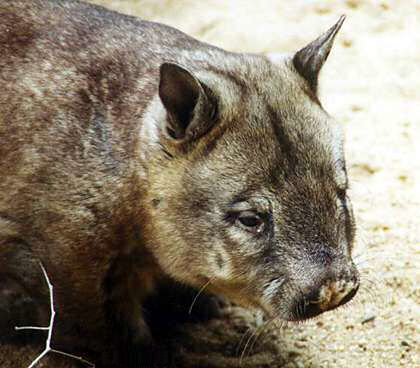
The northern hairy-nosed wombat is one of the world's rarest large mammals and the largest of the three living wombat species [QldGov 2024]. It once occurred more widely across eastern Australia, but by the twentieth century it had contracted to a single remnant group, and by the 1980s only about 35 animals remained at one site in central Queensland [QldSOE 2024]. Decades of intensive management have since lifted that number above 400, making the species a closely watched test case for whether a marsupial reduced to a few dozen individuals can be brought back [QldSOE 2024].
This page summarizes its biology, the reasons it became so rare, and the verifiable conservation work underway. The species remains among the most imperiled mammals on the continent, and its recovery is neither complete nor guaranteed.
Biology and Identification
The northern hairy-nosed wombat is a stocky, fossorial marsupial that can reach roughly one metre in length and weigh up to about 40 kg, making it the heaviest of the wombats [QldGov 2024]. It is distinguished from the common (bare-nosed) wombat by softer fur, a broad muzzle covered in fine hair, and longer, more pointed ears [QldGov 2024; ADW].
It is a nocturnal grazer. Dietary analysis using DNA metabarcoding has confirmed a grass-dominated diet, with grasses (Poaceae) accounting for the large majority of food consumed and the introduced buffel grass (Cenchrus ciliaris) forming a substantial share [Casey et al. 2023]. Like other wombats, its cheek teeth grow continuously, offsetting the wear caused by abrasive forage [ADW].
The species is a prolific digger, and the deep, stable microclimate of its burrows is an important adaptation to a hot, semi-arid setting: burrow temperatures vary by only a few degrees over a day and remain well above freezing on cold nights, far steadier than conditions at the surface [QldGov 2024]. Reproduction is slow. Females typically breed only every two to three years and produce a single young that is carried in the pouch for roughly eight to nine months before weaning at about twelve months [QldGov 2024; ADW]. Breeding success is strongly tied to rainfall and grass availability [QldGov 2024].
Habitat and Range
The species requires two specific conditions: deep, well-drained soils suitable for burrowing and a reliable year-round supply of grass, typically within semi-arid eucalypt woodland [QldGov 2024]. Historically it ranged more widely across eastern Australia, but the last natural population persisted in a small area of central Queensland after the species was lost across the rest of its former range [Taggart et al. 2016].
Today the animal occurs only at managed sites in Queensland. The original surviving population is at Epping Forest National Park (Scientific), where the wombats historically occupied a core area of only a few square kilometres within the wider park [Taggart et al. 2016]. To reduce the danger of a single catastrophe affecting every animal at once, additional populations have been deliberately established elsewhere in the State [QldSOE 2024]. In keeping with sensitive-species practice, this page does not publish burrow locations or fine-scale site maps.
Conservation Status
The northern hairy-nosed wombat is assessed as Critically Endangered on the IUCN Red List, assessed in 2015 and published in 2016, under criterion B2ab(iii) [Taggart et al. 2016]. That listing reflects an extremely restricted geographic range — a single population occupying well under 10 km² — together with a continuing decline in habitat quality, which leaves the taxon acutely exposed to chance events [Taggart et al. 2016]. It is likewise listed as Critically Endangered nationally under Australia's Environment Protection and Biodiversity Conservation (EPBC) Act, a status applied in 2018 [DCCEEW 2021].
When the IUCN assessment was prepared, the population was on the order of a few hundred individuals concentrated at a single site [Taggart et al. 2016]. Monitoring has documented continued growth: counts rose from roughly 113 animals in 2003 to an estimated 230 by 2015, and to more than 400 across all sites by 2024 [QldSOE 2024]. The IUCN population trend is recorded as increasing, though the species' total number and footprint remain very small [Taggart et al. 2016].
Threats
The defining threat is the species' own rarity: a single small population is exposed to drought, flood, wildfire, and disease that could affect a large fraction of all individuals at once [Taggart et al. 2016]. Predation has been a documented and serious pressure. During 2000 and 2001, dingoes killed about ten wombats at Epping Forest — close to ten percent of the population at the time — despite an existing baiting program [QldGov 2024; Wombat Foundation 2024].
Competition for grass with introduced and native grazers, prolonged drought that reduces forage, and the historic loss and modification of habitat across the former range are additional documented pressures [Taggart et al. 2016; DCCEEW 2021]. Because so few animals exist, reduced genetic diversity is also a long-term concern for the species' resilience [Taggart et al. 2016].
What Is Being Done
After the dingo predation events, the Queensland Government completed a roughly 20-kilometre predator-exclusion fence around the occupied habitat at Epping Forest in 2002, which markedly reduced predation pressure [QldGov 2024; Wombat Foundation 2024]. Ongoing management at the site includes population monitoring, water and grass management in dry periods, and burrow surveys [QldGov 2024].
To spread risk across more than one location, an insurance population was established at Richard Underwood Nature Refuge in southern Queensland beginning in 2009 [QldSOE 2024]. In 2024 a third site was added at Powrunna State Forest, where managers have translocated animals progressively to build an additional self-sustaining population [QldSOE 2024; Wombat Foundation 2024]. This work is coordinated among the Queensland Government, conservation organisations, and research partners, and is informed by published ecological studies of the species [Taggart et al. 2016; Casey et al. 2023].
How You Can Help
A reliable way to support this species is to back the organisations and government programs that fund its monitoring, fencing, and translocation work, and to support habitat protection in semi-arid Queensland more broadly. Sharing accurate, sourced information, rather than unverified claims, helps maintain public understanding of why a single small population is fragile. Readers interested in the science can follow the recovery documentation and peer-reviewed studies listed below as new assessments are published.
References
[Taggart et al. 2016] Taggart, D., Martin, R. & Horsup, A. (2016). Lasiorhinus krefftii (Northern Hairy-nosed Wombat). The IUCN Red List of Threatened Species 2016: e.T11343A21959050. https://www.iucnredlist.org/species/11343/21959050
[DCCEEW 2021] Department of Climate Change, Energy, the Environment and Water (Australia). Northern Hairy-nosed Wombat (Lasiorhinus krefftii) — Priority Mammals / Species Profile and Threats Database. https://www.dcceew.gov.au/environment/biodiversity/threatened/action-plan/priority-mammals/northern-hairy-nosed-wombat
[QldGov 2024] Queensland Government, Department of Environment, Tourism, Science and Innovation. About northern hairy-nosed wombats. https://www.qld.gov.au/environment/plants-animals/conservation/threatened-species/featured-projects/northern-hairy-nosed-wombat/northern-hairy-nosed-wombat/about-northern-hairy-nosed-wombats
[QldSOE 2024] Queensland Government. Northern hairy-nosed wombat — State of the Environment Report 2024. https://www.stateoftheenvironment.detsi.qld.gov.au/biodiversity/case-studies/northern-hairy-nosed-wombat
[Wombat Foundation 2024] The Wombat Foundation. The northern hairy-nosed wombats' story; Powrunna State Forest translocation news (2024). https://www.wombatfoundation.com.au/wombats/
[Casey et al. 2023] Casey, F., Old, J. M. & Stannard, H. J. (2023). Assessment of the diet of the critically endangered northern hairy-nosed wombat (Lasiorhinus krefftii) using DNA metabarcoding. Ecology and Evolution, 13(9): e10469. https://doi.org/10.1002/ece3.10469
[ADW] Animal Diversity Web. Lasiorhinus krefftii (northern hairy-nosed wombat). University of Michigan Museum of Zoology. https://animaldiversity.org/accounts/Lasiorhinus_krefftii/
[DCCEEW Recovery] Department of the Environment (Australia). National recovery plan for the northern hairy-nosed wombat Lasiorhinus krefftii. https://www.dcceew.gov.au/sites/default/files/documents/l-krefftii.pdf