
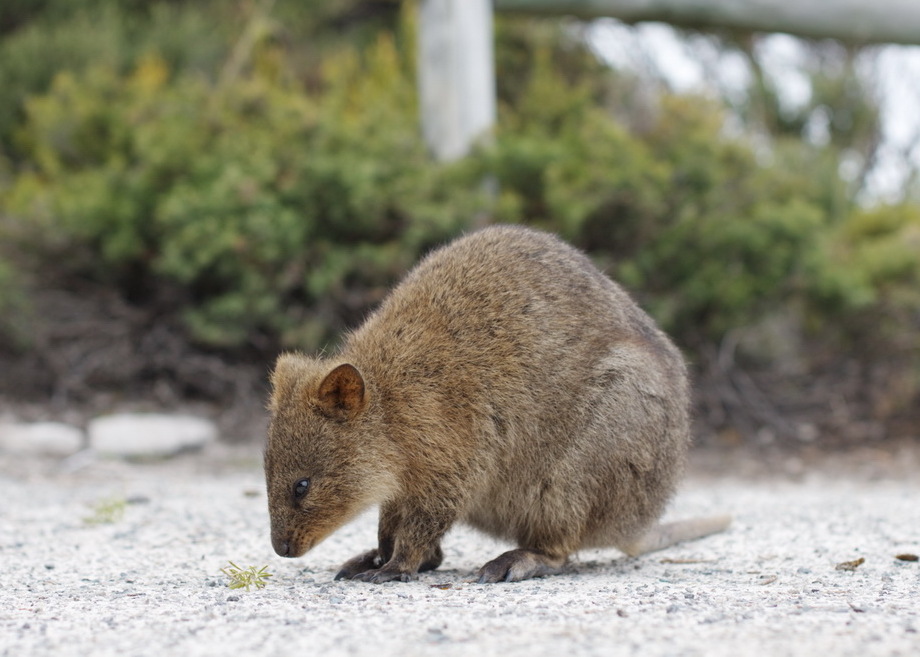
The quokka is a small, short-tailed wallaby endemic to the southwest of Western Australia, best known for the photogenic colony on Rottnest Island and the only living member of its genus. Once widespread across the southwest, mainland populations have contracted sharply under predation and habitat change, while the largest secure populations now persist on offshore islands [Burbidge & Woinarski 2020]. This profile examines the species' biology, the threats it faces, and the conservation work underway to keep it on the landscape.
Biology and Identification
The quokka is a compact macropod with a head-and-body length of roughly 40–54 cm, a short tail, and a body weight of about 2.7–4.2 kg [Hayward et al. 2003]. Its coat is coarse, grizzled grey-brown, and its rounded face and short muzzle give it the distinctive appearance for which it is widely recognized. It is the sole species in the genus Setonix.
Quokkas are herbivores, browsing and grazing a range of grasses, sedges, leaves, and shoots, and can survive long dry periods by drawing on stored fat and obtaining moisture from vegetation. Like other macropods, females raise a single young in a pouch. Reproductive timing differs between populations: on Rottnest Island breeding is largely confined to a defined season, whereas mainland populations can breed throughout the year [Hayward et al. 2003].
The species is nocturnal to crepuscular, sheltering by day in dense vegetation and emerging to feed in cooler hours. On the mainland it is closely tied to thick understory cover, particularly in swampy and riparian thickets, which provides both food and refuge from predators [Hayward et al. 2003].
Habitat and Range
The quokka is restricted to the southwest of Western Australia. The largest populations occur on two offshore islands — Rottnest Island and Bald Island — while mainland animals persist as scattered, fragmented subpopulations in the southern forests and coastal heath of the region [Burbidge & Woinarski 2020].
On the mainland the species depends on dense vegetation associated with swamps, creeklines, and recently regenerating habitat, and its distribution there has contracted substantially from its former extent. The island populations, lacking the introduced predators that affect the mainland, support the species' most robust numbers [Burbidge & Woinarski 2020].
In accordance with NRWL sensitive-species policy, specific site locations, refuge sites, and seasonal movement details are not disclosed in this article.
Conservation Status
The quokka is listed as Vulnerable on the IUCN Red List under criterion B1ab(iii,v), reflecting its restricted and fragmented range and continuing decline in habitat quality on the mainland [Burbidge & Woinarski 2020]. It is also listed as Vulnerable under Australian and Western Australian legislation, and is not subject to international commercial trade [Burbidge & Woinarski 2020; DCCEEW 2024].
The global population trend is assessed as stable overall, buoyed by the secure island colonies, but the assessment emphasizes that mainland subpopulations remain small, fragmented, and vulnerable to predation and fire [Burbidge & Woinarski 2020]. Recovery planning under Australian law sets out coordinated actions across the species' range, prioritizing predator control and habitat protection on the mainland while safeguarding the island strongholds [DCCEEW 2024].
Threats
Introduced predators are the principal threat on the mainland. Predation by the introduced red fox, compounded by feral cats, is the main driver of mainland declines and a key constraint on recovery [Hayward et al. 2005].
Habitat loss and alteration. Clearing, drainage of swamps, and changes to vegetation structure have reduced and fragmented the dense cover the species needs, isolating remaining mainland subpopulations [Burbidge & Woinarski 2020].
Altered fire regimes. Inappropriate fire frequency and intensity can remove the thick understory quokkas depend on for food and shelter, with effects that interact with predation to depress local populations [Hayward et al. 2005].
Disease and the plant pathogen Phytophthora cinnamomi. Dieback caused by the introduced soil pathogen degrades the vegetation communities that provide quokka habitat, an additional stressor on mainland populations [DCCEEW 2024].
What Is Being Done
Predator control. Sustained fox-baiting programs across parts of the southwest, including landscape-scale baiting operations, are central to mainland quokka management and have supported stable or increasing numbers at some monitored sites [Hayward et al. 2005].
Island safeguards. Management of the Rottnest Island and Bald Island populations — which remain free of foxes — protects the species' largest and most secure colonies and provides a buffer against mainland losses [Burbidge & Woinarski 2020].
Recovery planning and monitoring. The national recovery plan coordinates survey, predator control, habitat protection, and disease management across jurisdictions, and ongoing monitoring in the jarrah forest tracks population trends to guide management [DCCEEW 2024; Bain et al. 2016].
Habitat and disease management. Programs to manage fire regimes and to limit the spread of Phytophthora cinnamomi aim to maintain the dense vegetation structure that mainland quokkas require [DCCEEW 2024].
How Readers Can Help
Citizen science. Photograph and log wildlife observations through platforms such as iNaturalist. Verified occurrence records contribute directly to range-mapping efforts and IUCN assessments.
Policy engagement. Support funding for fox and feral-cat control, habitat protection in southwestern Western Australia, and biosecurity measures that limit the spread of dieback disease.
Responsible visitation. On Rottnest Island and other quokka habitat, observe wildlife from a respectful distance, never feed wild animals, and follow local guidance — human food and handling can harm the animals.
Education outreach. Share accurate, science-based information about the quokka's reliance on dense vegetation and the role of introduced predators in its mainland decline.
References
[Bain et al. 2016] Bain, K., Wayne, A. & Bencini, R. (2016). Risks in extrapolating habitat preferences over the geographical range of threatened taxa: a case study of the quokka (Setonix brachyurus) in the southern forests of Western Australia. Wildlife Research, 43(8), 681–689. https://doi.org/10.1071/WR16070
[Burbidge & Woinarski 2020] Burbidge, A.A. & Woinarski, J. (2020). Setonix brachyurus (amended version of 2019 assessment). The IUCN Red List of Threatened Species 2020: e.T20165A166611530. https://dx.doi.org/10.2305/IUCN.UK.2020-1.RLTS.T20165A166611530.en
[DCCEEW 2024] Department of Climate Change, Energy, the Environment and Water (Australia). (2024). Setonix brachyurus — Quokka, Species Profile and Threats Database, and Quokka Recovery Plan. https://www.dcceew.gov.au/sites/default/files/documents/quokka-recovery-plan.pdf
[Hayward et al. 2003] Hayward, M.W., de Tores, P.J., Dillon, M.J. & Fox, B.J. (2003). Local population structure of a naturally occurring metapopulation of the quokka (Setonix brachyurus Macropodidae: Marsupialia). Biological Conservation, 110(3), 343–355. https://doi.org/10.1016/S0006-3207(02)00240-9
[Hayward et al. 2005] Hayward, M.W., de Tores, P.J., Dillon, M.J. & Banks, P.B. (2005). Predicting the occurrence of the quokka, Setonix brachyurus (Macropodidae: Marsupialia), in Western Australia. Wildlife Research, 32(1), 15–24. https://doi.org/10.1071/WR04031