
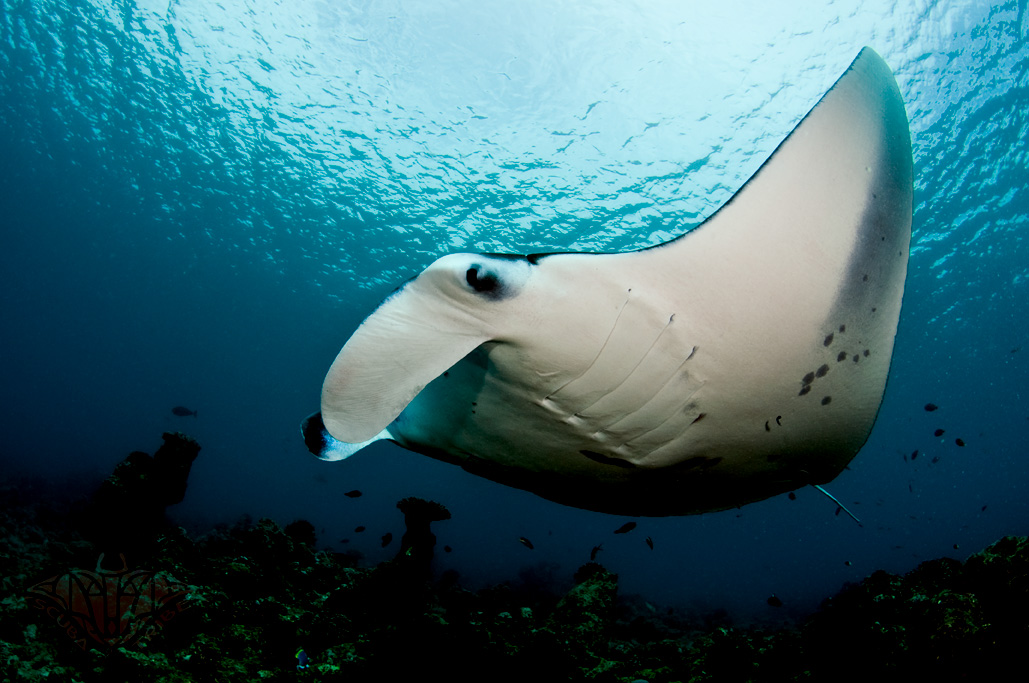
The reef manta ray is one of the largest rays in the ocean, a planktivorous giant that glides along tropical coastlines and coral reefs across the Indian and Pacific Oceans. Recognizable by its broad, diamond-shaped body, paddle-like cephalic fins, and individually unique belly spot patterns, it is a charismatic ambassador for reef ecosystems and a major draw for marine ecotourism. Its extremely slow reproduction makes it especially sensitive to human pressures.
Biology and Identification
The reef manta ray is a large filter-feeding ray, typically reaching a disc width of about 3 to 3.5 metres and growing to a maximum of roughly 4.3 metres [Manta Trust 2024]. The dorsal surface is dark, ranging from black to deep blue-grey with paler shoulder markings, while the underside is white with a scattering of dark spots; these belly patterns are unique to each individual and are used by researchers for photo-identification [Manta Trust 2024; Marshall & Bennett 2010]. It feeds almost exclusively on zooplankton, swimming with its mouth open to filter prey from the water and frequently visiting "cleaning stations" on reefs where smaller fish remove parasites and dead skin [Manta Trust 2024].
Reproduction is exceptionally slow. The species is ovoviviparous, with a gestation of roughly a year and a litter of usually a single pup, and females typically reproduce only once every two to five years [Marshall & Bennett 2010; IUCN 2019]. This conservative life history—late maturity, low fecundity, and a lifespan estimated at around 40 years or more—gives the reef manta one of the lowest rates of population increase among elasmobranchs, and demographic modelling shows that population recovery depends heavily on high adult survival [Manta Trust 2024; Smallegange et al. 2016].
Habitat and Range
The reef manta ray inhabits tropical and subtropical coastal and reef waters throughout the Indian and western Pacific Oceans, from East Africa and the Red Sea across to the islands of the central Pacific [IUCN 2019]. It is most often associated with coral and rocky reefs, lagoons, seamounts, and productive coastal upwellings, where it returns predictably to aggregation and cleaning sites [Harris & Stevens 2021]. Range states include Mozambique, the Maldives, Indonesia, the Philippines, Australia, Fiji, and many others, and across this broad distribution the global population is divided into many small, largely isolated subpopulations [IUCN 2019].
Conservation Status
The reef manta ray is listed as Vulnerable on the IUCN Red List, assessed in 2019 (with an amended version issued in 2022) [IUCN 2019]. The global population trend is decreasing, and the assessment notes that most known regional subpopulations are small—generally estimated at fewer than a thousand individuals—while the Maldives supports the largest documented population, with thousands of individually identified animals catalogued through long-term photo-identification monitoring [IUCN 2019; Harris & Stevens 2021]. The species is listed on Appendix II of the Convention on International Trade in Endangered Species (CITES), a listing that entered into force in 2014 to regulate international trade, and all mobulid rays are also listed under the Convention on the Conservation of Migratory Species (CMS) [CITES 2014; Lawson et al. 2017]. Its slow reproduction means that even modest levels of fishing mortality can drive long-term declines that are difficult to reverse.
Threats
The most significant documented threat to the reef manta ray is fishing pressure, both from targeted fisheries and from incidental bycatch [IUCN 2019]. Demand for mobulid gill plates, used in some Asian health tonics, has driven targeted harvest in parts of the species' range, while individuals are also caught accidentally in nets and other gear [Lawson et al. 2017; IUCN 2019]. Because reef mantas aggregate predictably at feeding and cleaning sites, they are easy to locate and catch, which amplifies fishing impacts on local populations [IUCN 2019]. Additional pressures include entanglement in fishing gear and marine debris, habitat degradation, boat strikes and disturbance at heavily visited tourism sites, and the longer-term risk that climate change will alter the abundance and distribution of the zooplankton on which the species depends [IUCN 2019; Manta Trust 2024].
What Is Being Done
A range of organizations and governments are working to protect reef manta rays. The Manta Trust coordinates global research and conservation through its network of affiliated projects, using photo-identification databases to monitor individuals and populations across the Indo-Pacific [Manta Trust 2024; Harris & Stevens 2021]. International instruments provide a legal framework: the CITES Appendix II listing regulates cross-border trade in manta products, and the CMS listing supports cooperation on migratory protection [CITES 2014; Lawson et al. 2017]. Several range states have introduced national protections and established marine protected areas covering key aggregation and feeding habitats, and peer-reviewed studies continue to map the movements, habitat use, and population structure that underpin these measures [Harris & Stevens 2021; Smallegange et al. 2016].
How You Can Help
The public can support reef manta conservation in several practical, evidence-based ways. Supporting reputable science-based organizations such as the Manta Trust helps fund the monitoring and research that guide policy [Manta Trust 2024]. Divers and snorkelers can contribute photographs of manta belly patterns to citizen-science identification databases, which directly improve population estimates [Manta Trust 2024; Marshall & Bennett 2010]. Choosing responsible, low-impact wildlife tourism operators that maintain respectful distances reduces disturbance at aggregation sites, and avoiding products derived from manta or other mobulid rays removes demand that drives targeted fishing [Lawson et al. 2017; Manta Trust 2024]. Informed advocacy for the enforcement of CITES and national protections also strengthens long-term recovery efforts.
References
[IUCN 2019] Marshall, A., Barreto, R., Carlson, J., Fernando, D., Fordham, S., Francis, M.P., Herman, K., Jabado, R.W., Liu, K.M., Pacoureau, N., Rigby, C.L., Romanov, E., & Sherley, R.B. (2019). Mobula alfredi (Reef Manta Ray). The IUCN Red List of Threatened Species 2019 (amended version of 2022 assessment): e.T195459A214395983. https://www.iucnredlist.org/species/195459/214395983
[Manta Trust 2024] Manta Trust. (2024). Reef Manta Ray (Mobula alfredi) Species Guide. Manta Trust. https://www.mantatrust.org/mobula-alfredi
[CITES 2014] Convention on International Trade in Endangered Species of Wild Fauna and Flora. (2014). Appendix II listing of Mobula alfredi (entered into force 2014). CITES Secretariat. https://cites.org/eng/app/appendices.php
[Lawson et al. 2017] Lawson, J.M., Fordham, S.V., O'Malley, M.P., Davidson, L.N.K., Walls, R.H.L., Heupel, M.R., Stevens, G., Fernando, D., Budziak, A., Simpfendorfer, C.A., Ender, I., Francis, M.P., Notarbartolo di Sciara, G., & Dulvy, N.K. (2017). Sympathy for the devil: a conservation strategy for devil and manta rays. PeerJ, 5, e3027. https://doi.org/10.7717/peerj.3027
[Marshall & Bennett 2010] Marshall, A.D., & Bennett, M.B. (2010). Reproductive ecology of the reef manta ray Manta alfredi in southern Mozambique. Journal of Fish Biology, 77(1), 169-190. https://doi.org/10.1111/j.1095-8649.2010.02669.x
[Smallegange et al. 2016] Smallegange, I.M., van der Ouderaa, I.B.C., & Tibiriçá, Y. (2016). Effects of yearling, juvenile and adult survival on reef manta ray (Manta alfredi) demography. PeerJ, 4, e2370. https://doi.org/10.7717/peerj.2370
[Harris & Stevens 2021] Harris, J.L., & Stevens, G.M.W. (2021). Environmental drivers of reef manta ray (Mobula alfredi) visitation patterns to key aggregation habitats in the Maldives. PLoS ONE, 16(6), e0252470. https://doi.org/10.1371/journal.pone.0252470
[Stevens et al. 2018] Stevens, G., Fernando, D., Dando, M., & Notarbartolo di Sciara, G. (2018). Guide to the Manta and Devil Rays of the World. Princeton University Press. https://press.princeton.edu/books/paperback/9780691183329/guide-to-the-manta-and-devil-rays-of-the-world