
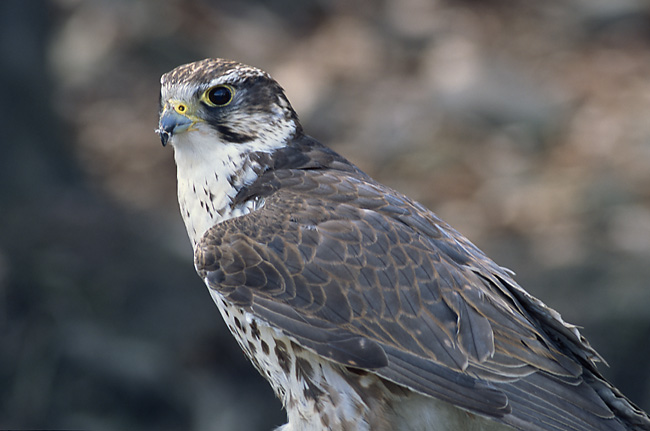
The Saker Falcon is one of the largest falcons in the world, a powerful steppe hunter that pursues ground squirrels and birds in low, horizontal chases across open grassland rather than stooping from height like its relative the Peregrine. Once a conservation success story in parts of Europe, the species has reversed course: the IUCN Red List lists it as Endangered (EN), with a global population estimated at roughly 12,200–29,800 mature individuals and still declining [BirdLife International 2021]. Prized for millennia in Arabian and Central Asian falconry, the Saker now faces a tangle of pressures — illegal trapping, electrocution on power lines, poisoning, and habitat change — that together drive one of the steeper declines among the world's large raptors [Kovács et al. 2014].
Biology and Identification
The Saker Falcon (Falco cherrug J.E. Gray, 1834) belongs to the family Falconidae and is closely allied to the Gyrfalcon (Falco rusticolus) and other "hierofalcons." It is a large, robust falcon measuring approximately 45–57 cm in body length with a wingspan of about 97–126 cm [BirdLife International 2021]. The species is strongly sexually dimorphic in size: females are substantially heavier than males, a typical raptor pattern that reflects differing roles in incubation and prey delivery [Bold et al. 2024]. Plumage is highly variable across the range, spanning pale sandy individuals streaked with brown to darker chocolate-toned birds, generally with contrasting streaked underparts and a comparatively pale head.
Saker Falcons are open-country predators that frequently hunt in fast, low, horizontal pursuit rather than the high vertical stoop. Diet varies regionally but is dominated by small to medium mammals and birds; in Mongolian breeding areas, a mammal-rich diet—particularly ground squirrels and other small rodents—is strongly associated with larger clutches and higher breeding success [Bold et al. 2024]. Satellite-tracking of breeding adults in Mongolia shows that males range over larger foraging areas than females and that home-range size contracts where prey is abundant, underscoring the species' tight dependence on rodent availability [Bold et al. 2024].
Like most large falcons, Sakers do not build their own nests. They reuse stick nests constructed by other species—ravens, buzzards, eagles, and storks—on cliffs, trees, and increasingly on artificial structures such as pylons and purpose-built nest boxes [Kovács et al. 2014]. Clutches typically comprise three to five eggs, and pairs frequently show fidelity to successful nesting territories across years [Lazarova et al. 2021].
Habitat and Range
The Saker Falcon is a Palearctic species whose breeding range extends from Central and Eastern Europe eastward across the steppes and semi-deserts of Central Asia to Mongolia, northern China, and Manchuria [BirdLife International 2021]. Core habitat consists of open landscapes—native steppe grassland, forest-steppe mosaics, semi-desert, and arid montane plateaus—where the bird can hunt in open flight and where colonial ground-dwelling rodents are abundant [Kovács et al. 2014]. Northern and central populations are largely migratory or partially migratory, wintering south and west into the Middle East, North Africa, the Arabian Peninsula, and South Asia, while some southern birds are more sedentary [Shobrak 2015].
The species' distribution has contracted markedly over the past several decades. It disappeared as a regular breeding bird from parts of its former European range—including Bulgaria, where it was considered effectively extinct as a breeder by the early 2000s before reintroduction efforts began to reverse that loss [Lazarova et al. 2021]. Conversion of native steppe to agriculture, declines in burrowing-rodent prey, and direct mortality have collectively reduced both range and density across much of Eurasia [Kovács et al. 2014]. Mongolia and parts of Central Asia now hold an important share of the global breeding population [Bold et al. 2024].
In accordance with NRWL sensitive-species policy, specific site locations, seasonal movement details, and den or nest coordinates are not disclosed in this article.
Conservation Status
The Saker Falcon is currently listed as Endangered (EN) on the IUCN Red List, assessed by BirdLife International in 2021 [BirdLife International 2021]. The classification reflects a very rapid estimated population reduction; the global population is placed at approximately 12,200–29,800 mature individuals and the overall trend is decreasing [BirdLife International 2021]. The species was previously listed as Vulnerable, and the uplisting to Endangered reflects renewed concern about the pace and breadth of decline despite localized recovery in some regions.
The Saker Falcon is listed on CITES Appendix II, which regulates international commercial trade and requires exporting countries to demonstrate that any trade is legal and not detrimental to the species' survival [CITES 2025]. Because the bird is so highly valued in falconry, this trade regulation is central to its conservation, and the species is also covered by the Convention on Migratory Species (CMS), which prompted the creation of a dedicated international Saker Falcon Task Force [CMS Raptors MoU 2025].
Population status varies regionally. Several European subpopulations remain very small and depend on active management, while large Asian populations—particularly in Mongolia—face heavy mortality from infrastructure and trapping pressure [Dixon et al. 2020; Shobrak 2015]. Generation length is relatively short for a large raptor, which means demographic losses can translate quickly into measurable population-level declines [BirdLife International 2021].
Threats
The Saker Falcon faces several well-documented, interacting threats:
-
Electrocution on power lines. Medium-voltage distribution poles with unsafe configurations kill large numbers of perching raptors. Surveys beneath power lines in Mongolia recovered 1,721 electrocuted Saker Falcons across 2013–2015 and 2018, with mortality concentrated among certain age and sex classes—evidence that electrocution can shape population demographics [Dixon et al. 2020].
-
Illegal trapping and trade for falconry. Wild Sakers are captured along migration routes and on wintering grounds for the falconry market. Long-term monitoring in Saudi Arabia documented increasing numbers of trapped Saker and Peregrine Falcons over a 23-year period, indicating sustained unregulated offtake despite CITES protection [Shobrak 2015].
-
Habitat loss and prey decline. Conversion of native steppe to cropland and the reduction of colonial burrowing-rodent prey diminish both nesting and foraging suitability across the range [Kovács et al. 2014].
-
Poisoning. Rodenticides used in agriculture and rodent-control campaigns, along with other toxic substances, cause secondary poisoning of falcons feeding on affected prey [Kovács et al. 2014].
-
Shooting and persecution. Direct illegal killing remains a documented mortality source in parts of the range [Kovács et al. 2014].
These pressures act cumulatively, so reducing any single source of mortality without addressing the others yields limited population benefit [Dixon et al. 2020].
What Is Being Done
A coordinated international framework now underpins Saker Falcon conservation. Under the CMS Memorandum of Understanding on the Conservation of Migratory Birds of Prey (Raptors MoU), a dedicated Saker Falcon Task Force was established following CMS Resolution 10.28, bringing together government representatives, scientists, falconers, and conservationists from across the species' many range states [CMS Raptors MoU 2025].
The central instrument is the Saker Falcon Global Action Plan (SakerGAP), adopted by CMS Parties in 2014 and implemented over a ten-year horizon. It sets out a management and monitoring system aimed at addressing electrocution, illegal trade, poisoning, and habitat loss range-wide [Kovács et al. 2014].
Practical interventions are advancing on several fronts. In Mongolia, large-scale artificial-nest programmes have created thousands of breeding opportunities on otherwise nest-limited steppe, and research into power-line retrofitting has identified effective mitigation to reduce electrocution mortality [Dixon et al. 2020; Kovács et al. 2014]. In Bulgaria, a structured reintroduction programme led by Green Balkans and partners re-established breeding after roughly two decades of local absence, with the first confirmed wild nest of reintroduced birds documented in 2018 [Lazarova et al. 2021]. CITES Appendix II controls and associated non-detriment processes continue to govern legal international trade [CITES 2025].
How Readers Can Help
Readers can contribute to Saker Falcon conservation through several constructive avenues. Reporting raptor observations to citizen-science platforms such as eBird and iNaturalist helps researchers track distribution and seasonal movements at scale, and reporting suspected electrocution sites or injured raptors to national wildlife authorities supports mitigation planning [Dixon et al. 2020]. Supporting policies and utility programmes that retrofit dangerous power-line poles addresses one of the species' best-documented mortality sources [Dixon et al. 2020]. Consumers and travellers can choose to support only legal, well-documented falconry and avoid any wildlife purchase lacking valid CITES documentation, since regulated, transparent trade is central to the species' protection [CITES 2025]. Finally, following and engaging with the work of established range-state conservation bodies and the CMS Raptors MoU framework helps sustain the long-term, cross-border coordination this wide-ranging migrant requires [CMS Raptors MoU 2025].
References
[BirdLife International 2021] BirdLife International (2021). Falco cherrug. The IUCN Red List of Threatened Species 2021: e.T22696495A204182473. https://dx.doi.org/10.2305/IUCN.UK.2021-3.RLTS.T22696495A204182473.en
[Bold et al. 2024] Bold, B., Rahman, M.L., Purev-Ochir, G., Saruul, A., Zhan, X. & Dixon, A. (2024). Influence of prey availability on the movement pattern of breeding saker falcons (Falco cherrug) in Mongolia. Current Zoology, 70(6), 810–820. https://doi.org/10.1093/cz/zoae024
[CITES 2025] CITES (2025). Falco cherrug — Appendix II. Convention on International Trade in Endangered Species of Wild Fauna and Flora, Checklist of CITES Species. https://checklist.cites.org/#/en/search/output_layout=alphabetical&level_of_listing=0&show_synonyms=1&show_author=1&show_english=1&show_spanish=1&show_french=1&scientific_name=Falco+cherrug
[CMS Raptors MoU 2025] CMS Raptors MoU (2025). Saker Falcon Task Force. Coordinating Unit of the Memorandum of Understanding on the Conservation of Migratory Birds of Prey in Africa and Eurasia, Convention on Migratory Species. https://www.cms.int/raptors/en/workinggroup/saker-falcon-task-force
[Dixon et al. 2020] Dixon, A., Batbayar, N., Bold, B., Davaasuren, B., Erdenechimeg, T., Galtbalt, B. & Tsolmonjav, P. (2020). Variation in electrocution rate and demographic composition of Saker Falcons electrocuted at power lines in Mongolia. Journal of Raptor Research, 54(2), 136–146. https://doi.org/10.3356/0892-1016-54.2.136
[Kovács et al. 2014] Kovács, A., Williams, N.P. & Galbraith, C.A. (2014). Saker Falcon Falco cherrug Global Action Plan (SakerGAP). Raptors MOU Technical Publication No. 2; CMS Technical Series No. 31. Coordinating Unit of the CMS Raptors MOU, Abu Dhabi. https://raptors.cms.int/sites/default/files/publication/SakerGAP_e.pdf
[Lazarova et al. 2021] Lazarova, I., Petrov, R., Andonova, Y., Klisurov, I. & Dixon, A. (2021). Re-introduction of the Saker Falcon (Falco cherrug) in Bulgaria — preliminary results from the ongoing establishment phase by 2020. Biodiversity Data Journal, 9, e63729. https://doi.org/10.3897/BDJ.9.e63729
[Shobrak 2015] Shobrak, M.Y. (2015). Trapping of Saker Falcon Falco cherrug and Peregrine Falcon Falco peregrinus in Saudi Arabia: implications for biodiversity conservation. Saudi Journal of Biological Sciences, 22(4), 491–502. https://doi.org/10.1016/j.sjbs.2014.11.024