
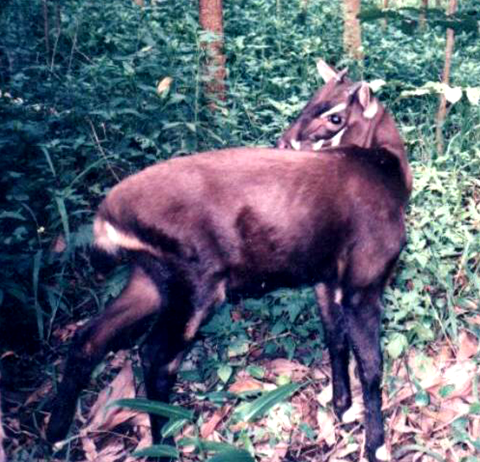
A Bovid Discovered in 1992 and Possibly Already Extinct
The saola — sometimes called the "Asian unicorn" — is a forest-dwelling bovid endemic to the Annamite Mountains along the Vietnam–Laos border. It is one of the most spectacular zoological discoveries of the 20th century: previously unknown to Western science, it was identified in May 1992 when a survey team in Vu Quang Nature Reserve, Vietnam (Vu Quang National Park since 2002) examined a set of unusual horns in a hunter's home and recognised them as belonging to an undescribed bovid genus [Dung et al. 1993].
Within three decades of its scientific discovery, the saola may already be functionally extinct. The IUCN lists Pseudoryx nghetinhensis as Critically Endangered with an estimated population of fewer than 100 individuals — and possibly far fewer, with no confirmed sightings since 2013 [Timmins et al. 2016]. Camera-trap surveys totalling tens of thousands of trap-nights across known historical range have failed to produce confirmed saola images since the 2013 individual [Saola Working Group / IUCN SSC Asian Wild Cattle Specialist Group 2024].
This brief is a case study in how rapidly a species can transition from "discovered" to "feared extinct" in modern conditions of intensive snare-trap hunting.
Biology and identification
Pseudoryx nghetinhensis is the only species in the monotypic genus Pseudoryx. Adults are estimated at 80–90 cm at the shoulder and 80–100 kg, with both sexes carrying nearly parallel, slightly back-curved horns reaching approximately 50 cm in adults [Dung et al. 1993; Robichaud 1998]. Coat colour is dark chestnut-brown with a distinctive black stripe along the back and prominent white facial markings (eyebrow patches, muzzle band, chin stripe). The species' superficial resemblance is to a small antelope, but skull and dental morphology place it firmly within Bovidae, related to wild cattle.
Direct observation of the species in the wild has been extraordinarily limited — fewer than a dozen confirmed photographs in three decades, and most documented saola information derives from a small number of captives (none of which survived more than weeks to months in captivity) and from indigenous hunter accounts and field-sign surveys. The captive failures, combined with the rapid wild-population collapse, mean that fundamental biology — diet ecology, reproductive parameters, social structure — remains largely unknown.
Saola occupy wet evergreen forest at moderate elevations (typically 400–1,000 m), in steep terrain along streams and ridge lines. The species is presumed solitary or in small groups; reports from hunters consistently describe single individuals or female-calf pairs.
Habitat and range
The saola's known range is restricted to the Annamite Mountains (Vietnam called Trường Sơn, Lao called Sai Phou Louang) along approximately 1,200 km of the Vietnam–Laos border. Confirmed historical records come from six provinces in Vietnam (Nghệ An, Hà Tĩnh, Quảng Bình, Quảng Trị, Thừa Thiên Huế, Quảng Nam) and three or four provinces of Laos [Timmins et al. 2016]. Within this range, the species was apparently always rare; the original 1992 discovery and subsequent surveys consistently described saola as encountered with very low frequency by long-time hunters in the region.
Current potential range is unknown — it is possible that small surviving populations persist undetected in particularly remote sections of the Annamites, but the failure of intensive recent camera-trap surveys to detect the species suggests that even these surviving populations are very small or already absent.
Conservation status
The saola is listed as Critically Endangered on the IUCN Red List, with population estimate "<100, perhaps <50" mature individuals and an explicit note that the species may already be functionally extinct [Timmins et al. 2016]. CITES Appendix I applies; international commercial trade is prohibited (a moot point given the species' rarity).
The IUCN SSC Saola Working Group, established in 2006, is the principal scientific and conservation coordination body. Their assessments are unusually candid in publications and outreach: the working group has explicitly stated that without an emergency captive-breeding intervention in the near term, extinction is the likely outcome [Saola Working Group 2024].
Threats
Indiscriminate snare-trapping in Annamite forests is the dominant cause of saola decline. Snares set by hunters target wild boar, sambar deer, civets, muntjac, and other commercial-bushmeat species; saola are caught incidentally. The Annamite Mountains have been described as having among the highest snare densities of any tropical forest globally — multiple studies have documented tens to hundreds of thousands of snares removed annually from individual protected areas during anti-snare patrols [WWF Vietnam / WWF Laos 2023]. Snares do not discriminate by species and have been estimated to kill far more wildlife than commercial hunting could absorb directly.
Forest loss and fragmentation across the Annamites — primarily for agricultural expansion, infrastructure construction (notably the Ho Chi Minh Highway corridor through Vietnam), and selective logging — has reduced and fragmented the species' habitat. The remaining intact saola habitat is concentrated in steep, remote terrain that has been most resistant to conversion but is also most difficult to patrol.
Captive-management failures. Multiple attempts to maintain captive saola (a small number of individuals removed from snares or hunters' camps over the years) have all ended with the animal's death within weeks or months. No saola has ever been documented to breed in captivity. The combination of stress-sensitivity, dietary unknowns, and the species' rarity mean that ex situ conservation has not been a viable backup strategy.
Direct hunting for trophies or bushmeat is a smaller documented threat than snare bycatch but contributes.
What is being done
- The IUCN SSC Saola Working Group coordinates range-wide research, snare-removal monitoring, and the proposed emergency captive-breeding facility (the Saola Conservation Breeding Centre, planned for Bach Ma National Park in Vietnam — the facility is in advanced planning/construction stages but has not yet held saola). The strategy: if any remaining saola can be located and safely captured, establish a closely-managed captive breeding population while sufficient wild habitat remains for eventual reintroduction [Saola Working Group 2024].
- WWF Vietnam and WWF Laos — the largest in-country conservation organisations supporting saola work, principally through anti-snare patrols and protected-area co-management.
- Saola Foundation for Annamite Mountains Conservation (Vietnam) — local foundation supporting community-based conservation in saola range provinces.
- Anti-snare patrols in key protected areas including Vu Quang, Pu Mat, Bach Ma, Hue Saola Nature Reserve (Vietnam) and Nakai-Nam Theun and Xe Sap National Protected Areas (Laos). Indigenous Katu, Vân Kiều, and other ethnic-minority community engagement is the principal social mechanism.
- eDNA (environmental DNA) sampling of forest stream water as a survey method that doesn't require direct camera-trap detection — an emerging technique that has yielded some preliminary positive saola eDNA signals at certain Annamite sites, though the field method is not yet conclusive for confirming wild populations [Wilkinson et al. 2018, conceptual reference for eDNA in tropical forest mammals].
The dominant scientific assessment as of recent IUCN reporting: time is running out, and without successful capture of remaining individuals for emergency breeding, the species' extinction is the most-likely outcome of the next decade.
How readers can help
- Support the IUCN SSC Saola Working Group. Donations flow through Wildlife Conservation Network's Saola Conservation Program and through the Saola Working Group's partner NGOs (WWF Vietnam, WWF Laos).
- Support WWF's anti-snare programmes in the Annamites. Snare removal is labour-intensive and ongoing — these programmes need sustained funding for ranger patrols, GPS tracking of snare removals, and community-engagement work.
- Do not buy bushmeat in Vietnam or Laos. Demand for wild meat (civet, wild boar, sambar) in urban Vietnamese restaurants is a structural driver of the snare-trapping that produces saola bycatch. Consumer choices in Hanoi, Ho Chi Minh City, Vientiane, and surrounding urban areas matter directly.
- Travel responsibly in the Annamites. Ecotourism revenue at Vu Quang, Pu Mat, Bach Ma (Vietnam) and Nakai-Nam Theun (Laos) supports the political and economic case for sustained protection. Choose tour operators with documented partnerships with protected-area management.
- Support the broader Annamite endemic-species community. Other Annamite endemics — Annamite striped rabbit, large-antlered muntjac, owston's civet, southern saola muntjac — face the same snare-trap pressure. Conservation organisations work on the entire suite of endemics together because the threat is shared.
- For sustained engagement: follow the Saola Working Group's annual reporting. Any confirmed wild saola sighting becomes globally significant news; sustained public awareness creates the political environment for the emergency interventions the species needs.
Last verified: 2026-05-23 Conservation status: Critically Endangered (IUCN Red List 2016 assessment); possibly functionally extinct in the wild — no confirmed sightings since 2013.
References
- Dung, V. V., Giao, P. M., Chinh, N. N., Tuoc, D., Arctander, P., & MacKinnon, J. (1993). A new species of living bovid from Vietnam. Nature 363(6428): 443–445.
- IUCN SSC Saola Working Group (2024). Saola Conservation Strategy and Annual Update. https://www.savethesaola.org/
- Robichaud, W. G. (1998). Physical and behavioral description of a captive saola, Pseudoryx nghetinhensis. Journal of Mammalogy 79(2): 394–405.
- Timmins, R. J., Hedges, S., Robichaud, W., et al. (2016). Pseudoryx nghetinhensis. IUCN Red List of Threatened Species. e.T18597A166485696.
- Wilkinson, S. P., Davy, S. K., Bunce, M., & Stat, M. (2018). Taxonomic identification of environmental DNA with informatic sequence classification trees. PeerJ Preprints.
- WWF Vietnam / WWF Laos (2023). Annamite Snare Crisis — joint annual report. https://www.wwf.org.vn/