
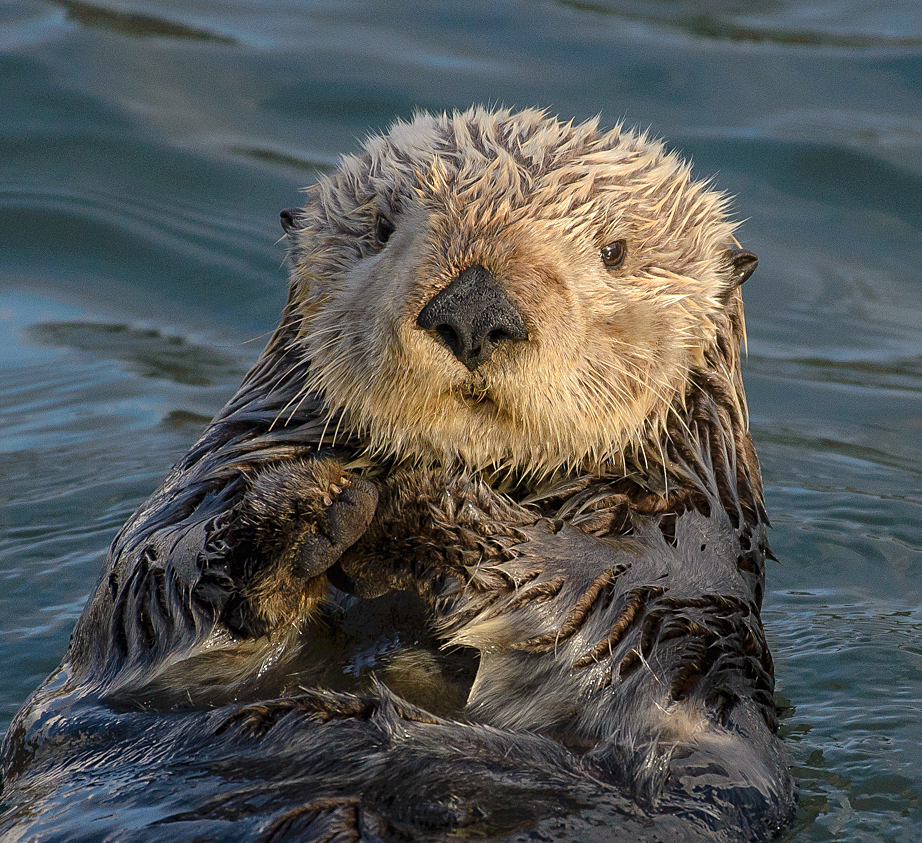
A Keystone Predator That Builds Kelp Forests — Recovered from the Fur Trade, Still Fragile
The sea otter is the smallest marine mammal and one of the most ecologically influential. By preying on sea urchins, otters prevent urchins from overgrazing kelp — so where otters thrive, kelp forests flourish, and where they are absent, "urchin barrens" replace the kelp. This makes the sea otter a textbook keystone species, a concept the ecologist James Estes developed substantially through sea otter research [Estes & Palmisano 1974]. The species was hunted to near-extinction for its fur (the densest of any animal) during the 18th–19th-century maritime fur trade, reduced from an estimated 150,000–300,000 to perhaps 1,000–2,000 survivors in scattered remnant groups by 1911 [Kenyon 1969]. The IUCN lists Enhydra lutris as Endangered; recovery has been substantial in some regions and stalled or reversed in others [Doroff & Burdin 2015].
Biology and identification
Enhydra lutris adults reach 1–1.5 m in length and 14–45 kg (males larger), making them the heaviest member of the weasel family (Mustelidae) but the smallest marine mammal [Riedman & Estes 1990]. Sea otters lack the blubber that insulates other marine mammals; instead they rely on the densest fur of any animal — up to 150,000 hairs per cm² — trapping air for insulation. This dependence on fur for warmth is exactly what made them a fur-trade target and what makes them acutely vulnerable to oil spills (oil mats the fur and destroys its insulating property).
To fuel their high metabolic rate in cold water without blubber, sea otters must eat approximately 20–25% of their body weight daily — predominantly sea urchins, crabs, clams, mussels, and snails. They are famous tool users, using rocks to crack open hard-shelled prey on their chests while floating — one of the few non-primate mammals documented to use tools habitually.
Reproduction is slow: females produce a single pup roughly annually, and pup-rearing is energetically demanding. Sea otters do not migrate; populations are relatively sedentary, which means recovery spreads slowly along coastlines rather than in leaps.
Habitat and range
Sea otters inhabit shallow coastal waters of the North Pacific rim, historically from northern Japan around the Pacific arc through the Aleutian Islands, Alaska, British Columbia, and down the west coast of North America to Baja California [Riedman & Estes 1990]. Three subspecies are recognised:
- Southern (California) sea otter (E. l. nereis) — central California coast; recovered slowly from ~50 survivors in 1938 to ~3,000 today, with the population's growth now stalled
- Northern sea otter (E. l. kenyoni) — Alaska, British Columbia, Washington
- Asian/Russian sea otter (E. l. lutris) — Kuril Islands, Kamchatka, Commander Islands
The Aleutian Islands population (within the northern subspecies range) collapsed dramatically from the 1990s — attributed substantially to increased killer whale predation, possibly a cascade effect of declines in the whales' usual prey [Estes et al. 1998].
Conservation status
The sea otter is listed as Endangered on the IUCN Red List [Doroff & Burdin 2015]. The southern (California) sea otter is listed as Threatened under the U.S. Endangered Species Act and depleted under the Marine Mammal Protection Act. CITES Appendix I (Asian populations) / Appendix II (others). All sea otters in US waters are protected under the MMPA.
Recovery has been regionally uneven: strong in much of Alaska and parts of British Columbia and Russia, stalled for the southern California population (which remains around 3,000 and has not expanded its range as hoped), and collapsed in the Aleutians.
Threats
Oil spills are the acute catastrophic threat for the southern California population specifically. Because sea otters rely entirely on fur for insulation, oil that mats the fur causes hypothermia and death; a single large spill in the otters' concentrated central-California range could eliminate a large fraction of the population. The 1989 Exxon Valdez spill in Alaska killed thousands of otters and is the canonical example.
Range stagnation (California) — the southern population has not expanded north or south as expected, limiting its resilience to a localised catastrophe. Causes are debated and include shark bites (white shark bite mortality has risen), food limitation, and disease.
Disease and pollution — land-based pathogens (notably Toxoplasma gondii, which reaches the ocean via cat feces in runoff, and Sarcocystis) cause documented sea otter mortality in California, linking otter health to terrestrial land-use and water quality.
Killer whale predation (Aleutians) — the Aleutian collapse has been linked to increased orca predation, possibly a knock-on effect of declines in the orcas' usual prey (seals, sea lions) [Estes et al. 1998].
Historical fur trade — the cause of the original near-extinction; ended by the 1911 North Pacific Fur Seal Convention, which gave the remnant populations the chance to recover.
Conflict with shellfish fisheries — because otters eat commercially-valuable shellfish (abalone, crab, urchin), their recovery has at times conflicted with fishery interests, complicating range-expansion politics.
What is being done
- U.S. Fish and Wildlife Service manages the southern sea otter under the ESA and MMPA, including a recovery plan and the Monterey Bay Aquarium's surrogate-rearing program.
- Monterey Bay Aquarium Sea Otter Program — a renowned surrogate-rearing program that pairs stranded orphaned pups with captive female otters who raise them for release, plus research and public education.
- Oil-spill response planning — given the catastrophic-spill risk to the concentrated California population, spill-prevention and rapid-response capacity is a central management focus.
- Toxoplasma / land-sea pollution work — research and policy linking cat-feces runoff and water quality to otter disease, connecting terrestrial land-use to marine otter health.
- The Elakha Alliance and reintroduction proposals — efforts exploring sea otter reintroduction to Oregon (where they were extirpated), which would expand and connect the fragmented range.
- Russian and Alaskan management — the larger northern and Asian populations are managed under national frameworks; the Aleutian decline remains a research and management concern.
How readers can help
- Support the Monterey Bay Aquarium Sea Otter Program and the U.S. Fish and Wildlife sea otter recovery work — the surrogate-rearing program and research are direct conservation channels.
- For cat owners near the coast: keep cats indoors and never flush cat litter. Toxoplasma gondii from cat feces reaches the ocean and is a documented sea otter killer. This is a concrete, individual action with a direct otter-health link.
- Support oil-spill prevention policy. The concentrated California population's greatest catastrophic risk is a major spill; supporting strong spill-prevention regulation and response capacity protects the population.
- Choose sustainable seafood and support clean-water/runoff regulation — sea otter health is tied to coastal water quality.
- Support sea otter range-expansion and reintroduction efforts (e.g., the Oregon reintroduction feasibility work), which would increase the species' resilience by spreading the population across more coastline.
- For coastal visitors: observe otters from a distance (a legal requirement under the MMPA), never feed them, and keep dogs leashed near otter habitat.
Last verified: 2026-05-24 Conservation status: Endangered (IUCN Red List 2015 assessment); southern (California) sea otter Threatened under U.S. ESA.
References
- Doroff, A., & Burdin, A. (2015). Enhydra lutris. IUCN Red List of Threatened Species. e.T7750A21939518.
- Estes, J. A., & Palmisano, J. F. (1974). Sea otters: their role in structuring nearshore communities. Science 185(4156): 1058–1060.
- Estes, J. A., Tinker, M. T., Williams, T. M., & Doak, D. F. (1998). Killer whale predation on sea otters linking oceanic and nearshore ecosystems. Science 282(5388): 473–476.
- Kenyon, K. W. (1969). The Sea Otter in the Eastern Pacific Ocean. North American Fauna 68. U.S. Bureau of Sport Fisheries and Wildlife.
- Riedman, M. L., & Estes, J. A. (1990). The Sea Otter (Enhydra lutris): Behavior, Ecology, and Natural History. U.S. Fish and Wildlife Service Biological Report 90(14).