
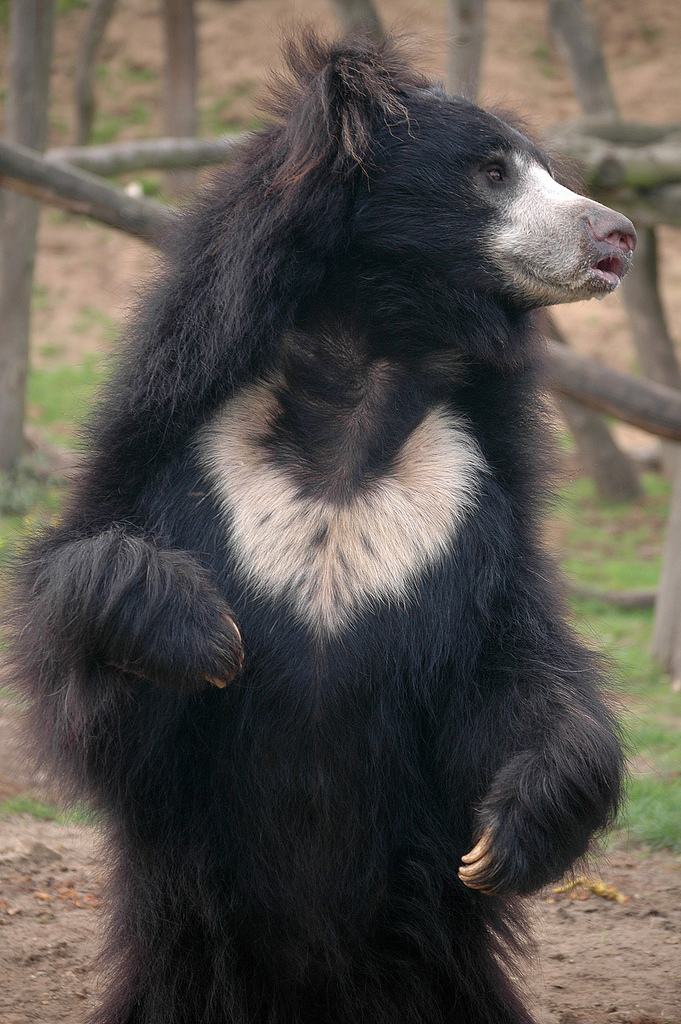
The sloth bear is a medium-sized, insectivorous bear native to the Indian subcontinent, instantly recognizable by its shaggy black coat, pale chest blaze, and long, curved claws. Unlike most bears, it is a dietary specialist on ants and termites, which it suctions up through a gap in its front teeth. Once distributed widely across lowland South Asia, the species now occupies a fragmented range and faces sustained pressure from habitat loss and conflict with people.
Biology and Identification
The sloth bear has a long, shaggy black coat that lacks dense underfur, together with a distinctive pale, cream-colored U- or Y-shaped marking across the chest [IABRM 2024]. Adults measure roughly 1.4–1.9 m in body length; males typically weigh about 80–175 kg and the smaller females about 55–95 kg [IABRM 2024]. The species is highly specialized for feeding on social insects: it lacks its upper middle incisors, creating a channel through which it sucks up ants and termites, and it can voluntarily close its nostrils to keep out dust while feeding, producing loud sucking sounds audible at a distance [IABRM 2024].
Sloth bears are predominantly myrmecophagous, feeding heavily on termites and ants for much of the year, but they also consume fruits, flowers, honey, and other vegetation, with plant matter dominating in the summer months [Joshi et al. 1997; Rabari & Dharaiya 2022]. They are generally solitary except for females accompanied by cubs, and females characteristically carry young cubs on their backs from the time the cubs leave the den until they are several months old [IABRM 2024]. Litters typically contain one to two cubs, which remain dependent on the mother for well over a year [Joshi et al. 1997; IABRM 2024].
Habitat and Range
The sloth bear occurs across the Indian subcontinent, with the great majority of the population in India and additional populations in Sri Lanka and Nepal; it is considered extirpated from Bangladesh, and recent records from Bhutan are lacking [IUCN 2016; IABRM 2024]. The species uses a wide range of habitats, including moist and dry tropical deciduous forests, savannas, scrublands, grasslands, and some evergreen forest, and is most often associated with lower-elevation forested and rocky terrain [IUCN 2016; IABRM 2024]. Across this broad but patchy distribution, populations have become increasingly isolated as natural habitat has been converted and fragmented by human land use [IUCN 2016].
Conservation Status
The sloth bear is listed as Vulnerable on the IUCN Red List, assessed in 2016 under criteria A4cd [IUCN 2016]. The IUCN reports a decreasing population trend, with the assessment inferring and projecting a population reduction of 30–49% over a three-generation period driven primarily by habitat loss and exploitation [IUCN 2016]. Reliable large-scale population estimates are lacking, but the global population has been broadly estimated at roughly 10,000–20,000 individuals, the large majority in India [IUCN 2016]. The species is listed on Appendix I of the Convention on International Trade in Endangered Species (CITES), the strictest category of international trade protection, and it is protected under Schedule I of India's Wildlife (Protection) Act [CITES 2023; IUCN 2016].
Threats
The principal documented threats to the sloth bear are habitat loss, degradation, and fragmentation resulting from agricultural expansion, settlement, logging, mining, and infrastructure development [IUCN 2016]. Because the species frequently occurs near people, human–bear conflict is a significant pressure: surprise encounters in shared landscapes injure people and can prompt retaliatory killing of bears, with many incidents occurring while people gather non-timber forest products, fuelwood, or graze livestock [Dhamorikar et al. 2017; IUCN 2016]. Poaching and illegal trade also threaten the species, including killing for body parts such as gall bladders used in traditional medicine and, historically, the capture of cubs for the "dancing bear" trade [IUCN 2016; Wildlife SOS 2024]. Together these pressures have contributed to range contraction and local extirpations across the species' historical distribution [IUCN 2016].
What Is Being Done
The sloth bear is protected under national wildlife law in India and listed on CITES Appendix I, restricting international commercial trade [CITES 2023; IUCN 2016]. The IUCN Species Survival Commission's Bear Specialist Group coordinates research, monitoring, and status assessment for the species, providing the scientific basis for conservation planning [IABRM 2024; IUCN 2016]. Peer-reviewed studies of human–bear encounters have helped identify where and how conflict arises, informing community-based mitigation in shared landscapes [Dhamorikar et al. 2017]. The organization Wildlife SOS, working with Indian authorities and local communities, brought an end to the centuries-old "dancing bear" practice—India's last such bear was surrendered in 2009—rescuing more than 600 bears, establishing the Agra Bear Rescue Facility, and providing alternative livelihoods and education to the Kalandar community that had depended on the trade [Wildlife SOS 2023; Wildlife SOS 2024].
How You Can Help
Members of the public can support sloth bear recovery in honest, practical ways. Supporting established conservation and research organizations that work on sloth bears—such as Wildlife SOS and the IUCN SSC Bear Specialist Group—helps fund habitat protection, conflict mitigation, and rehabilitation work [Wildlife SOS 2023; IUCN 2016]. Travelers can avoid attractions or souvenirs that exploit wild bears or trade in bear products, which reduces demand that drives poaching [CITES 2023]. People living in or visiting bear range can learn and share science-based information about safe coexistence and conflict reduction, and can support informed policy advocacy for protected areas and habitat connectivity that benefit the species [Dhamorikar et al. 2017; IUCN 2016].
References
[CITES 2023] Convention on International Trade in Endangered Species of Wild Fauna and Flora (2023). Appendices I, II and III. CITES Secretariat. https://cites.org/eng/app/appendices.php
[Dhamorikar et al. 2017] Dhamorikar, A.H., Mehta, P., Bargali, H., & Gore, K. (2017). Characteristics of human – sloth bear (Melursus ursinus) encounters and the resulting human casualties in the Kanha-Pench corridor, Madhya Pradesh, India. PLOS ONE, 12(4), e0176612. https://doi.org/10.1371/journal.pone.0176612
[IABRM 2024] International Association for Bear Research and Management / IUCN SSC Bear Specialist Group (2024). Sloth Bear (Melursus ursinus). https://www.bearbiology.org/the-eight-bear-species/melursus-ursinus-sloth-bear/
[IUCN 2016] Dharaiya, N., Bargali, H.S., & Sharp, T. (2016). Melursus ursinus. The IUCN Red List of Threatened Species 2016: e.T13143A45033815. https://www.iucnredlist.org/species/13143/45033815
[Joshi et al. 1997] Joshi, A.R., Garshelis, D.L., & Smith, J.L.D. (1997). Seasonal and habitat-related diets of sloth bears in Nepal. Journal of Mammalogy, 78(2), 584–597. https://doi.org/10.2307/1382910
[Rabari & Dharaiya 2022] Rabari, V., & Dharaiya, N. (2022). A systematic review on the feeding ecology of Sloth Bear Melursus ursinus Shaw, 1791 in its distribution range in the Indian subcontinent. Journal of Threatened Taxa, 14(12). https://threatenedtaxa.org/index.php/JoTT/article/view/8092
[Wildlife SOS 2023] Wildlife SOS (2023). Bear Conservation. Wildlife SOS. https://wildlifesos.org/our-work/bear/
[Wildlife SOS 2024] Wildlife SOS (2024). 'Dancing' Bear Project. Wildlife SOS. https://wildlifesos.org/conservation/dancing-bear-project/