
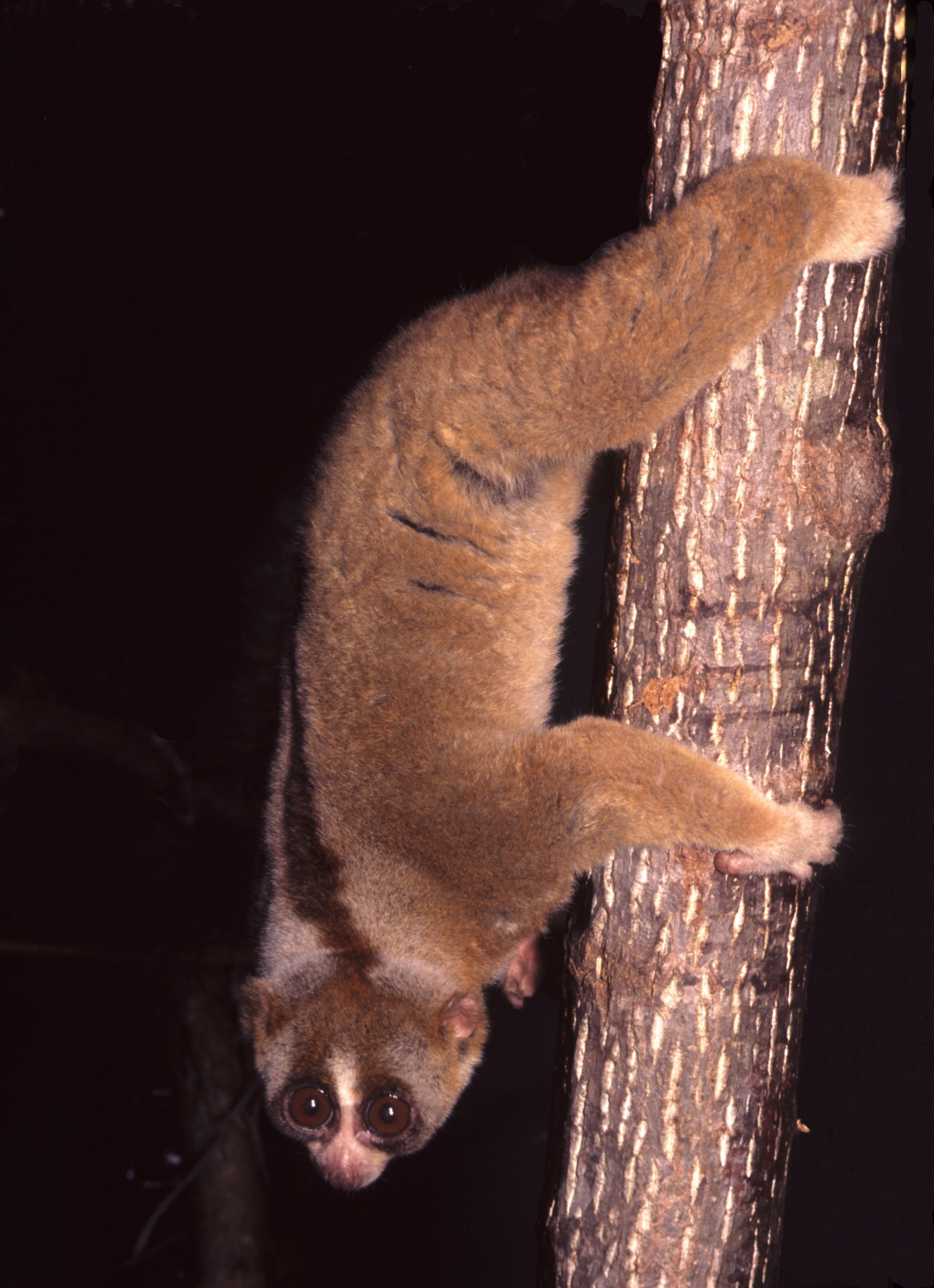
The Sunda slow loris is a small, nocturnal primate of Southeast Asia and one of the few mammals on Earth — and the only primate — capable of delivering a toxic bite [Nekaris et al. 2013a]. Distinguished by enormous forward-facing eyes, a slow and deliberate climbing gait, and a specialized diet of tree gums and exudates, it occupies a distinctive ecological niche in the forests of Sumatra and the Malay Peninsula [Nekaris & Starr 2015]. Its appeal as a "cute" exotic pet has made it one of the most heavily trafficked primates in regional wildlife markets, a pressure that — compounded by rapid forest loss — has driven a steep population decline [Nijman et al. 2017; Nekaris et al. 2013b]. This profile examines the biology that makes the species both remarkable and at risk, the trade and habitat pressures it faces, and the conservation work underway across its range.
Biology and Identification
The Sunda slow loris is a compact strepsirrhine primate, measuring roughly 27–38 cm in head-and-body length and weighing approximately 599–685 g [Nekaris & Starr 2015]. It has dense woolly fur, ranging from light brown to reddish, marked by a dorsal stripe and a contrasting facial pattern; the large, round, closely set eyes are adapted for nocturnal vision and possess a reflective tapetum lucidum. Like other lorises, the species lacks a tail and moves through the canopy with a slow, hand-over-hand quadrupedal climb, typically maintaining a powerful grip with at least three limbs at a time — an anatomy supported by specialized vascular networks (retia mirabilia) in the limbs that allow prolonged gripping without muscle fatigue [Nekaris & Starr 2015].
The Sunda slow loris is one of a small guild of primates that rely heavily on plant exudates. It gouges and licks gum, sap, and nectar from trees, supplementing this with floral resources, fruit, and arthropods; the relative importance of gum in the diet distinguishes lorises from most other primates [Nekaris & Starr 2015]. Its procumbent lower incisors and canines form a toothcomb used in both grooming and exudate feeding.
Uniquely among primates, the species produces a defensive toxin. A secretion from the brachial gland on the inner upper arm is drawn into the mouth and, combined with saliva, can be delivered through the toothcomb in a bite; in humans, slow loris bites have caused painful wounds and, in rare cases, anaphylactic reactions [Nekaris et al. 2013a]. Evidence indicates the toxin functions substantially in intraspecific competition, in addition to predator deterrence [Nekaris et al. 2013a].
Habitat and Range
The Sunda slow loris inhabits tropical and subtropical forest, including primary and secondary evergreen forest, and tolerates some disturbed and edge habitats [Nekaris & Poindexter & Streicher 2020]. Its range spans the southern Malay Peninsula (Peninsular Malaysia and southern Thailand), the island of Sumatra and nearby islands in Indonesia, and Singapore [Nekaris & Poindexter & Streicher 2020]. Modern taxonomic work, drawing in part on facial-marking patterns and specimens documented in the pet trade, has split forms once grouped under N. coucang into multiple species, refining the boundaries of the Sunda slow loris's recognized distribution [Munds et al. 2013].
As an arboreal, exudate-dependent species, the Sunda slow loris is closely tied to forest cover and to the continuity of the canopy through which it travels.
In accordance with NRWL sensitive-species policy, specific site locations, den or nest sites, and seasonal movement details are not disclosed in this article.
Conservation Status
The Sunda slow loris is listed as Endangered on the IUCN Red List, assessed in 2020 with a decreasing population trend [Nekaris & Poindexter & Streicher 2020]. The assessment attributes the listing to a population reduction inferred from intense exploitation for the pet and traditional-medicine trade combined with extensive habitat loss across its range [Nekaris & Poindexter & Streicher 2020].
The species is listed on CITES Appendix I, the strictest category of the Convention, which prohibits international commercial trade. The entire genus Nycticebus was transferred from Appendix II to Appendix I at the 14th Conference of the Parties (CoP14) in The Hague in 2007, on a proposal submitted by Cambodia, in response to the scale of the trade [CITES 2007; CITES 2023].
Taxonomic uncertainty complicates conservation: because closely related slow loris species are difficult to distinguish and have at times been managed as a single unit, trade and population data have historically conflated forms now treated as distinct species [Munds et al. 2013; Nekaris & Starr 2015].
Threats
The illegal pet trade is among the most severe pressures on the species. Slow lorises are consistently recorded as one of the most frequently and openly traded protected primates in Indonesian wildlife markets, and a long-term study of Indonesian market surveys documented slow lorises among the taxa whose trade increased over a 25-year period [Nijman et al. 2017]. Animals captured for the pet trade routinely have their teeth clipped or pulled to make handling safer for owners, an injury that causes infection, impairs feeding, and renders rehabilitated individuals unsuitable for release [Nekaris & Starr 2015].
Demand amplified by online media. Analysis of viral "cute" slow loris videos found that a substantial share of public comments expressed a desire to own one as a pet, indicating how social-media exposure can stimulate demand for a CITES Appendix I species [Nekaris et al. 2013b].
Habitat loss and fragmentation. Conversion of forest to agriculture — including oil-palm and timber plantations — reduces and fragments the continuous canopy on which this arboreal, exudate-feeding species depends [Nekaris & Starr 2015].
Use in traditional medicine. Across parts of South and Southeast Asia, slow lorises are taken for traditional medicine and associated cultural uses, an additional source of offtake documented through ethnoprimatological surveys [Nekaris et al. 2010; ESR 2015b].
What Is Being Done
International trade regulation. The transfer of all slow lorises to CITES Appendix I in 2007 prohibits commercial international trade and provides the legal basis for enforcement and seizures across signatory states [CITES 2007; CITES 2023]. The species is additionally protected under national wildlife legislation in range states including Indonesia [Nekaris & Poindexter & Streicher 2020].
Field research and conservation programs. The Little Fireface Project, a long-term loris research and conservation initiative, conducts behavioural-ecology fieldwork, supports law-enforcement training and confiscations, and runs community education and wildlife-friendly agriculture programs in slow loris range, including in Indonesia [LFP 2024; Nekaris & Starr 2015].
Rescue, rehabilitation, and welfare. Because confiscated animals are frequently injured — notably through dental mutilation — specialized care and the provision of appropriate exudate-based diets are central to rehabilitation efforts, and research has clarified the husbandry needs of these dietary specialists [Nekaris & Starr 2015].
Understanding the trade. Market surveys and ethnoprimatological studies continue to document the volume, drivers, and cultural context of the slow loris trade, providing the evidence base for enforcement priorities and demand-reduction work [Nijman et al. 2017; Nekaris et al. 2010; ESR 2015b].
How Readers Can Help
Do not buy or share. Never purchase a slow loris or any wild primate as a pet, and avoid sharing or amplifying "cute" social-media videos of pet lorises — research shows such content can drive demand for a protected species [Nekaris et al. 2013b].
Citizen science. Log wildlife observations through platforms such as iNaturalist. Verified, responsibly shared occurrence records can contribute to distribution mapping and assessments, while location-sensitive sightings of trafficked species should be handled with care.
Support effective organizations. Back reputable field-conservation and anti-trafficking organizations working in slow loris range, such as long-term research and rescue programs [LFP 2024].
Informed consumer choices. Support deforestation-free and wildlife-friendly products where available, since habitat conversion is a primary driver of decline [Nekaris & Starr 2015]. Report suspected illegal wildlife sales to the appropriate authorities.
References
[CITES 2007] CITES. (2007). CoP14 Prop. 1: Transfer of Nycticebus spp. from Appendix II to Appendix I. Fourteenth Meeting of the Conference of the Parties, The Hague, June 2007. https://cites.org/sites/default/files/eng/cop/14/prop/E14-P01.pdf
[CITES 2023] CITES. (2023). Appendices I, II and III. Convention on International Trade in Endangered Species of Wild Fauna and Flora. https://cites.org/eng/app/appendices.php
[ESR 2015b] Nekaris, K.A.I., Shepherd, C.R., Starr, C.R. & Nijman, V. (2010). Traditions, taboos and trade in slow lorises in Sundanese communities in southern Java, Indonesia. Endangered Species Research, 25(1), 79–88. https://doi.org/10.3354/esr00610
[LFP 2024] Little Fireface Project. (2024). About the Little Fireface Project — loris research and conservation. https://www.nocturama.org/en/about-little-fireface-project/ (accessed 2024)
[Munds et al. 2013] Munds, R.A., Nekaris, K.A.I. & Ford, S.M. (2013). Taxonomy of the Bornean slow loris, with new species Nycticebus kayan (Primates, Lorisidae). American Journal of Primatology, 75(1), 46–56. https://doi.org/10.1002/ajp.22071
[Nekaris & Poindexter & Streicher 2020] Nekaris, K.A.I., Poindexter, S. & Streicher, U. (2020). Nycticebus coucang. The IUCN Red List of Threatened Species 2020: e.T163017685A17970966. https://dx.doi.org/10.2305/IUCN.UK.2020-2.RLTS.T163017685A17970966.en
[Nekaris & Starr 2015] Nekaris, K.A.I. & Starr, C.R. (2015). Conservation and ecology of the neglected slow loris: priorities and prospects. Endangered Species Research, 28(1), 87–95. https://doi.org/10.3354/esr00674
[Nekaris et al. 2010] Nekaris, K.A.I., Shepherd, C.R., Starr, C.R. & Nijman, V. (2010). Exploring cultural drivers for wildlife trade via an ethnoprimatological approach: a case study of slender and slow lorises (Loris and Nycticebus) in South and Southeast Asia. American Journal of Primatology, 72(10), 877–886. https://doi.org/10.1002/ajp.20842
[Nekaris et al. 2013a] Nekaris, K.A.I., Moore, R.S., Rode, E.J. & Fry, B.G. (2013). Mad, bad and dangerous to know: the biochemistry, ecology and evolution of slow loris venom. Journal of Venomous Animals and Toxins including Tropical Diseases, 19(1), 21. https://doi.org/10.1186/1678-9199-19-21
[Nekaris et al. 2013b] Nekaris, K.A.I., Campbell, N., Coggins, T.G., Rode, E.J. & Nijman, V. (2013). Tickled to death: analysing public perceptions of "cute" videos of threatened species (slow lorises – Nycticebus spp.) on Web 2.0 sites. PLOS ONE, 8(7), e69215. https://doi.org/10.1371/journal.pone.0069215
[Nijman et al. 2017] Nijman, V., Spaan, D., Rode-Margono, E.J., Roberts, P.D. & Nekaris, K.A.I. (2017). Changes in the primate trade in Indonesian wildlife markets over a 25-year period: fewer apes and langurs, more macaques, and slow lorises. American Journal of Primatology, 79(11), e22517. https://doi.org/10.1002/ajp.22517 </content> </invoke>