
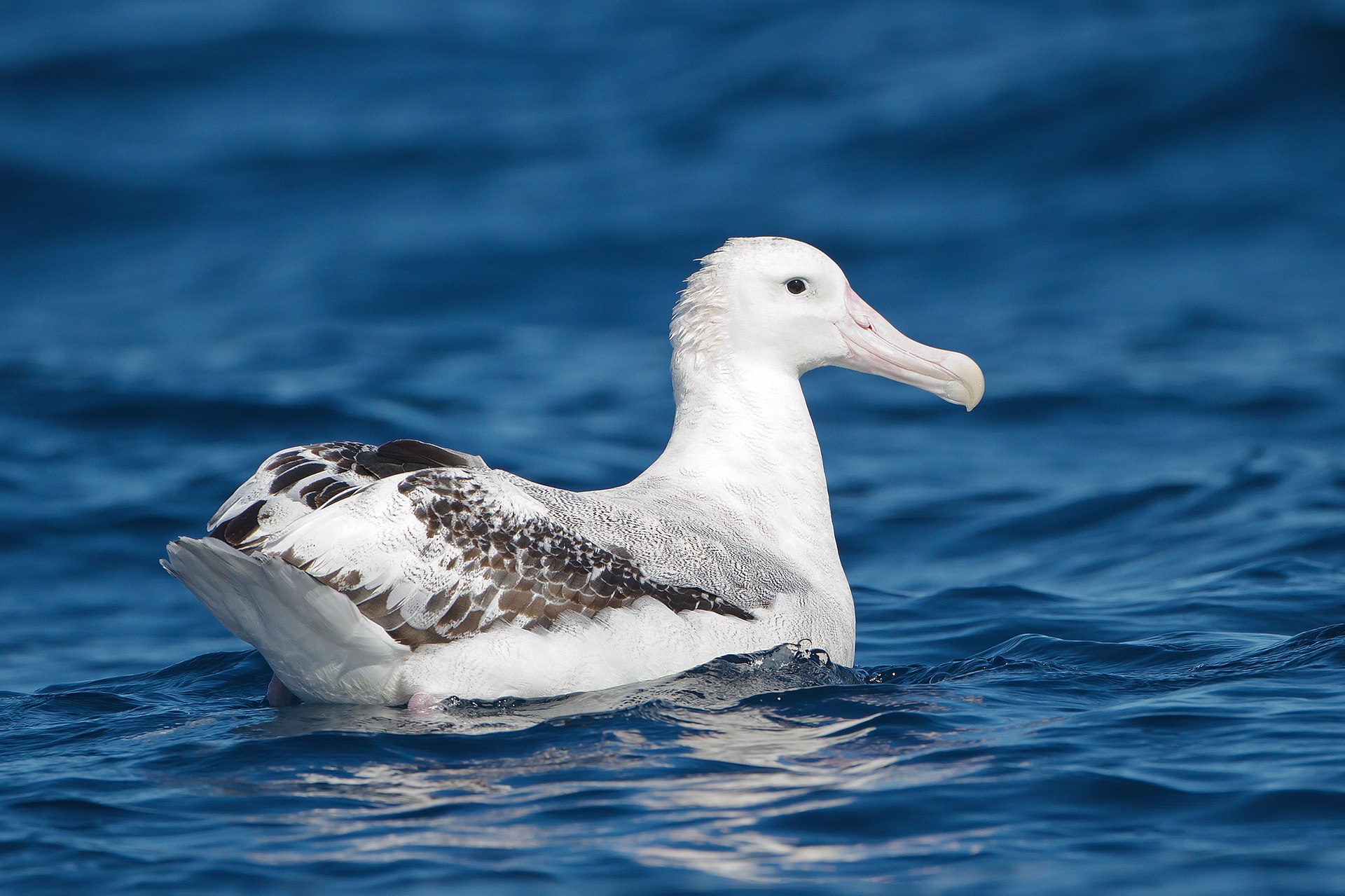
The wandering albatross carries the greatest wingspan of any living bird, a span that lets it cross thousands of kilometres of open Southern Ocean on almost motionless wings. A true ocean wanderer, it spends most of its life at sea, returning to remote sub-Antarctic islands only to breed. Long-lived, slow to reproduce, and tightly coupled to the wind systems of the far south, it has become a sentinel for the health of the Southern Ocean — and a focus of one of the most coordinated international seabird-conservation efforts attempted [BirdLife 2018; ACAP 2009].
Biology and Identification
Adult wandering albatrosses are unmistakable. Wingspans commonly reach 3.1 metres and can extend toward roughly 3.5 metres — the largest documented in any extant bird — and body mass typically ranges from about 6 to 12 kg [ACAP 2009]. Plumage whitens with age: birds are dark as juveniles and become increasingly white-bodied over years, with older males the whitest of all, retaining black flight feathers along the trailing wing edge. The large pink-tinged bill and hooked upper mandible are diagnostic among the great albatrosses.
The species' defining adaptation is its mode of flight. Rather than flapping, it uses dynamic soaring, extracting energy from the vertical gradient of wind speed above the ocean surface through a repeating cycle of windward climbs and leeward descents. GPS tracking in the southern Indian Ocean experimentally confirmed this four-phase manoeuvre and showed how it permits sustained travel — including progress upwind — at almost no muscular cost [Sachs et al. 2013]. Flight is so tightly linked to wind that shifts in Southern Ocean wind fields measurably alter travel speed, foraging-trip duration, and even body mass [Weimerskirch et al. 2012; Cornioley et al. 2016].
Reproduction is exceptionally slow. Wandering albatrosses breed biennially when successful, laying a single egg; incubation lasts roughly eleven weeks and chick-rearing extends across most of a year, so a successful pair raises at most one chick every two years [ACAP 2009]. Birds do not begin breeding until their early-to-middle years and are among the longest-lived of all birds, with documented lifespans exceeding fifty years. This life history — late maturity, low fecundity, high adult survival — means populations recover only slowly, and demographic analyses show that even small increases in adult death rates drive sustained decline [Pardo et al. 2013; Pardo et al. 2017].
Habitat and Range
The wandering albatross (sensu stricto Diomedea exulans) breeds on scattered sub-Antarctic islands of the South Atlantic and southern Indian Oceans, including South Georgia, the Crozet and Kerguelen archipelagos, and Marion and Prince Edward Islands [ACAP 2009; Rackete et al. 2021]. Outside breeding, and during the "sabbatical" year between attempts, birds range across the circumpolar Southern Ocean, exploiting its productive frontal zones and prevailing high-latitude westerly winds [Weimerskirch et al. 2012].
Foraging trips can cover thousands of kilometres from the colony, and birds from different colonies use partly separate areas of ocean — a segregation that exposes them to different fishing fleets and therefore unequal risk [Rackete et al. 2021]. The species feeds largely on cephalopods and fish taken at the surface and readily attends fishing vessels, a behaviour central to the threats it faces.
In accordance with NRWL sensitive-species policy, specific site locations, corridor routes, and seasonal movement details are not disclosed in this article.
Conservation Status
The wandering albatross is listed as Vulnerable on the IUCN Red List, assessed by BirdLife International in 2018 under criteria reflecting a continuing population reduction [BirdLife 2018]. The global population is estimated in the low tens of thousands of mature individuals and is classified as decreasing, with declines documented at long-monitored colonies over recent decades [BirdLife 2018; Rackete et al. 2021]. At Bird Island, South Georgia — one of the longest-studied colonies — numbers fell at roughly 3% per year between 1999 and 2018, a trajectory attributed primarily to mortality in fisheries [Rackete et al. 2021; Pardo et al. 2017].
The species is listed on Annex 1 of the Agreement on the Conservation of Albatrosses and Petrels (ACAP), the multilateral treaty established to coordinate conservation of these birds, and is covered by the Convention on Migratory Species [ACAP 2009]. Demographic modelling combining more than four decades of individual monitoring with environmental and fisheries data shows that bycatch and climate act as additive pressures on survival and breeding, driving the ongoing declines across the South Georgia albatross community [Pardo et al. 2017].
Threats
Fisheries bycatch is the dominant driver of decline. Wandering albatrosses are attracted to baited hooks behind longline vessels and to trawl warps; birds that seize baits are dragged under and drowned, or struck by cables. Demographic studies identify incidental mortality in longline fisheries as the principal cause of the sustained declines at South Georgia [Pardo et al. 2017; BirdLife 2018]. Because adult survival governs population trajectory in such a slow-breeding species, even modest bycatch rates have outsized demographic consequences.
Invasive house mice have emerged as an escalating threat at certain breeding islands. Introduced mice attack and kill albatross chicks, and at Marion and Gough Islands have now been documented killing brooding adults — the first such records for great albatrosses — raising the prospect that unchecked predation could push island populations toward local extinction [Connan et al. 2024; Wanless et al. 2007].
Plastic and marine debris ingestion adds a further, often underestimated, source of harm; analysis indicates plastic-related mortality is a substantial and previously underrecognised pressure on southern-hemisphere albatrosses [Roman et al. 2019].
Climate-driven changes in wind and ocean systems alter foraging conditions. Poleward-shifting and intensifying westerly winds have changed albatross distribution, travel speed, and body condition; while some effects have been temporarily favourable, projected future wind changes may reverse those gains [Weimerskirch et al. 2012; Cornioley et al. 2016].
What Is Being Done
International coordination. ACAP provides the framework under which range states agree best-practice bycatch-mitigation standards, share monitoring data, and prioritise island restoration, with the wandering albatross among its listed species [ACAP 2009].
Bycatch mitigation in fisheries. A suite of measures — bird-scaring (streamer or "tori") lines, night setting, and weighting branch lines so baited hooks sink rapidly beyond the birds' reach — sharply reduces seabird mortality. A large-scale assessment across multiple pelagic longline fleets found that night setting and tori lines together substantially lowered bycatch rates, and that broad adoption of such measures could deliver major global reductions in seabird deaths [Jiménez et al. 2020].
Island restoration. Because invasive rodents are a leading island threat, eradication programmes aim to remove mice from key breeding islands. Evidence that mice can drive seabird population collapse, and the documented killing of adult albatrosses, underpins major planned mouse-eradication efforts at affected sub-Antarctic islands [Wanless et al. 2007; Connan et al. 2024].
Long-term tracking and demographic monitoring. Decades of individual ringing, colony counts, and satellite/GPS tracking let researchers measure survival, link mortality to specific fisheries and conditions, and target mitigation where overlap with fleets is greatest [Pardo et al. 2017; Rackete et al. 2021; Sachs et al. 2013].
How Readers Can Help
Support credible conservation organisations. Backing ACAP-aligned seabird and marine-conservation groups helps sustain colony monitoring, tracking, and island-restoration work.
Make informed seafood choices. Choose seafood certified by recognised sustainability schemes that require seabird-bycatch mitigation, and favour fisheries documented to use tori lines, night setting, and line weighting [Jiménez et al. 2020].
Reduce plastic waste. Cutting single-use plastics and supporting reduction of marine debris addresses a measurable source of albatross mortality [Roman et al. 2019].
Engage with policy. Support measures that strengthen bycatch-mitigation requirements in regional fisheries management organisations and that fund eradication of invasive predators on seabird islands.
Contribute to citizen science. Logging verified seabird observations through platforms such as eBird and iNaturalist supports distribution mapping that informs assessments.
References
[ACAP 2009] Agreement on the Conservation of Albatrosses and Petrels. (2009). ACAP Species assessment: Wandering Albatross Diomedea exulans. https://www.acap.aq/acap-species/304-wandering-albatross/file
[Wanless et al. 2007] Wanless, R.M., Angel, A., Cuthbert, R.J., Hilton, G.M. & Ryan, P.G. (2007). Can predation by invasive mice drive seabird extinctions? Biology Letters, 3(3), 241–244. https://doi.org/10.1098/rsbl.2007.0120
[BirdLife 2018] BirdLife International. (2018). Diomedea exulans. The IUCN Red List of Threatened Species 2018: e.T22698305A132640680. https://doi.org/10.2305/IUCN.UK.2018-2.RLTS.T22698305A132640680.en
[Connan et al. 2024] Connan, M., Jones, C.W., Risi, M.M., Smyth, L.K., Oppel, S., Perold, V., Stevens, K.L., Daling, R. & Ryan, P.G. (2024). First evidence of mouse predation killing adult great albatrosses. Biological Invasions, 26, 25–31. https://doi.org/10.1007/s10530-023-03177-2
[Cornioley et al. 2016] Cornioley, T., Börger, L., Ozgul, A. & Weimerskirch, H. (2016). Impact of changing wind conditions on foraging and incubation success in male and female wandering albatrosses. Journal of Animal Ecology, 85(5), 1318–1327. https://doi.org/10.1111/1365-2656.12552
[Jiménez et al. 2020] Jiménez, S., Domingo, A., Winker, H., Parker, D., Gianuca, D., Neves, T., Coelho, R. & Kerwath, S. (2020). Towards mitigation of seabird bycatch: Large-scale effectiveness of night setting and Tori lines across multiple pelagic longline fleets. Biological Conservation, 247, 108642. https://doi.org/10.1016/j.biocon.2020.108642
[Pardo et al. 2013] Pardo, D., Barbraud, C. & Weimerskirch, H. (2013). Females better face senescence in the wandering albatross. Oecologia, 173(4), 1283–1294. https://doi.org/10.1007/s00442-013-2704-x
[Pardo et al. 2017] Pardo, D., Forcada, J., Wood, A.G., Tuck, G.N., Ireland, L., Pradel, R., Croxall, J.P. & Phillips, R.A. (2017). Additive effects of climate and fisheries drive ongoing declines in multiple albatross species. Proceedings of the National Academy of Sciences USA, 114(50), E10829–E10837. https://doi.org/10.1073/pnas.1618819114
[Rackete et al. 2021] Rackete, C., Poncet, S., Good, S.D., Phillips, R.A., Passmore, K. & Trathan, P. (2021). Variation among colonies in breeding success and population trajectories of wandering albatrosses Diomedea exulans at South Georgia. Polar Biology, 44, 221–227. https://doi.org/10.1007/s00300-020-02780-6
[Roman et al. 2019] Roman, L., Hardesty, B.D., Hindell, M.A. & Wilcox, C. (2019). A quantitative analysis linking seabird mortality and marine debris ingestion. Conservation Letters, 12(1), e12785. https://doi.org/10.1111/conl.12785
[Sachs et al. 2013] Sachs, G., Traugott, J., Nesterova, A.P. & Bonadonna, F. (2013). Experimental verification of dynamic soaring in albatrosses. Journal of Experimental Biology, 216(22), 4222–4232. https://doi.org/10.1242/jeb.085209
[Weimerskirch et al. 2012] Weimerskirch, H., Louzao, M., de Grissac, S. & Delord, K. (2012). Changes in wind pattern alter albatross distribution and life-history traits. Science, 335(6065), 211–214. https://doi.org/10.1126/science.1210270