
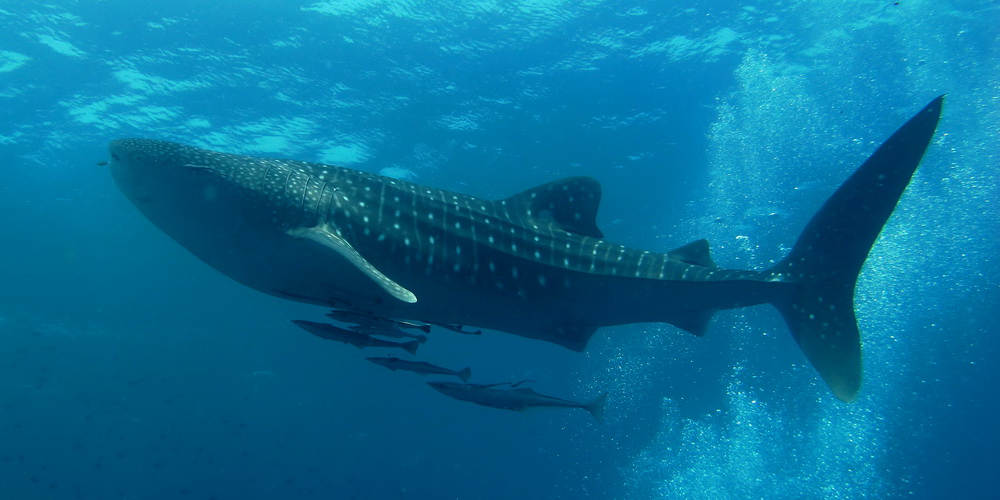
The Largest Fish on Earth — a Filter-Feeding Giant Still Hunted and Struck
The whale shark is the largest living fish, reaching lengths of 12–18 m and possibly more. Despite its size it is a harmless filter-feeder, cruising tropical and warm-temperate oceans straining plankton, small fish, and fish eggs through specialised filter pads. The IUCN reassessed Rhincodon typus as Endangered in 2016, citing an estimated population decline exceeding 50% over the past three generations (approximately 75 years), driven by targeted fisheries, bycatch, and vessel strikes [Pierce & Norman 2016]. It is the second elasmobranch profiled on NRWL, alongside the great hammerhead.
The whale shark's combination of a circumtropical range, late maturity, predictable seasonal aggregations (which make it both a tourism asset and a fishing target), and trans-boundary migration makes it a textbook case for why marine megafauna conservation requires coordinated international management rather than single-nation regulation.
Biology and identification
Rhincodon typus is identified by:
- Enormous size — confirmed individuals to ~18 m and 20+ tonnes; the largest fish species
- Distinctive checkerboard pattern of pale spots and stripes on a dark grey-blue back — each individual's spot pattern is unique and used (like right whale callosities and tiger stripes) for photo-identification of individuals
- Broad, flattened head with a terminal mouth up to 1.5 m wide
- Filter-feeding apparatus — 20 filter pads straining plankton from water pumped across the gills
Whale sharks are highly migratory, ranging across entire ocean basins, and gather in predictable seasonal aggregations at sites of high plankton or fish-spawn productivity — Ningaloo Reef (Australia), Isla Holbox and the "Afuera" aggregation (Mexico), the Philippines (Donsol, Oslob), the Maldives, Mozambique, Djibouti, the Galápagos, and others [Pierce & Norman 2016].
Reproductive biology is poorly understood but clearly slow: the species is ovoviviparous (a single pregnant female examined in 1995 carried approximately 300 embryos at various developmental stages), maturity is reached at approximately 25–30 years, and generation time is estimated at approximately 25 years [Pierce & Norman 2016]. This extreme late maturity makes the species highly vulnerable to adult mortality.
Habitat and range
Circumtropical and warm-temperate, between approximately 30°N and 35°S in all major ocean basins. The species ranges from coastal aggregation sites to the open ocean, and from the surface to depths exceeding 1,900 m on documented dives [Pierce & Norman 2016]. Major known aggregation sites are coastal and seasonal, tied to plankton blooms or fish-spawning events.
Aggregation sites are conservation flashpoints: they concentrate the population at predictable times and locations, which makes them both the basis of a significant ecotourism economy (whale-shark snorkeling is a major industry in Australia, Mexico, the Philippines, and the Maldives) and a target for fisheries where the species is still harvested.
Conservation status
The whale shark is listed as Endangered on the IUCN Red List [Pierce & Norman 2016]. It was listed on CITES Appendix II in 2002 (one of the first shark species listed), requiring non-detriment findings for international commercial trade [CITES CoP12 2002]. It is also listed on Appendices I and II of the Convention on Migratory Species (CMS), reflecting its trans-boundary movements and the need for coordinated international management [CMS 2017].
Many range states have enacted national protection: the Philippines (1998), India (2001), Taiwan (2007, phased fishing ban), Mexico, Australia, the Maldives, and others prohibit targeted whale-shark fishing in their waters.
Threats
Targeted fisheries — historically, whale sharks were harvested for meat, fins (low-grade but tradeable), liver oil, and skin. Large targeted fisheries operated in Taiwan, the Philippines, India, and elsewhere before national bans. A significant illegal/residual trade persists; a 2014 investigation documented a large-scale whale shark processing operation in Pu Qi, China, processing hundreds of whale sharks annually for liver oil and other products [WildLifeRisk 2014].
Fisheries bycatch — whale sharks are caught incidentally in tuna purse-seine fisheries, where they associate with the same surface schools targeted by the fishery. Purse-seine sets made around whale sharks (using them as a fish-aggregating cue) were a documented practice; the Inter-American Tropical Tuna Commission and other Regional Fisheries Management Organisations have adopted measures prohibiting intentional setting on whale sharks and requiring safe-release protocols [IATTC Resolution C-19-06].
Vessel strikes — because whale sharks feed at the surface, often in coastal waters with heavy vessel traffic, ship strikes are a documented and likely-underestimated mortality source. Aggregation sites with high tourism-boat traffic (e.g., parts of Mexico and the Philippines) carry elevated strike risk.
Unregulated tourism — at some aggregation sites, provisioning (feeding whale sharks to keep them in place for tourists, notably documented at Oslob, Philippines) alters natural behaviour and may affect the animals' health and migration; crowding by boats and swimmers can stress the animals and increase strike risk. Well-managed whale-shark tourism (Ningaloo, with strict codes of conduct) is a conservation asset; poorly-managed provisioning tourism is a concern.
Climate change — affects the plankton productivity that drives aggregation timing and location, with uncertain long-term implications for the predictable feeding aggregations on which both the species and its tourism economy depend.
What is being done
- CITES Appendix II + CMS Appendices I/II — the international regulatory framework, requiring trade permits and encouraging coordinated range-state management.
- National protection laws in most major range states prohibiting targeted fishing.
- RFMO bycatch measures — IATTC, ICCAT, IOTC, and WCPFC (the four tuna RFMOs) have adopted prohibitions on intentional purse-seine setting on whale sharks and safe-release requirements.
- Photo-identification networks — the global Wildbook for Whale Sharks (whaleshark.org) crowdsources spot-pattern photographs from divers and tourists worldwide, building a global individual-identification database used for population monitoring.
- Marine Megafauna Foundation, Wild Me (Wildbook), and the Whale Shark Research Programme — coordinate global research, tagging, and aggregation-site monitoring.
- Whale-shark ecotourism codes of conduct — Ningaloo (Australia) is the model for well-regulated, low-impact whale-shark tourism that funds conservation while minimising disturbance.
How readers can help
- Choose responsible whale-shark tourism only. If you snorkel with whale sharks, choose operators that follow a strict code of conduct (no touching, minimum approach distances, no provisioning/feeding, limited boats per shark). Avoid provisioning-based operations (e.g., the Oslob, Philippines model) where sharks are fed to stay in place. Ningaloo (Australia) and Holbox/Isla Mujeres (Mexico, with regulated permits) are well-managed examples.
- Contribute photos to the Wildbook for Whale Sharks (whaleshark.org). If you photograph a whale shark's left-side flank (showing the spot pattern behind the gills), the photo can be submitted and matched to identify the individual — genuine citizen-science contribution to population monitoring.
- Do not buy shark products. Whale shark meat, fins, liver oil, and skin enter trade despite CITES Appendix II. Avoid all shark products.
- Support the Marine Megafauna Foundation and Wild Me. Both fund the global research and photo-ID infrastructure.
- Support RFMO bycatch reform. The four tuna RFMOs set the rules for the purse-seine fisheries that produce whale-shark bycatch; civil-society engagement at RFMO annual meetings affects bycatch measures.
Last verified: 2026-05-24 Conservation status: Endangered (IUCN Red List 2016 assessment); CITES Appendix II since 2002; CMS Appendices I & II.
References
- CITES (2002). Conference of the Parties 12 — inclusion of Rhincodon typus in Appendix II. Santiago, Chile.
- CMS (2017). Convention on Migratory Species — Rhincodon typus on Appendices I and II. https://www.cms.int/
- IATTC (2019). Resolution C-19-06 on the conservation of whale sharks. Inter-American Tropical Tuna Commission.
- Pierce, S. J., & Norman, B. (2016). Rhincodon typus. IUCN Red List of Threatened Species. e.T19488A2365291.
- WildLifeRisk (2014). Planet's Biggest Slaughter of Whale Sharks Exposed in Pu Qi, Zhejiang Province, China. WildLifeRisk investigation report.